11.26.2015

Happy Thanksgiving 2015

Looking at a piece of fruit,
or, for that matter, at another
object of beauty as well.

Tasting Malabar fish curry,
or, for that matter, any
savory portion as well.

Music!

Smelling a Madagascar jasmine,
or, for that matter, anything
pleasant as well.

Touching a lover's left hand,
or, for that matter, 
the beloved right one as well.

What makes one happy?
Love:

being oneself to such a degree
that only the whole world is left.

11.10.2015

White Flight

No, I'm not referring to the exodus of whites from inner cities to suburbia which occurred during the sixties.  I'm referring to white flight from life...to an early grave.  The death rate for white middle-aged Americans aged 45-54 has been increasing since 2000 in a truly alarming fashion.  The increase is found solely among working-class whites, that is, those whose highest level of education is high school or less. (Wealthy white professionals are doing just fine.)

This surprising statistic was brought to light by the research of a husband and wife team, Angus Deaton, who was awarded the 2015 Nobel Prize in economics, and Dr. Ann Case.  The death rate shown below is for all U.S. whites; the death rate for working class whites in this age group must be even worse. (The death rate for non-working class whites continues to decrease.)


The results are astounding.  Although not shown in this chart, the death rates for blacks and Hispanics in this age group continue to decline.  The death rate for blacks, while higher than those for whites in this group, indicates that the gap in life expectancy is rapidly closing.  In addition, the rates for whites continue to decline in every industrialized country with the exception of the United States.

Three causes of mortality are (very) largely responsible for the increase: suicide, drugs and alcohol abuse.  If this trend continues for just a little longer, working-class whites will be the most vulnerable ethnic group prior to old age in the country.  (White males are especially affected.)  This is truly astounding, given the fact that blacks continue to suffer from widespread discrimination.

What's going on here?  The researchers are flummoxed.  The conservative commentator Ross Douthat believes ("The Dying of the Whites," New York Times, November 8, 2015) that the increase is largely due to decreasing religious affiliation in this group, and to government coddling--he mentions the provision of disability benefits in some cases as an example.  This is beneath comment.  David Frum, my favorite conservative, mentioned (Real Time with Bill Maher, November 6, 2015),  that increased feelings of alienation, loneliness and despair are the culprits.  I agree, but for different reasons.  He cites the fact that the marriage rate has decreased in this group as well as the decline in church attendance.  He is a compassionate conservative, but he still blames the victim.  Does he really think that all we need to do is to get these people spouses and convince them that a life without God is a life without meaning?  A highly dubious assertion!  Church attendance has fallen off more markedly in Europe, while death rates among whites in this age group continue to decline.  The majority of births occur out of wedlock in Sweden; Swedish death rates continue to decline as well.  Government programs for the poor and working class are much more generous in most European countries, yet the social mobility of the poor is greater. (America's is the lowest among industrialized nations.) The reasoning of Frum and Douthat in this regard is bogus.

I think I have a finger on the pulse of why so many whites are becoming, well, pulseless.  Racism obviously isn't a factor: if these whites had a better education and achieved marketable skills, they would indeed be sitting pretty.

A clue was provided by a survey conducted in 2014.  The first statement of the survey was, "America will be a land of opportunity in ten years." 45% of blacks agreed; 47% of Hispanics agreed--but only 29% of whites.  The second statement of the survey was, "(One is) More Likely to Get Ahead with Hard Work Playing by Rules in 10 years."  44% of blacks agreed; 49% of Hispanics agreed--but only 24% of whites agreed.  Mind you the respondents were not classified according to age and education--one would expect an even more dismal pessimism among working-class whites.

Why are Dick and Jane, Tom, Dick and Harry convinced that their glass is a good deal less than half full?  Aren't the incomes of working-class whites higher than those of blacks.? They are--but there is a difference.  Many of these whites come from families that were stable and doing quite well only a generation or so ago.  You didn't need a high school education to work in a steel mill.  Once upon a time, working-class whites willing to work hard could afford a house and an education for their children.  Those days are long gone  Blacks, in contrast, tend to come from families who had it even harder than contemporary black families due to the unspeakable racism of previous generations.  In short, working-class whites feel that their world is coming apart while blacks are much more likely to believe that things are getting better

The road to despair can be as short as the distance one takes  to fall flat on one's face.  Do we really have to study the relationship between despair and suicide, drugs and alcohol?  Yes, but undoubtedly only to determine the degree to which they apply in specific cases.  The iceberg tip of suicide always caps tons of frozen despair.  (For every suicide, how many are getting by with great difficulty, plagued by despair?  I'm not sure, but it's surely a lot.).

Causes and Solutions

To me the reason why working-class whites are increasingly pessimistic is abundantly clear;  it is due to the egregious degree of income inequality in this country, which is getting even worse.  I am, of course, not advocating affirmative action for working-class whites alone; I am, however, advocating for massive intervention to change the nightmares of poor and working-class Americans of all races into tolerable dreams.

The grim statistics prove that racism per se is not the only thing harmful to the welfare not only to blacks, but to all.  Poor and working-class blacks suffer a double whammy.  Notice that the vast majority of black victims of police brutality occurs among the poor.  Rich blacks in Gucci suits are hardly likely to be arrested and abused for jaywalking. Class matters.

The members of the white working class are the canaries trapped in the poisonous mine of unregulated capitalism.  A form of capitalism is arguably the most efficient governmental model; human nature, which is no stranger to untrammeled greed, demands that there be checks and balances, if democracy is to thrive.  Otherwise we're heading for a society in which oligarchs live in mansions inside gated communities and the rest live in hovels on the fences' wrong side.

At present the richest 1% of Americans own 40% of the wealth; the richest ten percent own 80% of the wealth, while the bottom 80% own only 7% of the wealth.  We have reached a very dangerous level of inequality; our democracy is very much under duress as a result.  Social mobility, one of the greatest guarantors of democracy,  is lower in America than it is in Canada and Europe.

We need to make education affordable for everyone.  We need to assure that everyone who works receives a living wage.  We need massive investments in our crumbling infrastructure; we need a New Deal-type program to provide the workers...

We really need a lot of things but are we going to get them?

One of the hindrances is the Democratic party itself.  It has increasingly practiced so-called identity politics, reaching out to women and minorities, while writing off working-class whites.  (What is the matter with Kansas?  Plenty; I'm not sure why, but its malignancy is unmerrily metastasizing throughout all fifty states.)  Angry and ignorant whites are the bread and butter of the Republican party.  Without their support, there are not enough oligarchs to elect a dog catcher.  If the Democrats ever convinced working-class whites to vote for their own interests, things would change for the better overnight.  I'm not sure how this can be done, it's not easy to reason with the alienated and marginalized, exposed to so much propaganda from the right, who tend to vote for those that look like them yet do not care about them at all. True, reaching out to those who bite the hands that need them is a daunting task; it is however an essential one.

If you believe as I do that income inequality is one of the most pressing of contemporary American problems, ask yourself this: which party would tend to decrease this pernicious trend?  The answer is obvious.

Progressives must understand that the mortality rate among working-class whites is a convincing indication that all victims of the current oligarchy need immediate relief.  If income inequality continues to increase at the current rate, our democracy, already injured, will not survive.

White flight to light--That would be a healthful turn indeed.

11.01.2015

In Memoriam: Shyamala Mahler (1934-2015)


I knew Shyamala for 43 years, years that went by much too quickly.  It is hard to come to terms with the fact that for the x number of years I have left,  there will be no new memories of my sister-in-law; the old memories will remain within, however, as long as I live.  As part of this gathering to celebrate Shyamala's life, I would like to share some of them with you today.

During those nearly four and a half decades,  we were together, along with other family members, on many occasions.  Thanksgiving was often celebrated at her house, Christmas as well.  For the last decade or so, my wife and I have hosted an annual "house music" party at our house to celebrate autumn.  She was there for every one, except, alas, the last one.  We often shared each other's company, along with other family members, on trips.  We traveled through Peru together, and most recently, last February, we were in India; we traveled to Kerala, where she was born.  My wife, son and I also had an unforgettable stay with Walt and Shyamala when they were in Africa, two decades ago.  There were many, many other visits arranged just for the fun of being together.

Shyamala was not one of those proverbial in-laws that one tolerates once a year at the Thanksgiving table with the help of stuffing one's mouth with, well, stuffing.  Shyamala made you wish that Thanksgiving occurred every day of the year.
This photo was taken during a family gathering at Shyam and Walt's house.  To the left is Nirmala, next to her is Romila.

I will now relate a few anecdotes that highlight Shyamala's winsome personality.  Nirmala, her sister and my wife, and/or I witnessed all of them.  These are personal views; others might have seen her somewhat differently, but certainly not radically differently.  I will then sum things up, and end with just what you would expect from a poet, a poem.

As I said, I knew Shyamala for the past 43 years, which means I didn't know her for nearly four decades before our first encounter.  I'd like to relate one incident from that period.  Shyamala was, as I've been told, very different when she was growing up.  She was very assertive and self-assured.  She was very career-oriented as well.  She believed women should have a career first, and then--only if they felt it was really necessary--get married.  In short, Shyamala was a proto-feminist in India.  Shyamala remained Shyamala, but her priorities changed when she finally reached her goal of settling in the West.  Let us call the Indian Shyamala whom I didn't know Shymala A and the American one I knew and loved as Shymala B.

Shymala A was, hands down, the most Western-oriented, and later the most Westernized member of all her siblings.  Both Shyamala A and well-traveled Shyamala B had a very adventurous streak; as a young girl growing up in India, however, America, the land most likely able to make her proto-feminist dreams a reality, was her goal from the outset.  Her father, a good man and an absolutely incorruptible policeman--rare in those days as well as in ours--had different priorities.  He decided, God bless him, that his girls should take music lessons, Indian music lessons.  In those days when your father said you're going to take music lessons, well, you're going to take music lessons.  One day, when Shyam, (Walt, her husband, called her by that name), was about sixteen, the music master appeared.  I imagine him as a man in his fifties, dressed entirely in white.  I imagine him to be like the Earth: if you dig down deep enough, everything is warm and flowing, but at the surface, things could be cold and stiff as a Baltimore lawn in winter. My wife and she--the two youngest sisters, Mridula and Romila, were too young at the time--were summoned from their play for the first music lesson.  Nirmala wanted to continue playing, but, as one would have expected, dutifully obeyed.  Her elder sister refused.  She told the master that she would only agree to take a lesson if she could call the tune.  And there was the master, aghast, sitting crossed-legged with a veena on his lap, an instrument so adept in accommodating the complex scales and rhythms of carnatic music.  You must teach me to play, she continued, completely unintimidated, Irene Good Night!  Irene Good Night, an um-pah pah-waltz from the Strauss era, is a melody which is just about the most polar opposite to anything carnatic.  (All right, How Much is That Doggy in the Window, is another contender.)  The man, who perhaps needed the rupees and who perhaps said to himself, ennu sayaddu?, (What to do?), proceeded.  Shyamala won.

Now lets fast forward a few decades.  Shyamala is now married.  She had come to America on a scholarship, completed her Ph.D. at Syracuse University where she met, Walter Mahler, the love of her life.  They married and had two children, to whom she was very dedicated until the day she died.  Shyamala A has become Shyamala B--she had become "homely."  That is, in the British meaning of that word, "dedicated to the home."  It is a compliment.  If there was such a thing as a selfie in those days and Shyamala took one, it would be different from frozen solipsisms common today.  I imagine her friend, Aquila, protesting. "How can you call that a selfie when you're not in it?"  Shyamala would then look at the photo of Walt and her two boys and say, "Aquila, that is my selfie!  That's me!"  

Walt soon began a very prominent career with the IMF which entailed prolonged stays abroad.  There was no way to accommodate a two career-family, which was rare in those days anyway. Shyamala did continue to teach--she apparently was a gifted teacher--but only on a short-term basis.  Her career had become her home.  Mind you, this was a conscious decision.  I do not mean to imply that Shyamala B was in any way inferior to Shyamala A.  To the contrary.

One of my first memories of Shyamala took place just about forty-two years ago from today.  Walt and Shyam were living in an apartment in Vienna, Virginia, at the time.  Beaming with pride, she led my wife Nirmala and me to a bedroom, where, Michael, her second son, barely three weeks old, lay fast asleep.  She was so happy!  Well, it's not rare that mothers are proud of their newborns; what came next was a good example of how Shyamala could multi-task and keep calm.  Roger, the older son, wasn't even three years old, and understandably jealous.  He became a little jihadist, wielding his bottle instead of a grenade.  I ducked just in time; the bottle hit the wall; milk splattered.  Shyamala, perfectly calm, put Michael back in the crib, and very gently said to her eldest, "No Roger, that's not nice!"  She held both his hand and his attention by showing him a picture book.  As infants are wont to do, Michael began to fuss in the adjoining room.  Shyamala, without missing a beat, told Roger that 'Aunty (my wife) wants to show you something--I'll be right back.'  It isn't easy managing a newborn and a toddler simultaneously; Shyamala, was already a pro.

Let's fast-forward about a year and a half.  Walt was out of the country on assignment; Shyamala and her children stayed a few days with us in New York City.  After a long and lovely walk in Central Park, we began to head back to the apartment on W 59th street where my wife and I lived.  I remember pushing Mike, who sat in his stroller with a completely self-absorbed expression on his face.  He reminded me of a little physicist contemplating the splendors of an inner cosmos,  Roger, in contrast,  was like a little comet orbiting the world so fast that it was able to chase its own tail.  Almost home, Roger announced that he wanted to ride on the subway.  My wife and I were tired; I said, "Good idea!  Maybe tomorrow..."  Shayamal didn't let me complete the sentence.  Ever the indulgent mother, she thought it was a great idea.  So we took a subway ride for a few stops and then came back.  On the way home, Roger was energetic as ever.  As kids of his age often do, Roger was testing parental limits.  He would run way ahead but always stopped at the corner until we arrived.  As we approached the apartment, Roger ran right inside and onto the elevator.  As we ran toward him, Roger had a broad smile on his face which, translated into English, said something like this: "Look how independent I am! I arrived first!"  Then the elevator door closed before we could reach him.  I will never forget  how quickly his expression turned from sheer delight to sheer terror.  I must have looked frightened as well.  I remember thinking, "He might be kidnapped!"  Shyamala calmed me down immediately with the following words, "Whatever goes up must come down.  Let's wait right here."  The elevator went up many stories and then, sure enough, came down.  The door opened and revealed a kindly lady toting a sniffling child that immediately ran to his mother.  Shyamala was probably upset as well, but she sure didn't show it.  She smiled, as if her son had just come off a kiddie ride at an amusement part.  That was Shyamala; she held things together, she kept things calm.

Now let's fast-forward several years.  It is now 1993.  My wife, my son and I are visiting Shyam, Walt and their son in Africa, where Walt was on an IMF assignment.  Shyam had invited us to stay with them for a week on our way to India; we accepted gladly.  They were staying in a huge house near Nairobi with an even huger, lovingly maintained garden.  Walt soon took us on a safari through Masai Mara, the large preserve that takes up many square miles of Kenya and Tanzania.  It was an unforgettable experience.  We were lucky enough to witness the annual wildebeest migration; thousands of them surrounded our jeep as we proceeded.  We saw crocodiles waiting for them in the river like white cops waiting for black jaywalkers.  (Sorry--I had to get that in.)  We saw several astonished wildebeests succumb to saurian jaws. Other animals astonished us as well. (If you've ever seen giraffes in love, you will never forget it.  The female looks completely uninterested.  She nibbles a few leaves, walks on a bit and stops.  Then the male, who looks just as uninterested--it's hard to  detect passion on a face of a giraffe--keeps the same gap between them by walking toward her. This goes on and on and on.)

The city folks among us were deeply moved by this unforgettable experience. The world had become a zoo in which we humans were nothing more than a minor exhibit.  This is where we evolved, I remember telling myself.

Shyamala was an excellent cicerone; she loved nature and knew the names and habits of most of the animals and birds.  If there was something interesting to be seen she was like one of those kids who could find Waldo way before you could.  At the end of the day, we stood on a hill overlooking a vast plain with Mt. Kilimanjaro in the distance.  "Look," Shyamala quietly exclaimed, pointing to a baobab tree in the distance.  She had spotted a leopard with a freshly killed antelope on one of the branches.  This is an extremely rare sight.  Shyamla had sharpened our vision.  Soon one of us glimpsed something moving behind bushes in the distance.  "See that little circle bobbing up and down, Shyamala?  What is that?"  "That," she replied, "is the head of a tourist!"  Our eyes just couldn't compete.

I want to point out now another trait of Shyamala's personality which this incident illustrates.  She didn't laugh at us, she laughed with us.  In all the 43 years that I knew her, I never heard Shyamala say or saw her do anything that could be modified iby the adjective, "mean."  This is extraordinary.  In all my seventy years, I can count all the people I know who never said or did anything mean on one hand--provided that that hand had no fingers. 
This photo was taken during our trip to India in February, 2015. These were the six surving siblings at that time.  From the left are Shyamala, Vimala, Rajagopalan, Romila, Nirmala and Mridula (1944-2015).  Mriduala passed away a few weeks after Shyamala.

Yes, Shyamala loved nature and science.  I'm told she wanted to study science.  Unfortunately, her father died when she was getting ready for college.  There were now financial problems.  She had to depend on a scholarship, and could not find one in the field she desired.  That's how she came to study political science.  To my knowledge, she never regretted that decision.  That's how Shyamala was; she would take the cards Fate dealt her, then proceed to beat him at his own game.

Love for nature and science, however, lasted her entire life. The American wing of the family, three sisters, their husbands and their children usually celebrated--in a very low-key way--Christmas at Shyam's.  I never had to think much about what to give her.  It was easy--a book on science, often on the subject of cosmology.  Not too long ago, I gave her The Universe from Nothing by Lawrence Krauss, which she very much appreciated.  She was an avid fan of the Cosmos series--both the Carl Sagan and Neil deGrasse Tyson versions.  We often talked about science together.  I especially recall one occasion of our shared interest.  Every year, I send a New Years card that includes one of my poems.  A few years ago, I included a poem, inspired by a poem by a Nobel-prize-winning Polish poet; it had several references to cosmology.  When I walked into her house at Christmas that year, she greeted me with a big smile.  She loved the poem, she told me.  I will never forget her enthusiasm; it was that palpable. The poem mentioned Enceladus, a moon of Saturn, that just might contain life.  She knew all about it.  Everyone knows that the universe is expanding and that the galaxies are hurtling away from each other.  There are notable exceptions, however.  Andromeda, the Milky Ways neighbor, is actually hurtling toward us--at a distance of 2.2 million light-years it's going to take a lot of hurtling to reach our galaxy, billions of years, in fact.  It's approaching us because it is part of the so-called local group, our galactic neighbors, in which there is more than enough matter, and hence more than enough gravity to overcome, lambda, the expansive force of the vacuum.  She knew all this.  She would have been a good scientist.

Shyamala had remarkable will power as well.  She had diabetes for many years.  She refused to take medicine and treated the diabetes with a very, very strict diet and exercise regimen. She had a lot of stamina as well.  She walked about two hours or so a day right up to the very end.  During family visits to Walt and Shyam's home in Virginia, Shyam and I would inevitably suggest a long walk through the neighborhood.  Shyamala always accommodated the rest of us, some of whom were less walk-happy than she was, by offerring to lead us on a two-hour, a one-hour or a half-hour walk. We usually opted for the one-hour walk.   

In India a few years ago, another sister-in-law noticed that Nirmala and I walk with a brisk gait.  "Slow down," she told us, "you're older now!"  Which sister-in-law do you think is our role model here?  If Shyamala ever looks down on Nirmala and me from on high--I hope she does--she would frequently find us at the gym.

We've seen that Shyamala was a calming influence on those around her.  She was, to put it mildly, not egotistical.  She was dedicated to family.  She was always kind and never jealous or envious.  In short, she accepted life as it is. This is very hard to do.  What was her secret?  Was there an Eastern core deep beneath the Western surface of the planet, always revolving around her husband and two sons, that was Shyamala?  I think there was.

She reminds me of the novels of Haruki Murakami.  Everything on the surface is very Westernized.  One of the characters hums a Rossini tune as he lands in Hamburg.  One owns a jazz club in Tokyo.  The novels often depict a brilliant young,  troubled woman--if she didn't have difficulties there would be no novel.  Everything is Westernized on the surface.  But the novels are very, very Japanese as well.  The symbol that Murakami uses to convey this is wells.  People disappear into them.  The wells represent the universe within. Traveling inside oneself is the traditional Eastern way of getting around.

I think Shyamala made that journey, although we never talked about it.  She never went to temples; she never liked carnatic music, etc.--as mentioned earlier, she was the most Westernized member of the family.  But the presence of a wise, deep spirituality reached  the surface occasionally, much as water occasionally breaks through, after a ten mile journey, to the surface on Enceladus.  My third eye always noticed.  She kept a little shrine to Ganesh in her kitchen.  I'm told that when a problem arose that worried her, she contacted her very religious older sister and requested that she arrange a puja on her behalf.  But these are superficial things; devotion to a personal god is that Hindus bhakti.  What about jnana, the visceral knowledge of the interconnectedness of all things?  This is the very height of Hinduism; it is called advaita, non-duality.  I am convinced that Shyamala had an intuitive knowledge of this, which informed just about everything she did.  

At the end of her life, my sister-in-law became more quiet.  She didn't hear well; her memory was beginning to fail.  Recently, I sometimes would sit next to her during a family gathering.  She wouldn't say much; neither would I.  As the great Hindu sage, Ramana Marashi said, after Somerset Maugham visited him and didn't say a word for the entire time he was in the sage's presence, "Silence is also conversation."

On the day of her death, I wrote a poem dedicated to her, which can be interpreted as a silent conversation between us.  I am not going to read it.  Instead, I will close with a poet much better than I, Walt Whitman.  Just like Shyamala, Whitman loved the dynamism of the West; his poems are filled with optimistic portraits of Americans from all classes and races. His world-view, or, better said, his cosmic view, comes closer to that of advaita than that of any other American poet I know.  The poem is the last section of "Song of Myself."  Imagine that a synthesis of Shyamala A and Shyamala B is doing the narrating.

The spotted hawk swoops by and accuses me, he complains of my gab and my loitering.

I too am not a bit tamed, I too am untranslatable,
I sound my barbaric yawp over the roofs of the world.

The last scud of day holds back for me,
It flings my likeness after the rest as true as any on the shadow'd wilds,
It coaxes me to the vapor and the dust.

I depart as air, I shake my white locks at the runaway sun,
I effuse my flesh in eddies, and drift it in lacy jags.

I bequeath myself to the dirt to grow as the grass I love,
If you want me again look for me under your boot-soles.

You will hardly know what I am or mean,
But I shall be good health to you nevertheless,
And filter and fibre your blood.

Failing to fetch me at first keep encouraged,
Missing me one place search another,
I stop somewhere waiting for you.


I look forward to many silent conversations with you, Shyamala.  I regret that our conversations will no longer contain gestures and words.  Rest in peace, dear sister-in-law, we will miss you very much.

10.22.2015

The Black Paintings of Goya Part ll


Goya's Black Paintings are a series of fourteen murals with which Goya decorated the walls of his house, near Madrid. Goya moved into the so-called Quinta del Sordo, "The Villa of the Deaf Man" in 1819 in his seventy-third year, and remained there until, disgusted with Spanish politics, he moved to Bordeux in 1824, where he died in 1828.  Thirty-five years after his death, the paintings were given to the Prado Museum, where they have been on display ever since; unfortunately, they suffered considerable damage as they were transferred from wall to canvas. Goya composed these to meet his own expressive needs; he never intended that they be seen by the general public.  He never wrote about them, and, to my knowledge, never discussed them.  He didn't even give them titles--the titles by which they are known today are all posthumous inventions. This deepens the enigmas of these already enigmatic works.  They are subject to diverse interpretations; the interpretations in this article are largely my own.   Only 'largely" because I am indebted to Veleriano Bozals book, Pinturas negras de Goya, (Machado Libros, 2009) for some historical facts and interpretive details.  (To my knowledge, there is no English translation.)

I first became aware of these paintings during a trip to Madrid with my wife in May, 2015.  I stood before them transfixed for a long time.  I was fascinated most of all with El Perro, The Dog, the subject of the first of this series of two.  I was also deeply moved by three of the other Black Paintings, which will be discussed in this essay along with a brief recounting of my impressions of The Dog.

1. Saturn (Saturno)


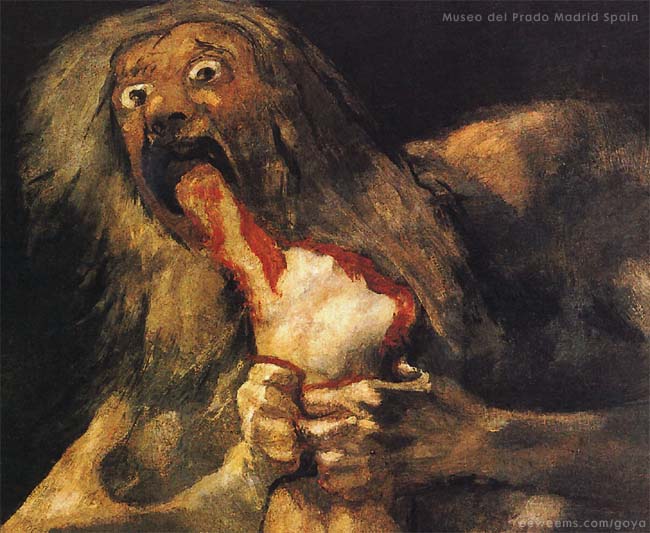
At first glance, this is the most striking painting of the entire group.  The intensity of Saturn's expression and the depicted horror cannot fail to gain one's attention.  What is Goya trying to convey here?

In Greek mythology, Saturn was the son of Uranus (Sky) and Gaia, (Earth).  Upon reaching maturity, Saturn castrated and imprisoned his father, thus becoming the undisputed ruler of the universe. He married his sister Rhea and ruled over the Golden Age during which no laws were needed, since everyone behaved righteously.  His was a divine yet  dysfunctional family, however, savage  to a degree almost unimaginable among  mortals. A prophecy revealed that a son would depose him.  Rhea gave birth to five children.  In order to contravene the prophecy, Saturn devoured each child shortly after birth.  During her sixth pregnancy, the queen decided to trick her husband and save the sixth child.  After she gave birth to a son, she wrapped a stone in swaddling clothes, which, supposing that it was his son, Saturn promptly swallowed whole.  Rhea raised her surviving child in secret.  Upon reaching adulthood, the son overthrew and subsequently imprisoned Saturn. Before banning his father to Tartarus, the son forced him to swallow an emetic, after which he disgorged his previous five children.  (In order of their birth, mind you; the Greeks certainly had vivid imaginations.) The son, of course, was Zeus; his disgorged siblings were Demeter, Neptune, Hades, Hera and Hephaestus; one imagines that they were, that is, are, eternally grateful.

A wild myth, signifying the brutality of nature, (Saturn was, after all, the son of Earth and Sky), and the brutality of humans, especially when they are drunk on power and willing to continue drinking this intoxicant at all costs.

Goya's painting differs significantly from depictions of Saturn's cannibalism.   In order to illustrate this difference, we turn to a painting of the well-known myth, in this case "Saturn" by Peter Paul Rubens:


Rubens's is a more conventional version of the myth.  An old man--Saturn is also the god of old age, hence the adjective, "saturnine"--is depicted devouring an infant.  (The terrified child appears actually to be a few months old; his head is smaller than an infant's in proportion to his torso, much like an adult's; Rubens made these slight changes for expressive purposes.)


Now let's examine Goya's version.  Goya's victim is no infant.  The contours of the buttocks and hips indicate that this is a young female. (Why did Goya choose to paint a female victim?  Perhaps she represents the innocence of nature?  Perhaps she, a defenseless youth, is a metaphorical representation of how the powerful treat the powerless?)  Has Saturn already bitten her head and/or left shoulder with the terrible evidence of his deed covered by his long, unkempt hair?  Hard to tell. Blood flows down her shoulders; she appears limp, pale--most likely she is already dead.  Saturn is about to bite off her left arm. 

Observe his mouth: no teeth, no tongue, just a large inhuman black hole about to devour flesh in much the same way black holes in the cosmos devour stars that come too near.  Rubens's protagonist is inhuman by behavior but quite human in appearance; Goya's is a crazed demon, half human, half beast.

No, this monster is no god.  A furious, dangerous version of the harmless Tom O'Bedlam perhaps, but no god.  His long, unkempt hair, gaunt features and near-nakedness suggests that this is an old man deformed by ravages of homelessness and insanity.  And those eyes!  Such a mad expression reveals someone driven by internal demons with minimal contact with reality.  His lower limbs appear more beast-like than human.

One must not forget that Goya endured a serious illness in 1793-1794, which left him deaf.  Embittered by external horror and internal instabilities, Goya increasingly feared for his sanity.  The feeling of impending doom was especially acute during the time of the Black Paintings, (1819-1824). One gets the impression that the paranoid, mad expression of Saturn's features not only represent the deeds of inhumane humans, but the machinations of inner demons as well.

As mentioned in Part l,  most of the Black Paintings convey a sense of outraged humanity. For Goya, life is sacred.  That this innate sacredness has been so horribly abused is what gives paintings such as this one their power.  Depicting horror for the sake of horror is not a shade on Goya's inner palette.

Goya was painfully aware of the atrocities committed during The Peninsular War (1808-1814)--the French invaded Spain in 1808--and the corruption of the subsequent Bourbon restoration.  Reacting to the chaos and cruelty around him, Goya made a series of aquatint engravings entitled, Los Desastres de la Guerra, The Disasters of War, which include brutal scenes of carnage.  Examples: in one of them, a naked man, held upside down by soldiers, is being castrated by one of the soldiers; another depicts a man whose hands have been chopped off; another depicts a man, tied to a tree, who has been castrated.  (Recall that Saturn castrated his father; the instrument with which he did this is included in the far mid-left region of the Goya's painting.  I think that this is as much a reference to the brutality of Spanish history in Goya's day as it is to the Greek myth.)

In this painting, Saturn appears to rise from a black abyss like a crazed, unloving god of untrammeled egocentricity.  It suggests a parody of a portrait of the Good Shepherd or of St. Jerome in the desert.

I interpret this painting not only as an example of physical violence, but of other types of violence as well.  You don't have to be outwardly violent to commit acts of cruelty.  Example:  violence is committed against the poor by those in power, who have little concern for those at the bottom of society. A Senator can look spiffy and be dressed to the nines; inside, however, his inner Saturn is willing to do anything to maintain his privileged position.  Thus, the painting becomes an allegorical representation  of a twisted soul drunk on greed and power.

The Saturn in a three-piece suit is perhaps the most dangerous Saturn of all.

Implicit in Goya's outraged humanity is an important question:  Will Saturn, debased humanity, return to the abyss whence he arose? That is up to us.

2. Two Old Men (Dos Viejos)


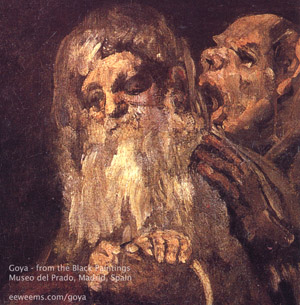
We see here an unforgettable rendering of an old man with a very serious, inward-looking expression on his face.  He has the trappings of old age, namely a long, white beard, and the use of a cane for support.  He is dressed as a monk, but this, along with the white beard, is more indicative of wisdom than of belief.  This is not meant to be a Catholic icon.  The face reveals a deep intelligence, wisdom, and more than a trace of melancholy.  It is reasonable to assume that there are some elements of a self-portrait here--Goya was old, sick and wise at the time of its composition--but autobiographical elements are not the primary focus here.  Goya here as well as in the other paintings is after making valid statements regarding the human condition--heavily influenced, of course, by the weariness and pessimism of his inner life at the time.
Now let us turn to the other figure.  If this is a second monk, as some have postulated, the order he belongs to is surreal.   Goya took great pains to depict here a cousin of Saturn, that is, a beast-like, debased human.  Notice the hypertelorism, (widely spaced eyes), characteristic of animals for whom a panoramic vision is more important, in order to spot or flee from prey; this is in marked contrast to  the more highly evolved closer-set eyes that enable binocular vision in humans.  They look more reptilian than human.  The mouth--recall what was said earlier about Saturn's--is indicative, to me at least, of a fish's--a fish about to swallow the wise man's ear rather than to whisper something into it. There is something lascivious about that mouth as well.  The sexual depravity element is accentuated by the ears, which would seem more at home on a satyr than on a human.  The simian hands reinforce the beast-like nature of the "second monk."  Note also that only the wise man is portrayed in full, the beast-man appears as little more than a head, which gives a sense of incorporeality to his being.

What is Goya conveying here?  Once again, I see this painting as more of an allegory than a portrait of two individuals.  Being old and wise does not mean that one is free from temptation--terrible temptations, in this case, as we observe the second man's face.  I interpret this satyr to be the wise man's inner demon.  He seems to me to represent lust rather than anything else, but anyone of the Seven Deadly Sins will do.  It might even represent insanity, a malady which Goya, now old, ill, disillusioned and more intense than ever, very much feared.

"Friedlich und heiter ist dann das Alter," wrote Hölderlin, "Old age will be peaceful and calm."  Well, not always--it certainly wasn't for that German poet, who went insane not too long after having written this poem.

The following immortal lines from Yeats's "Sailing To Byzantium" are very applicable to our interpretation: "An aged man is but a paltry thing,/ A tattered coat upon a stick, unless/Soul clap its hands and sing,/And louder sing/For every tatter in its mortal dress." The Goya-like old man of the portrait has a soul with hands that have done a lot of clapping and will most likely  continue to clap--but at the moment they are keeping time to the Weltschmerz of a Brahms symphony rather than to the joie de vivre of a Rossini overture.

Please now refer to the portrait in its entirety.  The wise man's head is bending away from his demon.  He is resisting temptation.  He will be successful at it as well, I assert, from the fact that his body remains erect.  He is like a tree the upper branches of which sway in the wind while the trunk remains firmly rooted in the ground.  His cane, I think, is not only representative of old age, but representative of a man in solid contact with the Earth. Serious temptations will continue to come--and go--to this old man; his soul will sing louder and louder, nevertheless.

3. El Perro (The Dog)


El Perro is the subject of Part l of this two-part series. (The article can be accessed on the internet by googling "El Perro Thomasdorsett" or on by blog.) I will therefore provide only a brief summary here.

This painting has been called, Un Perro Semihundito or A Partially Drowned Dog. Goya, as we stated before, didn't give titles to any of the Black Paintings.  "A Dog About To Go Under" would be more accurate.  The dog, about to disappear forever, a fact of which he is very much aware, looks  to the sky for his Master to come and save him.  The vast sky above the animal is an indication, in this interpretation, that not only is the cosmos vast, but impersonally vast.  There is no indication that the Master--God--will ever come to the faithful being who desperately hopes to be saved. Goya is perhaps telling us that hope for divine intervention is futile. The age of faith is over.  This is thus one of the first paintings of the modern era

4. Two Women and a Man (Dos Viejos y un Hombre)


We mentioned that the grisly Saturno painting evokes the greatest sense of horror of all the works in the series.  A careful look at this painting, however, reveals a scene that is no less disturbing

Once again we have both an allegory and a parody here.  The painting looks like a macabre version of a Flemish genre scene, which it mocks with its pessimistic Alice-in-Wonderland inversion of peasant life.  It is an allegory of both vulnerability and viciousness.

The man is not well dressed; this peasant is unkempt, perhaps a beggar. Now look closely at the man's face.  His eyes are closed; his mouth open.  He is completely self-absorbed; the external world, at least at this moment, does not exist for him  He is completely unaware of the two young women next to him.  Now look at his right arm.  He is masturbating.  His face indicates that he is at, or near, the moment of orgasm.

Such a severe disregard for social norms--not the masturbating, but the masturbating in public--indicates madness.  During intercourse between lovers, two individuals become ecstatically, albeit briefly, fused as one.  This man has nobody.  He is seeking a momentary respite from a painful existence.  Perhaps he is using self-stimulation as a drug to assuage overwhelming anxieties.  In any case, when the orgasm has passed, he will return to being destitute.  The first thing he will see is not the smile of a lover, but the malevolent grin on the face of a stranger.

George Herbert, the great English poet of the sixteenth century, wrote that he once felt troubled like a  man who had fallen into a ditch from which he could not get out by himself. Eventually God came down to his level, as it were, lent him a hand, and brought him back from his living grave.  Such a spiritual experience as Herbert's is rare among humans of his intellectual stature these days.

Simone Weil, the great--perhaps half-mad--philosopher who died young during the Second World War, was a believer, but a rather pessimistic one.  She did not expect God to lift people out of the ditches of their misery, for God has withdrawn from the world--at least for now.   She wrote that the only way to save an injured man who has fallen into a deep ditch is for one to go down to the same level as the man who had fallen.  ( I imagine him fastening a rope under the victim's shoulder, returning to the surface via the same rope, which  he had previously secured to a tree, and then hauling  the injured man to freedom.) Help must come, if it comes at all, from the God within, as it were, and not from without.  An intervention to save someone as lost as the mad peasant in Goya's painting entails great sacrifice.  The "savior" would need to abandon his own milieu, his own comfort, descend to the level of the fallen one, suffer along with him and then do his best to see to it that they return to the world together.

The chance of this happening is more likely to occur than the possibility of the Master ever coming to save El Perro, true, yet it almost never happens.  We tend to befriend those of the same age, race, ethnicity  and educational level.  Few are willing to sacrifice their own comfort for a beggar in a ditch.  Sure, some good people might help him, but to a limited degree.  Sooner or later, the mad beggar would once more be on his own, like the mentally ill who were released--and subsequently abandoned--when, decades ago, it was decided that hospitals for the mentally ill should be closed. After all, each has his own troubles!  That however is no excuse for disobeying the great commandment of loving one's neighbor as oneself.

It is, as in this painting, even worse than that.  The vulnerable who need more care than the rest of us are much more likely to be beaten, mocked and humiliated.  The girl with the evil grin knows what he is doing and laughs at the weird man's behavior--the diversion which mockery provides will briefly enable her to forget her own problems.  "I might have it bad," I imagine her telling herself, "but at least I'm not some crazy nobody like him!"

I have obviously made a riff on the theme of this paining, other interpretations are possible.  I am convinced, however, that the painting reveals  a hard truth.  As Jesus of Nazareth said, those with little, even the little they have will be taken away from them.  No doubt about it, many vulnerable  people enjoy kicking people who are even more vulnerable into a ditch.  The rest of us hardly notice, step around an inconvenience, and go right on our way.

                                                            *

I have presented four highly personal responses to four of the Black Paintings, the seminal series of works of art Goya composed late in his life without any concern for public acceptance or for the tastes of his time.  They are revolutionary in both form and content; I have concentrated on the latter.  Not being an art historian has perhaps some advantages--what you've read here you will not find anywhere else.  For whom have I written this article?   My ideal reader, hopefully you,  is someone whose sense of outraged humanity and whose love of great art has found something of value in this brief analysis of four masterpieces, written by a fellow human being who shares both of those characteristics as well.  

9.30.2015

Goin' On A Journey. In Memoriam: Mridula Jose, 1944-2015


My dear, sweet and almost always upbeat sister-in-law, Milla, (Mridula Jose), is no more.  A positive force in the lives of all who knew her, Milla and that force which appears to be so inexplicably negative came together on September 30, 2015.  The result is a terrible silence.

My sister-in-law had a period of extraordinary lucidity the day before she succumbed to a disease she had been fighting for years.  I want to call everyone and say good-bye, she told her son, Ranjit.  After doing this, she discussed final matters with him, including instructions for her funeral.

We got our call a few hours before she passed away. It was difficult for her to talk; her speech was slurred.  Despite these impediments, the Milla we knew shone through like sunlight at the mouth of a cave.

I will never forget how she announced her impending death.  "Time to go!" she told us.  It wasn't so much what she said but the way she said it.  Goin' on a journey, it's all right.  Those three words were vintage Milla.  No one else could put a positive spin on a negative spiral in such a disarmingly simple way.

She subsequently thanked us for everything--these were for us her last words.  In Indian culture, you don't tell your relatives that you love them all the time, but at the right time.  The right time had come.  We shouted, "I love you!  We love you!  We'll miss you forever!"  Sometimes five minutes add up to eternity, a truly glorious sum.

Her body decided to retire, not Milla.  A gifted teacher, Dr. Mridula Jose continued to walk into classrooms until the day she could no longer walk.  Many, many students whom she encountered while teaching literature at Stella Maris will, I am very sure, never forget her.

Real teachers cannot stop.  On her final day on earth, shortly before she called us, she asked Ranjit to read aloud T.S. Eliot's The Wasteland, one of her favorite poems.  She had to say good-bye to literature as well!  Ranji later told me that while he was reading the poem. she interrupted many times in order to deepen his understanding of the text.  A little room in Besant Nagar became, as it were, a large classroom in Stella Maris.  She was doing what she loved, teaching again, alas! for the very last time.


One of her last wishes, Ranji informed me, is that if any song is sung or played during a memorial for her it should be her favorite hymn, Nearer My God to Thee..  I don't think Ranji was familiar with the melody; I sang a few bars over the phone.

A few hours later, my wife, Nirmala, Milla's older sister, and I were sitting in meditation before an altar we had recently set up in our living room.  (We had transformed our coffee table to a shrine to commemorate the very recent death of Shyamala, Nirmala's older sister.  Four deaths in five months!  This has been a rough year.)  During meditation, I thought of Milla's request.  I knew I had a Gospel version of Nearer My God to Thee somewhere.  Rising from meditation, I searched till I found it.  While I was playing the hymn, a few feet from Nirmala and Nataraja, we got the phone call that Milla had died a few minutes before. We'll remember those moments "forever" as well.

Earth is a different place for us, now that Milla is no longer on it.

A few years ago, I composed a little hymn entitled, Goin' On A Journey.  The lyric tells a story of a near-death experience that becomes a real-death experience. The penultimate stanza is sad: "I have to leave my loved ones... It's hard, it's hard, it's very hard..."  Joy triumphs, however, with the return of the major key of the final stanza: We're gonna be together, it's all right!/ We're gonna be together, it's all right!/  Soon we're gonna be together/ no umbrellas needed EVER,/ We're gonna be together, it's all right!"

I didn't write that last stanza; Milla did. 


Addendum, one year later:


9.16.2015

A Review of "Life and Death Are Wearing Me Out," A Novel by Mo Yan


Life and Death are Wearing Me Out
by Mo Yan
Translated into English by Howard Goldblatt
Arcade Publishing, New York, 2006
540 pages

1.
Authoritarian regimes--China is a prominent contemporary example--fear their writers and go to elaborate lengths to control them.  Writers of literature are generally an independent lot for whom dedication to aesthetics and truth go hand in hand.  The latter aspect gets them into deep trouble with a regime that only permits dedication to its truth and represses the truth by persecuting dissent.  For Chinese writers who  adamantly object to totalitarian control of thought there are two choices: exile or prison.  It is sad to say that so many of the best Chinese writers and intellectuals have felt compelled to choose one or the other.

There is, of course, a third choice: compromise with, or even full acceptance of, a regime that does its best to crush independent thinking perceived as a threat to its power.  This is generally the choice preferred by hacks.  Mo Yan, who is the president of the state-sponsored Chinese Writers Association; Mo Yan who refuses to condemn the criminalization and incarceration of Lin Xiabo, the well-known activist for the democratization of China who received a Nobel peace prize in 2010; Mo Yan is arguably politically tainted but is, nevertheless, no hack.  He is a skilled writer; his novel, Life and Death are Wearing Me Out is well worth reading.

When he won the Nobel Prize for Literature in 2012,  his willingness to be in effect a part of a repressive state was like a big red ball thrown into your garden.  You couldn't ignore it; you had to pick it up.  Many Chinese intellectuals were either saddened or made furious by the news.  A previous recipient of the Noble Prize for Literature called the decision a "catastrophe."  Another prominent writer called Mo Yan a patsy.

In the year the award was given, Perry Link wrote an article for the New York Review of Books with the following title, "Does the Author Deserve the Prize?"  The essay implied that the price he has paid for a lucrative writing career endorsed by tyrants--that is, being a sycophant--made him unworthy of the award.  It is significant to note that whether Mo Yan is a good writer or not is not discussed.

It might be a sad fact but it is a fact: if an artist is brilliant and outshines most of his contemporaries, his moral shortcomings are relegated to his shadow.  It is unproblematic and very rewarding to enter the brilliant  realm of Wagner's music; the shadowy deficiencies of the man do not affect the notes. The novelist's case is admittedly somewhat--but not completely--different, since prose is a much less abstract art form than is music.

I believe that Life and Death Is Wearing Me Out proves beyond doubt that Mo Jan is a very good writer.

The novel is an epic tale of small-town life in China from 1950 until 2000.  It centers on a landowner, Ximen Nao, who is executed as a class enemy as soon as the Communists come to power.  He is subsequently reborn in turn as a donkey, an ox, a pig, a dog,  a monkey, and finally as a human, the Millennium Boy, Lan Quiansui.  The reincarnated animals, now serving those who had served Ximen Nao, are involved in many lively adventures with the inhabitants of the village of Ximen.  The background is the cataclysmic history of China during that period.

2.
There are many excellent novels that provide convincing portrayals of how life is or was  under a totalitarian regime.  Examples: Everyone Dies Alone, by Hans Fallada, depicting everyday life under the Nazis; The Land of Green Plums, depicting everyday life in Communist Romania, by Herta Müller-who, by the way, is the Nobel Prize winner who thinks that  the award to Mo Yan was a "catastrophe"; One Day in the Life of Ivan Denisovich by Alexander Solzhenitsyn, depicting life in a Soviet gulag; The Feast of the Goat by Mario Vargas Llosa, depicting life in Trujillo's Dominican Republic, and finally, der Turm by Uwe Tellkamp (as yet untranslated into English) which depicts life in East Germany.  Having read all of these, I assert without hesitation that these novels give one a better idea of how life was under those regimes than any history book.

If you are expecting a novel that accurately depicts the catastrophes of recent Chinese history, however, Yan's novel isn't the book for you. There is an important distinction between the novels I mentioned and the one I am now reviewing: all of the former were written by authors who lived through a terrible regime, and wrote their novels either in exile or after the regime in question  fell. (The sole exception is Solzhenitsyn's novel which was written in the Soviet Union at a time when a depiction of Stalinist terror was no longer taboo.) The only criticisms they faced were from reviewers and readers.  If Mo Yan, living in China, had given a more truthful portrait of life in China from 1950 until the present, he would either have been forced into exile or have been arrested.  He made his choice. He also made the choice to write well.

The current situation in China reminds me a little of the history of racism in America.  Seventy years ago racism in the United States was brutal; it has eased up since then but it is still omnipresent. There are no longer millions dying in China at the hands of a repressive regime; freedom of thought, however, remains very much unachieved.  Many people are still either exiled or jailed because of their democratic beliefs. The regime allows some mentioning of "excesses" of the past as long as they remain light-years away from an honest account.

Life and Death are Wearing Me Out follows unwritten Communist guidelines in this regard.  A character in the book, Lan Lian, the executed and reincarnated Ximen Nao's farmhand, resists, despite increasing pressure, to stop being an independent farmer and join a collective.  Lian insists that Mao Zedong permits independent farming.  When Chairman Mao dies, he is as grief-stricken as the most ardent Communists.  We see here an example of the Communist lie that the "excesses" came from the bottom and not from those at the top.  There are many examples of glossing over disasters of the past.  One of Ximen Nao's incarnations, a donkey, is killed and eaten by starving peasants.  There is no mention either of the cause of the starvation or that at least 30 million peasants died during it.  The disastrous bird-killing campaign is mentioned late in the book and only in passing.  The equally disastrous steel campaign during which China was deforested to fuel backyard furnaces that were to transform scrap metal into steel--it did not produce usable steel--is indeed mentioned, in, however, a very superficial way.  Later in the novel, a person is given the advice to contribute to rebuild a temple destroyed in the Cultural Revolution--that's the only mention of the enormous destruction of temples that were carried out during those horrible years.  The ravage of Tibet, still a very taboo topic, is, of course, not even mentioned in passing. Yan's  superficial, often humorous portrayal of Chinese history reminds me of Longfellow's line, "Into each life a little rain must fall."  The truth is that the intermittent downpours under Chairman Mao were unimaginably severe.

Why is such a revisionist novel still worth reading?

3.
For at least three reasons: Mo Yan is a great storyteller; he is very inventive and, finally, almost never boring.  (If it is true that he wrote this long novel in only 42 days, he also writes unbelievably fast and is thus an equal of Georges Simenon in this regard!)  Regarding his inventiveness, thinking animals, all incarnations of Ximen Nao, occur throughout; in lesser hands, this may have become tedious, but Yan pulls this off brilliantly. Most adults sometimes look back with nostalgia at a time in their lives in which animals talked and behaved like humans--at least in storybooks.    Yan captures this nostalgia without requiring the reader to suspend adult experience.  Far from it.  There is a wonderful scene in the first section in which human sexuality and asinine sexuality combine as Ximen Nao, now a donkey, approaches a young female donkey's behind. It was fun to feel like a kid and an id at the same time.

There are many interesting characters who are also character-types.  Ximen Nao's son Ximen Jinlong, adopted by Lan Lian after Ximen Nao's execution,  is a  well-portrayed type that exists everywhere: all he wants is power for himself, and will change according to the times in order to hold on to it.  During the time of Chairman Mao, he is a fervent Communist and browbeats his adoptive  father for remaining an independent farmer, since this threatens Jinlong's position as a high-ranking member of the Communist party.  Later on, he becomes a full-fledged capitalist and attempts to transform the village of Ximen into a resort!  (The Chinese government, by the way, intends to transform the village in which Yan was born into a "Cultural Experience Zone.") Another character, Hong Taiyue, "a typical lowlife, the dregs of society, a beggar who went around banging on the hip bone of a bull ox," rises in the local branch of the Party due to his impeccable peasant credentials; when China adopts capitalism, however, he feels as much at home as a minnow in a mall.  Desperate, he  puts on a suicide vest and kills both himself and the unscrupulous Jinlong.

The last section of the novel is by far the best.  Mo Yan who writes himself into the novel from the beginning, is responsible here  for a new direction of the plot.  He introduces the unhappily married Lan Jiefang to Pang Chunmiao, a beauty twenty years younger than himself.  History, that is revisionist history, is completely forgotten as Mo Yan tells the love story and its consequences.  (The affair causes a major scandal, proof that Chinese society--at least in rural areas-- has yet to permit the permissiveness  of the West. There's always room for progress!) Their tragic love story is a quintessential page-turner. This section of the novel is first rate-fiction, proof beyond doubt that Mo Jan is a very talented writer.

Conclusion

Perhaps Mo Yan has written here two novels, one for China and one for the rest of us.  If one knows what really happened, one can deconstruct the novel into one that confronts Chinese history with an effective use of poetic understatement.  A hint of horror can effectively bring those horrors to mind than pages of accurately depicted misery.  Those who have been brain-washed by state-controlled disinformation are able to view the novel as realistic historical fiction.  Am I being facetious?  Perhaps, perhaps not. Who knows what Mo Yan keeps to himself in order to remain the darling of the Communist Party? Time might tell.  In the meantime, read this enjoyable novel with an informed and inviolate eye.


You are welcome to read past book reviews of the Baltimore Online Book Club by googling the title of the novel along with my full name, Thomas Dorsett.

1. The New Life by Orhan Pamuk
2..Anna Karenina by Leo Tolstoy
3. Exit Ghost by Philip Roth
4. A Sport and a Pastime by James Salter
5. Life and Death are Wearing Me Out by Mo Yan

Our next meeting will take place on October 14, 2015.  On that date, the six members of our group will discuss the novel,  Absalom, Absalom!, by William Faulkner; I will post my review shorty therafter. You are invited to read the book and to post your comments onto the comment section of the review.   I wish you pleasurable reading!

9.07.2015

Black Lives Matter? Doesn't Everybody's?

1. Why me?

I remember reading, many years ago, about a study the result of which seemed convincing to me then and seems even more convincing to me now.  If I recall correctly, the teacher of an elementary school class had a student come up and stand in front of the room.  Then she said, as I retell it: "Jimmy, you've been doing great!  I'm very proud of you!  Now sit down." Whereupon Timmy smiled broadly, and buoyed by praise, floated, as it were, upon a sea of frowns.  The study found that if you praise someone before a group, the unpraised majority will tend to view it as a criticism of them.  "What about me, Mrs. Edwards?  You must think I'm doing badly." Anyone familiar with human nature knows this to be true.

If you think this finding only applies to kids, think again.  It is behind much of the white criticism to the Black Lives Matter movement.  I will explain.

The working class is under increasing--and unnecessary--duress in the United States.  A shameful percentage of the wealth generated by the recent recovery has gone to the very wealthy; not only that, the poor and the working class were forced to bear the brunt of the untrammeled greed of Wall Street.  It was the bankers and such whose fanatical devotion to the golden idols of money and power lead them to irresponsible decisions; they escaped the consequences of their acts, the poor and working class are still paying dearly for their errors.

All members of the working class have been affected.  Whites have been victimized as well.  Especially under-educated white males--their incomes have been declining for a long time.  Once you could live the American dream as a white man without a college degree; now lack of education is an invitation to the America nightmare. Please don't misunderstand; I'm not saying that African-Americans were not denied participation in the glory days of Ozzies and Harriets; racism and gender discrimination were rampant. What I am saying is that when whites under siege hear of a movement called "Black Lives Matter" the immediate reaction of many will be, "What about me?"  And that is exactly what has happened.

The reaction is inevitable as it is unjustified.  No objective person of any race can deny that racism is still very much with us.  No objective person of any race can deny that there haven't been egregious cases of white police officers abusing blacks, too often ending in death,  The abuse, which has gone on for far too long,  has to stop, "Black Lives Matter" is a legitimate movement.  My only criticism is this: in anticipation of the "what-about me?" reactions of disgruntled whites, maybe a better name for the movement would have been, "Black Lives Matter Too!"  Imagine the progress we would make in combating income inequality if the poor and the workers of all color came together--every Republican's nightmare!

2. Why Can't They Be Like Us?

No objective person of any race can deny...  OK, I can understand some of the testiness of the hard-pressed white working class.  But what about the lack of empathy among those who have no financial worries at all?

I was looking at my YouTube video recommendations and, Lord knows how, there was Bill O'Reilly.  My jaw dropped as I listened, my eyes bulging with, well, shock.  There he was insisting that there was no racism in the United States!  He was arguing with a blond woman who asserted that racism was embedded in the current cultural fabric.  He became livid.  He said he was ashamed of her conviction that racial prejudice still exits; he implied that she was unpatriotic and playing into the hands of America's enemies.  Besides, some degree of racism exists in all countries, he asserted--as if that was a justification to dismiss a widespread American problem.  Isn't that a bit like a doctor in the 1950s concluding  that, since  tuberculosis exits around the world, we can afford to be complacent about the cases in our own back yard?  On a more recent video, he insisted that the "Black Lives Matter" movement is a hate group, comparable to the Klu Klux Klan!!

Mr. O'Reilly miserably fails what I call the Moccasin Test.  If he had sincerely tried--the data is out there--to walk a mile or two in a black person's shoes, he would not be able to make such ridiculous statements.

America's great advantage is its pluralism.  It has allowed our country to be a magnet for talented people from all around the world.  E Pluribus unum--What will happen if we let our country's motto deteriorate into "From Many, two or three or four?"  What would happen if we let that motto, which has served most of us well, degenerate into "Everyone for himself and God against all?"

Trouble is that many whites ("us") consider blacks "them."

A friend of mine once said, wisely: First, you have to identify with yourself.  Then, you extend that identification to family and friends; after that, most important, you reach out to everyone else.  O'Reilly's concerns dead-end with people who look like him and who are rich like him.  Not a great moral achievement.

What if the O'Reillys of this world ignored how much melanin one had in one's skin and how much moolah one had in one's pocket?  What if the O'Reillys saw what happened to Freddie Gray and say, "This has got to stop!  He could have been my son!"

I am white and a senior--that puts me in the most conservative demographic group in America.  I would like to have a chance to consider voting for a true conservative.  That is unlikely if the Republican Party remains the party of oligarchs.

Conclusion

All right, Mr. Armchair President, what should we do now?
Two Things.

1. Assure that all Americans who can work have jobs that pay a living wage.  Assure that all Americans have adequate housing.  Assure that all Americans live in safe neighborhoods.  Norway does it, Sweden does it, why can't we?  Workers would be more satisfied with their lives--and empathy increases with happiness.  Working class whites would  be thus less likely to have the disgruntled Why-Me? view fostered by Fox News.

2,  Sharply reduce the segregation of poor African Americans into high-poverty neighborhoods.  Implement the Fair Housing Act of 1968!  Whites red-lined blacks into slums long ago; since then, their indifference has allowed things to actually get worse. (The number of people living in disadvantaged neighborhoods has nearly doubled since 2000.) Things must and will change, the sooner the better. Guess who's coming to borrow a cup of sugar?  Your neighbor, no matter the race, no matter how rich, no matter; what really matters is decency, what matters is the real you. It can happen.

This will not be an easy path, no doubt, and, no doubt, there is no other.

Thank you, Mr. Armchair President!  Do you hear the sound of one hand clapping? Congratulations, Mr. President!  It's clapping for you.