Goya's Black Paintings are a series of fourteen murals with which Goya decorated the walls of his house, near Madrid. Goya moved into the so-called Quinta del Sordo, "The Villa of the Deaf Man" in 1819 in his seventy-third year, and remained there until, disgusted with Spanish politics, he moved to Bordeux in 1824, where he died in 1828. Thirty-five years after his death, the paintings were given to the Prado Museum, where they have been on display ever since; unfortunately, they suffered considerable damage as they were transferred from wall to canvas. Goya composed these to meet his own expressive needs; he never intended that they be seen by the general public. He never wrote about them, and, to my knowledge, never discussed them. He didn't even give them titles--the titles by which they are known today are all posthumous inventions. This deepens the enigmas of these already enigmatic works. They are subject to diverse interpretations; the interpretations in this article are largely my own. Only 'largely" because I am indebted to Veleriano Bozals book, Pinturas negras de Goya, (Machado Libros, 2009) for some historical facts and interpretive details. (To my knowledge, there is no English translation.)
I first became aware of these paintings during a trip to Madrid with my wife in May, 2015. I stood before them transfixed for a long time. I was fascinated most of all with El Perro, The Dog, the subject of the first of this series of two. I was also deeply moved by three of the other Black Paintings, which will be discussed in this essay along with a brief recounting of my impressions of The Dog.
1. Saturn (Saturno)
.jpg/200px-Francisco_de_Goya,_Saturno_devorando_a_su_hijo_(1819-1823).jpg)
At first glance, this is the most striking painting of the entire group. The intensity of Saturn's expression and the depicted horror cannot fail to gain one's attention. What is Goya trying to convey here?
In Greek mythology, Saturn was the son of Uranus (Sky) and Gaia, (Earth). Upon reaching maturity, Saturn castrated and imprisoned his father, thus becoming the undisputed ruler of the universe. He married his sister Rhea and ruled over the Golden Age during which no laws were needed, since everyone behaved righteously. His was a divine yet dysfunctional family, however, savage to a degree almost unimaginable among mortals. A prophecy revealed that a son would depose him. Rhea gave birth to five children. In order to contravene the prophecy, Saturn devoured each child shortly after birth. During her sixth pregnancy, the queen decided to trick her husband and save the sixth child. After she gave birth to a son, she wrapped a stone in swaddling clothes, which, supposing that it was his son, Saturn promptly swallowed whole. Rhea raised her surviving child in secret. Upon reaching adulthood, the son overthrew and subsequently imprisoned Saturn. Before banning his father to Tartarus, the son forced him to swallow an emetic, after which he disgorged his previous five children. (In order of their birth, mind you; the Greeks certainly had vivid imaginations.) The son, of course, was Zeus; his disgorged siblings were Demeter, Neptune, Hades, Hera and Hephaestus; one imagines that they were, that is, are, eternally grateful.
A wild myth, signifying the brutality of nature, (Saturn was, after all, the son of Earth and Sky), and the brutality of humans, especially when they are drunk on power and willing to continue drinking this intoxicant at all costs.
Goya's painting differs significantly from depictions of Saturn's cannibalism. In order to illustrate this difference, we turn to a painting of the well-known myth, in this case "Saturn" by Peter Paul Rubens:

Rubens's is a more conventional version of the myth. An old man--Saturn is also the god of old age, hence the adjective, "saturnine"--is depicted devouring an infant. (The terrified child appears actually to be a few months old; his head is smaller than an infant's in proportion to his torso, much like an adult's; Rubens made these slight changes for expressive purposes.)

Now let's examine Goya's version. Goya's victim is no infant. The contours of the buttocks and hips indicate that this is a young female. (Why did Goya choose to paint a female victim? Perhaps she represents the innocence of nature? Perhaps she, a defenseless youth, is a metaphorical representation of how the powerful treat the powerless?) Has Saturn already bitten her head and/or left shoulder with the terrible evidence of his deed covered by his long, unkempt hair? Hard to tell. Blood flows down her shoulders; she appears limp, pale--most likely she is already dead. Saturn is about to bite off her left arm.
Observe his mouth: no teeth, no tongue, just a large inhuman black hole about to devour flesh in much the same way black holes in the cosmos devour stars that come too near. Rubens's protagonist is inhuman by behavior but quite human in appearance; Goya's is a crazed demon, half human, half beast.
No, this monster is no god. A furious, dangerous version of the harmless Tom O'Bedlam perhaps, but no god. His long, unkempt hair, gaunt features and near-nakedness suggests that this is an old man deformed by ravages of homelessness and insanity. And those eyes! Such a mad expression reveals someone driven by internal demons with minimal contact with reality. His lower limbs appear more beast-like than human.
One must not forget that Goya endured a serious illness in 1793-1794, which left him deaf. Embittered by external horror and internal instabilities, Goya increasingly feared for his sanity. The feeling of impending doom was especially acute during the time of the Black Paintings, (1819-1824). One gets the impression that the paranoid, mad expression of Saturn's features not only represent the deeds of inhumane humans, but the machinations of inner demons as well.
As mentioned in Part l, most of the Black Paintings convey a sense of outraged humanity. For Goya, life is sacred. That this innate sacredness has been so horribly abused is what gives paintings such as this one their power. Depicting horror for the sake of horror is not a shade on Goya's inner palette.
Goya was painfully aware of the atrocities committed during The Peninsular War (1808-1814)--the French invaded Spain in 1808--and the corruption of the subsequent Bourbon restoration. Reacting to the chaos and cruelty around him, Goya made a series of aquatint engravings entitled, Los Desastres de la Guerra, The Disasters of War, which include brutal scenes of carnage. Examples: in one of them, a naked man, held upside down by soldiers, is being castrated by one of the soldiers; another depicts a man whose hands have been chopped off; another depicts a man, tied to a tree, who has been castrated. (Recall that Saturn castrated his father; the instrument with which he did this is included in the far mid-left region of the Goya's painting. I think that this is as much a reference to the brutality of Spanish history in Goya's day as it is to the Greek myth.)
In this painting, Saturn appears to rise from a black abyss like a crazed, unloving god of untrammeled egocentricity. It suggests a parody of a portrait of the Good Shepherd or of St. Jerome in the desert.
I interpret this painting not only as an example of physical violence, but of other types of violence as well. You don't have to be outwardly violent to commit acts of cruelty. Example: violence is committed against the poor by those in power, who have little concern for those at the bottom of society. A Senator can look spiffy and be dressed to the nines; inside, however, his inner Saturn is willing to do anything to maintain his privileged position. Thus, the painting becomes an allegorical representation of a twisted soul drunk on greed and power.
The Saturn in a three-piece suit is perhaps the most dangerous Saturn of all.
Implicit in Goya's outraged humanity is an important question: Will Saturn, debased humanity, return to the abyss whence he arose? That is up to us.
2. Two Old Men (Dos Viejos)


We see here an unforgettable rendering of an old man with a very serious, inward-looking expression on his face. He has the trappings of old age, namely a long, white beard, and the use of a cane for support. He is dressed as a monk, but this, along with the white beard, is more indicative of wisdom than of belief. This is not meant to be a Catholic icon. The face reveals a deep intelligence, wisdom, and more than a trace of melancholy. It is reasonable to assume that there are some elements of a self-portrait here--Goya was old, sick and wise at the time of its composition--but autobiographical elements are not the primary focus here. Goya here as well as in the other paintings is after making valid statements regarding the human condition--heavily influenced, of course, by the weariness and pessimism of his inner life at the time.
Now let us turn to the other figure. If this is a second monk, as some have postulated, the order he belongs to is surreal. Goya took great pains to depict here a cousin of Saturn, that is, a beast-like, debased human. Notice the hypertelorism, (widely spaced eyes), characteristic of animals for whom a panoramic vision is more important, in order to spot or flee from prey; this is in marked contrast to the more highly evolved closer-set eyes that enable binocular vision in humans. They look more reptilian than human. The mouth--recall what was said earlier about Saturn's--is indicative, to me at least, of a fish's--a fish about to swallow the wise man's ear rather than to whisper something into it. There is something lascivious about that mouth as well. The sexual depravity element is accentuated by the ears, which would seem more at home on a satyr than on a human. The simian hands reinforce the beast-like nature of the "second monk." Note also that only the wise man is portrayed in full, the beast-man appears as little more than a head, which gives a sense of incorporeality to his being.
What is Goya conveying here? Once again, I see this painting as more of an allegory than a portrait of two individuals. Being old and wise does not mean that one is free from temptation--terrible temptations, in this case, as we observe the second man's face. I interpret this satyr to be the wise man's inner demon. He seems to me to represent lust rather than anything else, but anyone of the Seven Deadly Sins will do. It might even represent insanity, a malady which Goya, now old, ill, disillusioned and more intense than ever, very much feared.
"Friedlich und heiter ist dann das Alter," wrote Hölderlin, "Old age will be peaceful and calm." Well, not always--it certainly wasn't for that German poet, who went insane not too long after having written this poem.
The following immortal lines from Yeats's "Sailing To Byzantium" are very applicable to our interpretation: "An aged man is but a paltry thing,/ A tattered coat upon a stick, unless/Soul clap its hands and sing,/And louder sing/For every tatter in its mortal dress." The Goya-like old man of the portrait has a soul with hands that have done a lot of clapping and will most likely continue to clap--but at the moment they are keeping time to the Weltschmerz of a Brahms symphony rather than to the joie de vivre of a Rossini overture.
Please now refer to the portrait in its entirety. The wise man's head is bending away from his demon. He is resisting temptation. He will be successful at it as well, I assert, from the fact that his body remains erect. He is like a tree the upper branches of which sway in the wind while the trunk remains firmly rooted in the ground. His cane, I think, is not only representative of old age, but representative of a man in solid contact with the Earth. Serious temptations will continue to come--and go--to this old man; his soul will sing louder and louder, nevertheless.
3. El Perro (The Dog)

El Perro is the subject of Part l of this two-part series. (The article can be accessed on the internet by googling "El Perro Thomasdorsett" or on by blog.) I will therefore provide only a brief summary here.
This painting has been called, Un Perro Semihundito or A Partially Drowned Dog. Goya, as we stated before, didn't give titles to any of the Black Paintings. "A Dog About To Go Under" would be more accurate. The dog, about to disappear forever, a fact of which he is very much aware, looks to the sky for his Master to come and save him. The vast sky above the animal is an indication, in this interpretation, that not only is the cosmos vast, but impersonally vast. There is no indication that the Master--God--will ever come to the faithful being who desperately hopes to be saved. Goya is perhaps telling us that hope for divine intervention is futile. The age of faith is over. This is thus one of the first paintings of the modern era
4. Two Women and a Man (Dos Viejos y un Hombre)

We mentioned that the grisly Saturno painting evokes the greatest sense of horror of all the works in the series. A careful look at this painting, however, reveals a scene that is no less disturbing
Once again we have both an allegory and a parody here. The painting looks like a macabre version of a Flemish genre scene, which it mocks with its pessimistic Alice-in-Wonderland inversion of peasant life. It is an allegory of both vulnerability and viciousness.
The man is not well dressed; this peasant is unkempt, perhaps a beggar. Now look closely at the man's face. His eyes are closed; his mouth open. He is completely self-absorbed; the external world, at least at this moment, does not exist for him He is completely unaware of the two young women next to him. Now look at his right arm. He is masturbating. His face indicates that he is at, or near, the moment of orgasm.
Such a severe disregard for social norms--not the masturbating, but the masturbating in public--indicates madness. During intercourse between lovers, two individuals become ecstatically, albeit briefly, fused as one. This man has nobody. He is seeking a momentary respite from a painful existence. Perhaps he is using self-stimulation as a drug to assuage overwhelming anxieties. In any case, when the orgasm has passed, he will return to being destitute. The first thing he will see is not the smile of a lover, but the malevolent grin on the face of a stranger.
George Herbert, the great English poet of the sixteenth century, wrote that he once felt troubled like a man who had fallen into a ditch from which he could not get out by himself. Eventually God came down to his level, as it were, lent him a hand, and brought him back from his living grave. Such a spiritual experience as Herbert's is rare among humans of his intellectual stature these days.
Simone Weil, the great--perhaps half-mad--philosopher who died young during the Second World War, was a believer, but a rather pessimistic one. She did not expect God to lift people out of the ditches of their misery, for God has withdrawn from the world--at least for now. She wrote that the only way to save an injured man who has fallen into a deep ditch is for one to go down to the same level as the man who had fallen. ( I imagine him fastening a rope under the victim's shoulder, returning to the surface via the same rope, which he had previously secured to a tree, and then hauling the injured man to freedom.) Help must come, if it comes at all, from the God within, as it were, and not from without. An intervention to save someone as lost as the mad peasant in Goya's painting entails great sacrifice. The "savior" would need to abandon his own milieu, his own comfort, descend to the level of the fallen one, suffer along with him and then do his best to see to it that they return to the world together.
The chance of this happening is more likely to occur than the possibility of the Master ever coming to save El Perro, true, yet it almost never happens. We tend to befriend those of the same age, race, ethnicity and educational level. Few are willing to sacrifice their own comfort for a beggar in a ditch. Sure, some good people might help him, but to a limited degree. Sooner or later, the mad beggar would once more be on his own, like the mentally ill who were released--and subsequently abandoned--when, decades ago, it was decided that hospitals for the mentally ill should be closed. After all, each has his own troubles! That however is no excuse for disobeying the great commandment of loving one's neighbor as oneself.
It is, as in this painting, even worse than that. The vulnerable who need more care than the rest of us are much more likely to be beaten, mocked and humiliated. The girl with the evil grin knows what he is doing and laughs at the weird man's behavior--the diversion which mockery provides will briefly enable her to forget her own problems. "I might have it bad," I imagine her telling herself, "but at least I'm not some crazy nobody like him!"
I have obviously made a riff on the theme of this paining, other interpretations are possible. I am convinced, however, that the painting reveals a hard truth. As Jesus of Nazareth said, those with little, even the little they have will be taken away from them. No doubt about it, many vulnerable people enjoy kicking people who are even more vulnerable into a ditch. The rest of us hardly notice, step around an inconvenience, and go right on our way.
*
I have presented four highly personal responses to four of the Black Paintings, the seminal series of works of art Goya composed late in his life without any concern for public acceptance or for the tastes of his time. They are revolutionary in both form and content; I have concentrated on the latter. Not being an art historian has perhaps some advantages--what you've read here you will not find anywhere else. For whom have I written this article? My ideal reader, hopefully you, is someone whose sense of outraged humanity and whose love of great art has found something of value in this brief analysis of four masterpieces, written by a fellow human being who shares both of those characteristics as well.
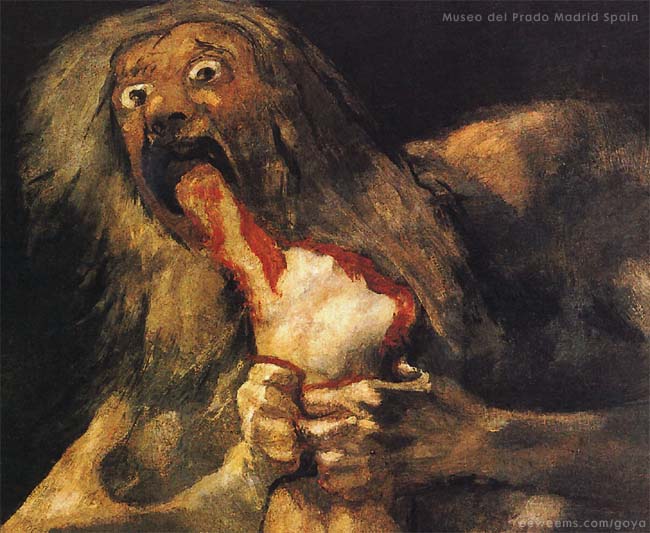
Now let's examine Goya's version. Goya's victim is no infant. The contours of the buttocks and hips indicate that this is a young female. (Why did Goya choose to paint a female victim? Perhaps she represents the innocence of nature? Perhaps she, a defenseless youth, is a metaphorical representation of how the powerful treat the powerless?) Has Saturn already bitten her head and/or left shoulder with the terrible evidence of his deed covered by his long, unkempt hair? Hard to tell. Blood flows down her shoulders; she appears limp, pale--most likely she is already dead. Saturn is about to bite off her left arm.
Observe his mouth: no teeth, no tongue, just a large inhuman black hole about to devour flesh in much the same way black holes in the cosmos devour stars that come too near. Rubens's protagonist is inhuman by behavior but quite human in appearance; Goya's is a crazed demon, half human, half beast.
No, this monster is no god. A furious, dangerous version of the harmless Tom O'Bedlam perhaps, but no god. His long, unkempt hair, gaunt features and near-nakedness suggests that this is an old man deformed by ravages of homelessness and insanity. And those eyes! Such a mad expression reveals someone driven by internal demons with minimal contact with reality. His lower limbs appear more beast-like than human.
One must not forget that Goya endured a serious illness in 1793-1794, which left him deaf. Embittered by external horror and internal instabilities, Goya increasingly feared for his sanity. The feeling of impending doom was especially acute during the time of the Black Paintings, (1819-1824). One gets the impression that the paranoid, mad expression of Saturn's features not only represent the deeds of inhumane humans, but the machinations of inner demons as well.
As mentioned in Part l, most of the Black Paintings convey a sense of outraged humanity. For Goya, life is sacred. That this innate sacredness has been so horribly abused is what gives paintings such as this one their power. Depicting horror for the sake of horror is not a shade on Goya's inner palette.
Goya was painfully aware of the atrocities committed during The Peninsular War (1808-1814)--the French invaded Spain in 1808--and the corruption of the subsequent Bourbon restoration. Reacting to the chaos and cruelty around him, Goya made a series of aquatint engravings entitled, Los Desastres de la Guerra, The Disasters of War, which include brutal scenes of carnage. Examples: in one of them, a naked man, held upside down by soldiers, is being castrated by one of the soldiers; another depicts a man whose hands have been chopped off; another depicts a man, tied to a tree, who has been castrated. (Recall that Saturn castrated his father; the instrument with which he did this is included in the far mid-left region of the Goya's painting. I think that this is as much a reference to the brutality of Spanish history in Goya's day as it is to the Greek myth.)
In this painting, Saturn appears to rise from a black abyss like a crazed, unloving god of untrammeled egocentricity. It suggests a parody of a portrait of the Good Shepherd or of St. Jerome in the desert.
I interpret this painting not only as an example of physical violence, but of other types of violence as well. You don't have to be outwardly violent to commit acts of cruelty. Example: violence is committed against the poor by those in power, who have little concern for those at the bottom of society. A Senator can look spiffy and be dressed to the nines; inside, however, his inner Saturn is willing to do anything to maintain his privileged position. Thus, the painting becomes an allegorical representation of a twisted soul drunk on greed and power.
The Saturn in a three-piece suit is perhaps the most dangerous Saturn of all.
Implicit in Goya's outraged humanity is an important question: Will Saturn, debased humanity, return to the abyss whence he arose? That is up to us.
2. Two Old Men (Dos Viejos)

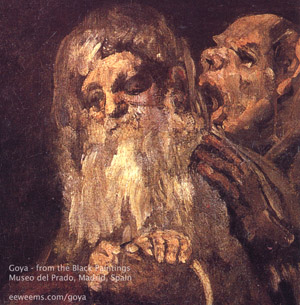
We see here an unforgettable rendering of an old man with a very serious, inward-looking expression on his face. He has the trappings of old age, namely a long, white beard, and the use of a cane for support. He is dressed as a monk, but this, along with the white beard, is more indicative of wisdom than of belief. This is not meant to be a Catholic icon. The face reveals a deep intelligence, wisdom, and more than a trace of melancholy. It is reasonable to assume that there are some elements of a self-portrait here--Goya was old, sick and wise at the time of its composition--but autobiographical elements are not the primary focus here. Goya here as well as in the other paintings is after making valid statements regarding the human condition--heavily influenced, of course, by the weariness and pessimism of his inner life at the time.
Now let us turn to the other figure. If this is a second monk, as some have postulated, the order he belongs to is surreal. Goya took great pains to depict here a cousin of Saturn, that is, a beast-like, debased human. Notice the hypertelorism, (widely spaced eyes), characteristic of animals for whom a panoramic vision is more important, in order to spot or flee from prey; this is in marked contrast to the more highly evolved closer-set eyes that enable binocular vision in humans. They look more reptilian than human. The mouth--recall what was said earlier about Saturn's--is indicative, to me at least, of a fish's--a fish about to swallow the wise man's ear rather than to whisper something into it. There is something lascivious about that mouth as well. The sexual depravity element is accentuated by the ears, which would seem more at home on a satyr than on a human. The simian hands reinforce the beast-like nature of the "second monk." Note also that only the wise man is portrayed in full, the beast-man appears as little more than a head, which gives a sense of incorporeality to his being.
What is Goya conveying here? Once again, I see this painting as more of an allegory than a portrait of two individuals. Being old and wise does not mean that one is free from temptation--terrible temptations, in this case, as we observe the second man's face. I interpret this satyr to be the wise man's inner demon. He seems to me to represent lust rather than anything else, but anyone of the Seven Deadly Sins will do. It might even represent insanity, a malady which Goya, now old, ill, disillusioned and more intense than ever, very much feared.
"Friedlich und heiter ist dann das Alter," wrote Hölderlin, "Old age will be peaceful and calm." Well, not always--it certainly wasn't for that German poet, who went insane not too long after having written this poem.
The following immortal lines from Yeats's "Sailing To Byzantium" are very applicable to our interpretation: "An aged man is but a paltry thing,/ A tattered coat upon a stick, unless/Soul clap its hands and sing,/And louder sing/For every tatter in its mortal dress." The Goya-like old man of the portrait has a soul with hands that have done a lot of clapping and will most likely continue to clap--but at the moment they are keeping time to the Weltschmerz of a Brahms symphony rather than to the joie de vivre of a Rossini overture.
Please now refer to the portrait in its entirety. The wise man's head is bending away from his demon. He is resisting temptation. He will be successful at it as well, I assert, from the fact that his body remains erect. He is like a tree the upper branches of which sway in the wind while the trunk remains firmly rooted in the ground. His cane, I think, is not only representative of old age, but representative of a man in solid contact with the Earth. Serious temptations will continue to come--and go--to this old man; his soul will sing louder and louder, nevertheless.
3. El Perro (The Dog)

El Perro is the subject of Part l of this two-part series. (The article can be accessed on the internet by googling "El Perro Thomasdorsett" or on by blog.) I will therefore provide only a brief summary here.
This painting has been called, Un Perro Semihundito or A Partially Drowned Dog. Goya, as we stated before, didn't give titles to any of the Black Paintings. "A Dog About To Go Under" would be more accurate. The dog, about to disappear forever, a fact of which he is very much aware, looks to the sky for his Master to come and save him. The vast sky above the animal is an indication, in this interpretation, that not only is the cosmos vast, but impersonally vast. There is no indication that the Master--God--will ever come to the faithful being who desperately hopes to be saved. Goya is perhaps telling us that hope for divine intervention is futile. The age of faith is over. This is thus one of the first paintings of the modern era
4. Two Women and a Man (Dos Viejos y un Hombre)

We mentioned that the grisly Saturno painting evokes the greatest sense of horror of all the works in the series. A careful look at this painting, however, reveals a scene that is no less disturbing
Once again we have both an allegory and a parody here. The painting looks like a macabre version of a Flemish genre scene, which it mocks with its pessimistic Alice-in-Wonderland inversion of peasant life. It is an allegory of both vulnerability and viciousness.
The man is not well dressed; this peasant is unkempt, perhaps a beggar. Now look closely at the man's face. His eyes are closed; his mouth open. He is completely self-absorbed; the external world, at least at this moment, does not exist for him He is completely unaware of the two young women next to him. Now look at his right arm. He is masturbating. His face indicates that he is at, or near, the moment of orgasm.
Such a severe disregard for social norms--not the masturbating, but the masturbating in public--indicates madness. During intercourse between lovers, two individuals become ecstatically, albeit briefly, fused as one. This man has nobody. He is seeking a momentary respite from a painful existence. Perhaps he is using self-stimulation as a drug to assuage overwhelming anxieties. In any case, when the orgasm has passed, he will return to being destitute. The first thing he will see is not the smile of a lover, but the malevolent grin on the face of a stranger.
George Herbert, the great English poet of the sixteenth century, wrote that he once felt troubled like a man who had fallen into a ditch from which he could not get out by himself. Eventually God came down to his level, as it were, lent him a hand, and brought him back from his living grave. Such a spiritual experience as Herbert's is rare among humans of his intellectual stature these days.
Simone Weil, the great--perhaps half-mad--philosopher who died young during the Second World War, was a believer, but a rather pessimistic one. She did not expect God to lift people out of the ditches of their misery, for God has withdrawn from the world--at least for now. She wrote that the only way to save an injured man who has fallen into a deep ditch is for one to go down to the same level as the man who had fallen. ( I imagine him fastening a rope under the victim's shoulder, returning to the surface via the same rope, which he had previously secured to a tree, and then hauling the injured man to freedom.) Help must come, if it comes at all, from the God within, as it were, and not from without. An intervention to save someone as lost as the mad peasant in Goya's painting entails great sacrifice. The "savior" would need to abandon his own milieu, his own comfort, descend to the level of the fallen one, suffer along with him and then do his best to see to it that they return to the world together.
The chance of this happening is more likely to occur than the possibility of the Master ever coming to save El Perro, true, yet it almost never happens. We tend to befriend those of the same age, race, ethnicity and educational level. Few are willing to sacrifice their own comfort for a beggar in a ditch. Sure, some good people might help him, but to a limited degree. Sooner or later, the mad beggar would once more be on his own, like the mentally ill who were released--and subsequently abandoned--when, decades ago, it was decided that hospitals for the mentally ill should be closed. After all, each has his own troubles! That however is no excuse for disobeying the great commandment of loving one's neighbor as oneself.
It is, as in this painting, even worse than that. The vulnerable who need more care than the rest of us are much more likely to be beaten, mocked and humiliated. The girl with the evil grin knows what he is doing and laughs at the weird man's behavior--the diversion which mockery provides will briefly enable her to forget her own problems. "I might have it bad," I imagine her telling herself, "but at least I'm not some crazy nobody like him!"
I have obviously made a riff on the theme of this paining, other interpretations are possible. I am convinced, however, that the painting reveals a hard truth. As Jesus of Nazareth said, those with little, even the little they have will be taken away from them. No doubt about it, many vulnerable people enjoy kicking people who are even more vulnerable into a ditch. The rest of us hardly notice, step around an inconvenience, and go right on our way.
*
I have presented four highly personal responses to four of the Black Paintings, the seminal series of works of art Goya composed late in his life without any concern for public acceptance or for the tastes of his time. They are revolutionary in both form and content; I have concentrated on the latter. Not being an art historian has perhaps some advantages--what you've read here you will not find anywhere else. For whom have I written this article? My ideal reader, hopefully you, is someone whose sense of outraged humanity and whose love of great art has found something of value in this brief analysis of four masterpieces, written by a fellow human being who shares both of those characteristics as well.