Author’s Note
A Poet in Cuba: This is the third installment of “A Poet
In…” series, the first, “A Poet in China,” dates from 2011, and the second, “A
Poet in India,” was written in 2015.
Both can be found by googling the title in question along with my name.
In each of these instances, I kept a diary of my travel to the country in question. The result is what might be called an “outer/inner” portrait of my
travel experiences, the first part dealing with encounters with people and
places, the second dealing with visits to various venues inside my mind. Being a poet, (five books and
numerous publications), I am confident that those who know me will not be surprised to discover that some of the rooms of my imagination became, during the course of
travel, furnished with poems.
My lovely wife, Nirmala, accompanied me on all three journeys—no
surprise and certainly no complaints here, since we have been inseparable for
nearly half a century. Before traveling
to Cuba, we spent a few days in Miami Beach, where this little outer/inner travelogue begins.
A Poet in Cuba
Miami Beach, March 24, 2017
Nirmala and I are spending a few days at the South Beach
section of Miami Beach. South Beach is
of interest due to the many Art Deco buildings along Ocean Highway and Collins
Avenue. This was a fashionable area in
the twenties and thirties, when hotels were still built on a human scale, and
not on the impersonal, monumental and more profitable scale that would soon
follow. When the in-crowd moved to outsized hotels along the beaches to the
north, developers, being developers, planned to tear down most of the historic
Art Deco Buildings and replace them with huge, multi-storied Godzillas. A prescient artist named Leonard Horowitz
founded a conservation society, oversaw and participated in the restoration of
many of the Art Deco structures, mostly hotels, which were built from
1926-1946. Eight hundred structures were
among the first to be registered with the National Register of Historic Places. This was at a time before corporations were
considered to be persons; in this rare case, the fat guys didn’t win.


Hordes of people under thirty everywhere! South Beach is a popular destination for
spring break. The young ones drink to
excess, just like a subgroup of people of my age, namely those who live in tents under
overpasses in cities like Baltimore. It
reminds me of the drinking habits which I witnessed at a bar in Prague. I watched in amazement as the man next to me,
a middle-aged worker, downed stein after stein of beer, after which he somehow
managed not to fall off his stool.
Cool? No.
The beach is good; it is quite wide. I wore my bathing trunks under my pants. Would you believe I hesitated to remove my
pants on the beach?
It is 1954, I was
nine years old. We parked our
brand-new ’54 Ford, at a parking area near the boardwalk of Asbury Park, New
Jersey. Just like in Miami, I removed my
pants in the car, which exposed my swimming trunks underneath. A really nasty
cop came and started yelling at my father, who was the driver. It seems that I had just done something
terribly obscene, and was corrupting the morals of the town. He threatened to
arrest my father, but Dad acted sufficiently contrite. The little man obviously enjoyed shaming
people; our morning low had provided him with a morning high. The incident remains seared in my memory.
In some part of my brain, the nasty copy of 1954, long
since dead, no doubt, was still hidden somewhere in my brain, ready to
strike like a snake. Insight removed his imaginary fangs, and, with a
wistful smile, I moved on.
As you might have guessed, nobody noticed. An old man dropping his pants to reveal a
bathing suit underneath is about as interesting as watching a stray dog pee.
The water was too cold for swimming; we soon returned to
our hotel.
On the bathroom wall of our hotel room, the following
stenciled quote greeted me:
No sé cuál es mi camino, todavia estoy caminando sobre
él.
--Olivia Newton-John
Well, duh. Here’s
how I modified the quote:
Sé
exactamente cuál es mi camino, todavia estoy caminando sobre él, en dépit de
toute.
--Thomas
Dorsett
Miami Beach, March 25, 2017
In the morning, we obtained information regarding an
outdoor music event on the evening of March 25, a few blocks from our
hotel. At the Frank Gehry-designed New
World Center, a concert was to be broadcast onto a huge white wall of that
building, while listeners sat on the lawn before it. We got there early—then it began to
pour. What to do? Go back to the hotel? Buy tickets?
We eagerly chose the latter option.
The concert hall is one of those modern facilities where the
seats surround the stage. We were seated
to the side of the strings. The acoustics were quite good.


The New World Orchestra consists of young musicians, nearly all
of whom are under thirty. Each of them has received a scholarship in order to participate in the orchestra, which was founded and is still directed by the renowned Michael Tilson Thomas. The purpose is, as one would imagine, to train
talented young people for careers in music.
The program consisted of Beethoven’s Second Symphony and
Shostakovitch’s Twelfth, conducted by James Conlin from the L.A.
Philharmonic. The tempi in the Beethoven
work were brisk; the tensions, so characteristic of the composer's music, were
expressed well by the strings. The quirkiness of the last movement, which so scandalized critics in Beethoven's day, came across well. The
lyrical elements, especially from the woodwinds, did not, however, meet the highest professional standards. With experience and age, improvements will follow.
Shostakovitch’s Twelfth, which I had not heard before, was
great. It hardly seemed like an uplifting
example of Socialist Realism, which it nominally is, or the Soviets wouldn’t
have allowed it to be performed. Like
much of the composer’s music, it is dark and ironic, an inner reaction to the
surrounding inanities and oppression of the Soviet regime. One of the French horn soloists was
outstanding.
March 26, 2017, South Beach
Nirmala informed me that South Beach is a popular destination for gays. I didn’t notice many, but that doesn’t mean
much. This morning, on the way back from
a coffee break at a local Starbuck’s, I did, however, notice several hookers.
One was trying to solicit a young man, who was leaning
nonchalantly against a parked car. “I’ll
do anything you want for a free bottle of liquor,” she exclaimed, poor thing, but the young man
refused. As I passed by, she said to me,
“Can I help you with your bags, Sir?”
The difference between the solicitation of a young man
and that of an old one was drily noted.
Notes
Some of you might know that the words "tired" and "weary" of the first line are a reference to the opening words of that wonderful gospel song by Thomas A. Dorsey, "Peace in the Valley."
My mentor in poetry, the renowned poet, José Garcia Villa, told
me long ago that poets shouldn't write poems while traveling; they should give full attention to their travels instead. I basically agree; I did not want to write any poems during the trip. Yet when a line comes to me, as if out of nowhere, I have no choice but to try to give it a fitting home.
March 28, 2017, Havana

'
Another full day which began with a walking tour of old Havana conducted by a local architect. Impressive. After that we visited the National Museum of Fine Arts, which contains examples of Cuban art as selected, I imagine, by government officials. Not impressive at all.
We had lunch at the Paladar Atelier. A paladar is a private restaurant, a relatively new phenomenon. The owners of paladars have to pay taxes to the state; otherwise, there isn't much taxation in Cuba. There are, by the way, two currencies in Cuba; one, the peso, for Cuban citizens, and another, the peso convertible, which foreigners must use. 25 pesos equal one peso convertible. Credit cards are of no use in Cuba; everything is paid in cash.
We ate at many paladars; they were spacious, clean, and comfortable places to eat. The food was good, sometimes a little more than good, and always exceedingly bland. I was surprised to discover that so few spices are used in contemporary Cuban cuisine. Cuba could use a few non-Jesuit missionaries, preaching the yummy and secular gospel of spice. (Nirmala, I'm pleased to say, converted me spicefully many years ago.)
Cubans, we were told, don't eat out much. Money is scarce; the salaries are low. The tab at a paladar could easily amount to a month's salary. Nirmala and I, both pescatarians, usually ordered, you guessed it, fish.
 The Havana bar where Hemingway downed innumerable mojitos.
After this, we made a surprise visit to a dance studio. All the dancers obviously practice a lot; they also demonstrated their considerable acrobatic skills. The performance was superb. I asked one of the dancers how long he practiced daily--six hours, he replied. When did he start? At age six. You can't perform strenuous dance like this for long--when do you retire from it? Early 30s. The skill, determination, and dedication of these dancers, who don't get paid much, was an inspiration.

In the evening, we attended a "Review of the Buena Vista Social Club." If you expected music with even a hint of the grandeur of the great artists who performed in the Wim Wenders film, you would be sorely disappointed. The venue looks like a Bavarian beer hall filled with thirsty tourists. A Cuban with any musical sense wouldn't be caught dead here. There were however, several half-dead Cubans present; these were the musicians.

My favorite singer of the group, a bass, is hidden by the third alto on the left. All sang well, however.
We visited the Bay of Pigs, the site of the invasion by about 1,500 Cuban exiles in 1961. They expected that the locals would join them, but they didn't. They also picked a strategically poor site to land; the invasion was over almost as quickly as it started. Plans for the attack started under Eisenhower; Kennedy, however, decided not to intervene. (The Bay of Pigs beach is currently occupied by Canadian and European tourists.)
 "When Imperialism wanted in vain to dig a trench, the Revolution erected an impenetrable bulwark."
If Imperialism had really wanted to dig trenches, they could have dug many indeed. The defeat of the unsupported, ill-planned incursion became a major source of propaganda for Fidel.
March 30th is Nirmala's birthday. I asked Lyn whether I could give a toast to Nirmala at dinner, but, Lyn, as usual, who had found out it was my wife's birthday from her passport, had everything covered:

The cake tasted a good deal better than it looks--a pleasant surprise!
We finally reached the Cayo Santa Maria resort. It is a lovely resort, pools, spacious rooms and a beautiful private beach. No Cubans here; everything is booked with pesos convertibles, the currency foreigners must use. Cuba needs hard money, and this is one of the places they get it. Drinks and meals were included; several tourists--not from our group, of course--had a good deal more than one mojito too many. One zigzagging drunk became the source, perhaps, of "Me like rum," the first line of my last poem written in Cuba.

The service at the resort was not good. Many Cubans who work in the service industry have a lot to learn.
March 31, 2017
This day included a visit to an old sugar mill, no longer in use. We also visited the town of Remedios which has an annual competition every December 24th, called Parrandas. Not much to see when the competition isn't taking place; a video would have helped.
 We had several opportunities to see and to listen to fine street musicians such as these.
The rest of the day we had free time at the resort. I spent some time reading at the pool. I especially enjoyed an article from a recent edition of The New York Review of Books, a copy of which I had brought along: the subject of the review is a book by Ben Lerner, "The Hatred of Poetry"; the article was written by Charles Simic, one of the finest contemporary American poets. It seems that poetry, in contrast to prose, aims higher; it seeks to reach a transcendent realm and thus necessarily fails. (Hasn't Mr. Lerner ever heard of dukka, the Buddhist term for the insufficiency of all experience?) Simic informs us that a professor contends that nobody reads poetry today because much of it lacks political content. Then, Wallace Stevens, is quoted, who believed that poetry should not be political at all. All of this, combined with my impressions of Cuba, resulted in the following poem:
When they sound right, the best poems'
images lead us to Zion.
Suits pass by, rags beg from tents;
is prose the rose of sentience?
Verse? What good is a buried pearl?
Must our music always fail?
No. If we wrought in-side and out,
what we write would sell. Yeah, right.
Around this time, I wrote another poem, this time dealing with a very different subject: the contrast between Cuba and the United States:
Cuba, No--Yanqui Tampoco
We make, that is made, Castro
Convertibles. They transform dollars into pesos
convertibles. The contrast between us
is incontrovertible: things and more things
in my country assail; in their country,
conscience is jailed--Can good neighbors thrive without
freedom that's fair? God's here nor there;
injustice is justice unshared.
Does anyone remember the Castro Convertible commercial from the 1950s? It depicted a little girl opening the couch into a bed. It is so easy, dear consumer, even you can do it!
April 1, 2017
After we left the resort, our first stop was the town of Santa Clara. This is an important site of revolutionary history; it was the first city that fell under the impressive leadership of Che Guevara. (He famously derailed a train carrying "fascist"--is that the right word?--soldiers, who surrendered without resistance.)

Che left Cuba to start revolutions elsewhere, He was murdered, with CIA collusion, in Bolivia. His grave remained there for twenty years; his remains were then exhumed and sent to Cuba. The granite mausoleum in Santa Clara has an eternal flame before Che's tomb. The vault contains the ashes of several famous--to them, at least--Party members. Faux religiosity reigned. You weren't allowed to talk, take pictures, etc. Two female guards were present to assure that regulations were not abrogated. One of the members of our group said something, almost in a whisper; for this one of the guards yelled at our tour guide. He obeyed them, told the offending tourist to keep quiet, and left. Later, he expressed his frustration with the nasty guard, who was annoyed by a whisper, yet tolerated the sounds of salsa outside. "That's Cuba!" he grumbled.
If this had occurred in the United States, I imagine the following dialogue might have taken place:
Guard: Please stop talking! No talking allowed here.
Visitor: This is a free country and you have no right to speak to me in that tone. Besides, I'm only talking in a whisper--which I will continue to do. I know my rights. Where's the sign, by the way, that requires us to be silent?
Guard: If you don't stop talking, you will have to leave this room immediately.
Visitor: It is time to move on to the next room anyway. (Spoken sarcastically) Have a nice day!
If our tour guide had said half as much as the imaginary visitor above, I think he would be in serious trouble. The cult of revolutionary figures is important for the regime, since without it, people might complain more about the hardships they have had to endure. I don't have a good idea of how the average Cuban views the current regime. Our guide says the campesinos adore Fidel--he really did a lot for them--but not every Cuban is a campesino.
Immediately after our visit to the Che shrine, we attended a concert, just for us, of Trovar music; a very talented and apparently well-known musician, Juan Carlos Campos, sang traditional Cuban standards, such as the famous bolero, "Quizás, Quizás, Quizás," by Osvaldo Ferrés. He accompanied himself splendidly on the guitar.
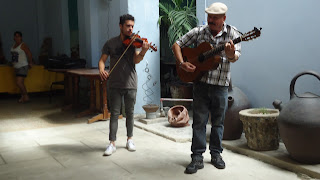
I was even more impressed by his son, who accompanied his father on the violin. His son was smaller and more introverted, in contrast to his extroverted father. The former is a superb violinist and accompanist--He always knew that he was there to supplement his father's performance; he never showed off. The inner-outer combination of the two was a delight to see and to hear.
Being rather "inner" myself, I rarely request to be photographed with performers after a concert. This time I couldn't resist.

After the concert, we traveled to the charming town of Sancti Spiritus, where we stayed for the final two nights of the trip.
After dinner, some of us danced at a local club next to the hotel, along with many Cubans of all ages. The musicians played nothing but salsas--no complaints. We had a lot of fun.
April 2, 2017, Sancti Spiritus
Much of the day was spent visiting the town of Trinidad, a Unesco World Heritage site. The town is well-maintained and lovely. We had time to shop a bit as well.


April 3, 2017 Sancti Spiritus
We had a delightful tour of a local music and dance elementary school. About eight students, from the ages of about 10 to 12, dazzled us with solos on their chosen instrument--piano, guitar, flute, trumpet, violin, etc. They were all good, but the flute soloist, Alejandro, was especially impressive; he played just about at a professional level. We were told that he soon would audition for further studies. If he doesn't pass the audition with flying colorful notes, justice, in my opinion, should demand another revolution.
We also saw a dance performance. The smallest dancer, a small, delicately built prepubertal boy, especially impressed. When he twirled his partner around, a girl who towered over him, he had a full smile on his face, a professional smile. He was already a pro; I hope he will have a significant growth spurt.
Our last stop was a visit to the workshop of Lazaro Nieblas. He makes portraits of local inhabitants out of wood. There is a shortage of material in Cuba; he told me that he sometimes uses the wood from old doors. I was very impressed by his work. He makes very subtle portraits; when you look into the eyes of his subjects, you feel as if you're looking into their souls. He is a very good artist indeed.

After, that, we traveled back to Santa Clara for our flight to Fort Lauderdale. Our subsequent flight from Miami to Baltimore was uneventful.

Lyn told as at the beginning that there is no other country like Cuba in the world, and she was right. I was astounded to see a country without strip malls, billboards, Walmarts, ATMs, McDonalds, etc. This is the only country I know where the poor have come out on top. But the top is no bigger than a molehill; the poor remain poor and the more educated are not much better off--and have become restless. Widespread use of the internet is coming, along with many other changes. The economy is already changing with the advent of the tourist industry. Workers in this field are paid in the tourist currency, pesos convertibles, which significantly increases one's purchasing power. I am not idealizing Cuba, I am aware of the governmental abuses, regimentation, lack of opportunities, etc. Despite everything, however, I think all of us were impressed by the many positive aspects of Cuba, the most important of which is the Cuban people. An unforgettable experience!
And, last not least, all the members of our group were friendly and kind; we "clicked" with several of them. This added to the enjoyment of our educational visit to Cuba. I end this travelogue by thanking, once again, our fantastic tour guide, Lyn, and our excellent local tour guide. José.
Addendum, the Last Poem
This poem really doesn't fit in with the others; I'm including it in an addendum, for the sake of completeness. The first line came to me, as I mentioned earlier, after witnessing a drunk adult at the resort, who was acting like a child. My mind immediately rhymed "rum" with "gun"--the third and fourth lines were originally and logically, "Me Cuban-/Amerikun," but I ditched that, since it could be interpreted as an ethnic slur, which was certainly not intended. It became a poem about the overuse of fuel, a significant factor behind the looming global warming crisis, which continues, degree by degree, to affect us all. Americans have five per cent of the world's population, yet consume 20% of the world's energy. In this poem, the consumption of meat symbolizes this excess use of energy, since it takes four times the amount of it to produce meat rather than vegetables.
We soon transferred to a hotel near the Miami Airport,
where we met members of our travel group, filled out forms, etc. in preparation
for a flight to Havana the next day. We
traveled with Go Ahead Tours; it is now time to introduce you to our tour
guide, the best one we ever had.
Lyn Quigg made sure that we all had a good time. Her social and organizational skills are
outstanding. Not only did she keep us on
schedule—and we had a very busy schedule indeed—she arranged many “surprise” events,
such as a city tour of Havana in pre-revolutionary American cars from the
1950s. Americans, only recently allowed to visit Cuba, cannot simply come as
tourists; they must be enrolled in an educational program. (A bureaucratic detail regarding American
visitors to Cuba demands that we keep a diary of our trip for at least five
years. I doubt if the Cuban government
spotchecks U.S. tourists, in order to assure that this rule is kept, but, in my
case at least, this travelogue would certainly be all the proof the government would
need!) As Lyn told us, visitors from other countries get to see buildings,
bridges, etc.; we saw those things as well, but were able to have many
unforgettable interactions with the Cuban people, which were the best parts of the tour. Without our exceptional tour guide, our trip
would not have been as memorable as it was.
Thank you, Lyn!


March 27, 2017, Havana
After an uneventful flight, we arrived in Havana. We had a busy schedule; we didn’t arrive at our
hotel until about 4 P.M. In Havana, we
met our local tour guide, José Luis Moreno.
He was excellent as well.
He was very knowledgeable and answered all our questions. We didn’t sense any governmental pressure on
him to present official interpretations of life in Cuba.


Our first stop was the exceedingly ugly Revolutionary
Square. It is also one of the largest
squares in the world, measuring over 72,000 square meters. It is dominated by a memorial to José Martí, who helped liberate Cuba from Spanish rule in the 1890s.
The opposite side of the square is flanked by government buildings, one
with a large steel outline of Che's face on its façade, another with a similar portrait
of Cienfuegos, another hero of the revolution.
There is no portrait of Castro. Fidel didn’t want any statues or other monuments commemorating him; he wanted to live on through his words and deeds. (Castro, unlike his brother Raúl, was quite articulate.) Quotes from Castro are, however, to be found here and there in public places. They stand out, along with the famous quote of Che’s, Hasta la Victoria Siempre, (Towards Victory Always), since there are absolutely no advertisements in Cuba. No billboards proclaiming such things as, “Reach for the Stars! Smoke Monte Cristo Cigars!” or “Drink Che Cola, the Official Drink of the Revolution!”


The Plaza de la Revolución is like the dried-out bed of a
huge lake, with the difference that it is covered with concrete instead of
caked mud. Many of Fidel’s speeches and
those of other dignitaries were, and still are, given here.
Those lacking zeal for communism must have been very bored indeed; at
least that’s the way I imagine it. The
square has undoubtedly been filled by those who were required to attend. (The requirement of giving the appearance of enthusiasm, is, of course, not limited to
Cuba. When I was a bureaucrat at the
Baltimore City Health Department, the entire staff was suddenly summoned to
stop what they were doing, and line up along Pratt Street, in order to cheer
Ronald Reagan as he whooshed by in a limousine. I felt like an idiot.)
After that, we took a tour of old Havana. The picture below is of the historic San
Francisco Square, located not far from where cargo ships used to unload their wares. (I imagine slaves were sold there as well.)
The church now functions as a concert hall, one of the best in Havana, we were told.


Regarding non-functional churches, there are plenty. Not many Cubans are practicing Catholics.
A highlight of the day was a visit to a local artist,
Lorenzo Lopez. He presented a huge work
of his, which dominated the main room of his impressive house. The picture I took of it didn’t turn out well,
so I will describe it instead. It consisted of
seven large circles, arranged in a steel frame; the circles formed a
six-pointed star, with one circle in the middle. The medallion at the bottom was a huge yellow
smiley face. Lorenzo informed us, in a
rather manic way, that all we need to do is to smile and troubles would
treacle off our tables like, well, treacle.
He certainly isn’t a great artist, but he obviously enjoyed what he was
doing. A good place for his work and others like it would be the Baltimore
Visionary Arts Museum, which presents quirky and sometimes quite beautiful works of
untrained artists.
I asked the ebullient artist if he ever came down form
his high. Never, he told me, never, never, never. If I had to live in a land where it was always day and the sun was a perpetual smiley face in a cloudless sky, I would very much miss the balance that night provides; I would have to create my own darkness; I would sometimes spend time in the shade.
His Pollyanna view of life got me thinking—What is
the source of my happiness, albeit intermittent and measured, yet happiness nevertheless? That night I began my first poem in Cuba; here is the final version:
I’m not tired, I’m not weary,
Soon I’ll be sleeping a lot.
In the meantime, I am happy—
What’s my secret?
Love and
Music, Wisdom’s key:
If you want to find it, lose it;
Meditate--then rock.
Notes
Some of you might know that the words "tired" and "weary" of the first line are a reference to the opening words of that wonderful gospel song by Thomas A. Dorsey, "Peace in the Valley."
My mentor in poetry, the renowned poet, José Garcia Villa, told
me long ago that poets shouldn't write poems while traveling; they should give full attention to their travels instead. I basically agree; I did not want to write any poems during the trip. Yet when a line comes to me, as if out of nowhere, I have no choice but to try to give it a fitting home.
March 28, 2017, Havana

'
Another full day which began with a walking tour of old Havana conducted by a local architect. Impressive. After that we visited the National Museum of Fine Arts, which contains examples of Cuban art as selected, I imagine, by government officials. Not impressive at all.
We had lunch at the Paladar Atelier. A paladar is a private restaurant, a relatively new phenomenon. The owners of paladars have to pay taxes to the state; otherwise, there isn't much taxation in Cuba. There are, by the way, two currencies in Cuba; one, the peso, for Cuban citizens, and another, the peso convertible, which foreigners must use. 25 pesos equal one peso convertible. Credit cards are of no use in Cuba; everything is paid in cash.
We ate at many paladars; they were spacious, clean, and comfortable places to eat. The food was good, sometimes a little more than good, and always exceedingly bland. I was surprised to discover that so few spices are used in contemporary Cuban cuisine. Cuba could use a few non-Jesuit missionaries, preaching the yummy and secular gospel of spice. (Nirmala, I'm pleased to say, converted me spicefully many years ago.)
Cubans, we were told, don't eat out much. Money is scarce; the salaries are low. The tab at a paladar could easily amount to a month's salary. Nirmala and I, both pescatarians, usually ordered, you guessed it, fish.

After this, we made a surprise visit to a dance studio. All the dancers obviously practice a lot; they also demonstrated their considerable acrobatic skills. The performance was superb. I asked one of the dancers how long he practiced daily--six hours, he replied. When did he start? At age six. You can't perform strenuous dance like this for long--when do you retire from it? Early 30s. The skill, determination, and dedication of these dancers, who don't get paid much, was an inspiration.

In the evening, we attended a "Review of the Buena Vista Social Club." If you expected music with even a hint of the grandeur of the great artists who performed in the Wim Wenders film, you would be sorely disappointed. The venue looks like a Bavarian beer hall filled with thirsty tourists. A Cuban with any musical sense wouldn't be caught dead here. There were however, several half-dead Cubans present; these were the musicians.
March 29, 2017, Havana
The day began with a visit to a tobacco factory, which
was very enjoyable. Although we were not permitted to take photographs inside this factory, we were allowed to take a photo through the window of another cigar factory, where the conditions were similar.
The factory we visited was a large pre-revolutionary building, similar to those that were present in every American city decades ago, some of which, long since abandoned and falling apart, have become, in the words of Trump, "rusted-out factories scattered like tombstones across the landscape of our nation."

Just as astronomers see the past when they look into space, since the light from a galaxy can take millions, or even billions of years to reach us, a look into this cigar factory is like looking into the past as well: these are how American factories used to be in the first half of the past century. No automation! Lots of workers doing repetitive work.
We were permitted to ask the workers questions. They work two four hour shifts beginning at 8:30 a.m., with an hour off for lunch at 12:30. At 8 a.m., they gather to read. (One of Fidel's outstanding achievements was wiping out illiteracy, which was rampant among the poor before the revolution. ) They apparently enjoyed reading the Count of Monte Cristo; there is now an eponymous cigar named in honor of the fictional aristocrat. I bet they have to read political tracts as well, though I'm not sure. Attendance is required; I imagine a lot of workers would prefer to skip the daily reading session. I told one worker that if I worked here I would organize poetry readings--every worker could bring a favorite poem for discussion. "What country are you from?" she asked. "I come from country even redder than yours," I replied. "I am a poet. I come from Mars!"
The workers get paid according to the number of cigars they make. One older worker--she said I could ask her anything except her age--makes 170 a day. Most younger workers make a good deal fewer. The quality of the cigars made here, all destined to be exported, is undoubtedly very high.
That night, the doctor in me came to the fore: how sad it is that two of the three main Cuban industries--there are not many--namely, sugar and cigars, are both injurious to health. (The third industry is tourism.) While trying to fall asleep, I wrote the following little poem in my head:
Fish and Tobacco
What improves health? Poisson
What is tobacco? Poison
Which one are you on? If you're eighty
or ninety, no need to respond.
Notes
This is a little study on the syllable, "on" which occurs in every line in various ways, along with an assonant "one" in line three. The French refers to a lesson everyone who has studied French knows: what a difference one consonant can make! Poisson=fish. Poison= poison. "Which one are you on?" that is, "Are you addicted to healthy or unhealthy things?" If you're very old, there is no need to answer, either because your genes have protected you or you have led a healthy life-style and don't need anyone to tell you, among other things, not to smoke.
After our visit to the cigar factory, we had a salsa lesson at a local dance studio. Nirmala and I don't usually do the salsa; when one is being played, we take a break. These lessons were very good. The two instructors, one male and one female, taught us six different moves, each lasting two measures. From now on, we won't be caught sitting down when a salsa is played
After lunch, we visited Finca Vigia, ("Lookout Farm"), Ernest Hemingway's estate near Havana. As one might expect, there were a lot of books on shelves and a lot of animal trophies on the walls. He bought the impressive estate with his prize money for $12,500 in 1940. It seems that Susan Hayward liked to swim naked in the pool. Hemingway's wife got jealous one day and took all of Hayward's clothes into the house, forcing the actress to return there without a stitch. Celos, tu nombre es mujer.

At dinner, we were entertained by a trio of fine musicians. Nirmala and I got up and danced. The singer later told us that in the ten years she has been performing here, we were the first ones to dance. She was quite pleased.

We ended our stay in Havana with one of the many surprises Lyn had for us: a tour of the city via well-maintained classic cars from the 1950s, abandoned by wealthy Cubans who were displaced by the revolution. (Since 2014, Cubans can buy used and even new cars, but it's very expensive to do so. The traffic is still like the traffic on Charles Street, a local street near our house--at 4 a.m. Very few cars in Cuba--not a bad thing.

March 30, 2017, en route to Cayo Santa Maria
This was a long travel day. On the bus, I wrote the shortest poem of the journey, three lines, a poem entitled "Sound Advice":
Sound our nature, humans, be
otiose as grass--Poetry;
one could do worse and you do.
Notes:
"Sound" refers to making music, and to delving into the depth's of human nature. When one makes this journey, life becomes more objective, thus "my" changes to "our." (By the way, this is the first and probably the last time I will ever use the word "otiose" in a poem; it is rarely used and means "of no practical purpose." But on the spiritual level grass isn't worthless at all--every blade is priceless. If you don't believe me, read Walt Whitman). Poetry here has two meanings as well: the first being generosity and loving-kindness and the second having to do with actual poems. We all fall short of the goals of love and wisdom, as the last line indicates.

We made our first stop at Cienfuegos, a quaint town. There Lyn gave us another treat: an a capella group, Fusion, performed for us. They covered a lot of centuries and cultures, beginning with a medieval Spanish piece, "O Magnum Mysterium," and ending with "Honeypot," which evoked Roaring Twenties America. They sang a few Cuban songs and a gospel standard as well. They were very good indeed.
Just as astronomers see the past when they look into space, since the light from a galaxy can take millions, or even billions of years to reach us, a look into this cigar factory is like looking into the past as well: these are how American factories used to be in the first half of the past century. No automation! Lots of workers doing repetitive work.
We were permitted to ask the workers questions. They work two four hour shifts beginning at 8:30 a.m., with an hour off for lunch at 12:30. At 8 a.m., they gather to read. (One of Fidel's outstanding achievements was wiping out illiteracy, which was rampant among the poor before the revolution. ) They apparently enjoyed reading the Count of Monte Cristo; there is now an eponymous cigar named in honor of the fictional aristocrat. I bet they have to read political tracts as well, though I'm not sure. Attendance is required; I imagine a lot of workers would prefer to skip the daily reading session. I told one worker that if I worked here I would organize poetry readings--every worker could bring a favorite poem for discussion. "What country are you from?" she asked. "I come from country even redder than yours," I replied. "I am a poet. I come from Mars!"
The workers get paid according to the number of cigars they make. One older worker--she said I could ask her anything except her age--makes 170 a day. Most younger workers make a good deal fewer. The quality of the cigars made here, all destined to be exported, is undoubtedly very high.
That night, the doctor in me came to the fore: how sad it is that two of the three main Cuban industries--there are not many--namely, sugar and cigars, are both injurious to health. (The third industry is tourism.) While trying to fall asleep, I wrote the following little poem in my head:
Fish and Tobacco
What improves health? Poisson
What is tobacco? Poison
Which one are you on? If you're eighty
or ninety, no need to respond.
Notes
This is a little study on the syllable, "on" which occurs in every line in various ways, along with an assonant "one" in line three. The French refers to a lesson everyone who has studied French knows: what a difference one consonant can make! Poisson=fish. Poison= poison. "Which one are you on?" that is, "Are you addicted to healthy or unhealthy things?" If you're very old, there is no need to answer, either because your genes have protected you or you have led a healthy life-style and don't need anyone to tell you, among other things, not to smoke.
After our visit to the cigar factory, we had a salsa lesson at a local dance studio. Nirmala and I don't usually do the salsa; when one is being played, we take a break. These lessons were very good. The two instructors, one male and one female, taught us six different moves, each lasting two measures. From now on, we won't be caught sitting down when a salsa is played
After lunch, we visited Finca Vigia, ("Lookout Farm"), Ernest Hemingway's estate near Havana. As one might expect, there were a lot of books on shelves and a lot of animal trophies on the walls. He bought the impressive estate with his prize money for $12,500 in 1940. It seems that Susan Hayward liked to swim naked in the pool. Hemingway's wife got jealous one day and took all of Hayward's clothes into the house, forcing the actress to return there without a stitch. Celos, tu nombre es mujer.

At dinner, we were entertained by a trio of fine musicians. Nirmala and I got up and danced. The singer later told us that in the ten years she has been performing here, we were the first ones to dance. She was quite pleased.

We ended our stay in Havana with one of the many surprises Lyn had for us: a tour of the city via well-maintained classic cars from the 1950s, abandoned by wealthy Cubans who were displaced by the revolution. (Since 2014, Cubans can buy used and even new cars, but it's very expensive to do so. The traffic is still like the traffic on Charles Street, a local street near our house--at 4 a.m. Very few cars in Cuba--not a bad thing.

March 30, 2017, en route to Cayo Santa Maria
This was a long travel day. On the bus, I wrote the shortest poem of the journey, three lines, a poem entitled "Sound Advice":
Sound our nature, humans, be
otiose as grass--Poetry;
one could do worse and you do.
Notes:
"Sound" refers to making music, and to delving into the depth's of human nature. When one makes this journey, life becomes more objective, thus "my" changes to "our." (By the way, this is the first and probably the last time I will ever use the word "otiose" in a poem; it is rarely used and means "of no practical purpose." But on the spiritual level grass isn't worthless at all--every blade is priceless. If you don't believe me, read Walt Whitman). Poetry here has two meanings as well: the first being generosity and loving-kindness and the second having to do with actual poems. We all fall short of the goals of love and wisdom, as the last line indicates.

My favorite singer of the group, a bass, is hidden by the third alto on the left. All sang well, however.
We visited the Bay of Pigs, the site of the invasion by about 1,500 Cuban exiles in 1961. They expected that the locals would join them, but they didn't. They also picked a strategically poor site to land; the invasion was over almost as quickly as it started. Plans for the attack started under Eisenhower; Kennedy, however, decided not to intervene. (The Bay of Pigs beach is currently occupied by Canadian and European tourists.)

If Imperialism had really wanted to dig trenches, they could have dug many indeed. The defeat of the unsupported, ill-planned incursion became a major source of propaganda for Fidel.
March 30th is Nirmala's birthday. I asked Lyn whether I could give a toast to Nirmala at dinner, but, Lyn, as usual, who had found out it was my wife's birthday from her passport, had everything covered:

The cake tasted a good deal better than it looks--a pleasant surprise!
We finally reached the Cayo Santa Maria resort. It is a lovely resort, pools, spacious rooms and a beautiful private beach. No Cubans here; everything is booked with pesos convertibles, the currency foreigners must use. Cuba needs hard money, and this is one of the places they get it. Drinks and meals were included; several tourists--not from our group, of course--had a good deal more than one mojito too many. One zigzagging drunk became the source, perhaps, of "Me like rum," the first line of my last poem written in Cuba.

The service at the resort was not good. Many Cubans who work in the service industry have a lot to learn.
March 31, 2017
This day included a visit to an old sugar mill, no longer in use. We also visited the town of Remedios which has an annual competition every December 24th, called Parrandas. Not much to see when the competition isn't taking place; a video would have helped.

The rest of the day we had free time at the resort. I spent some time reading at the pool. I especially enjoyed an article from a recent edition of The New York Review of Books, a copy of which I had brought along: the subject of the review is a book by Ben Lerner, "The Hatred of Poetry"; the article was written by Charles Simic, one of the finest contemporary American poets. It seems that poetry, in contrast to prose, aims higher; it seeks to reach a transcendent realm and thus necessarily fails. (Hasn't Mr. Lerner ever heard of dukka, the Buddhist term for the insufficiency of all experience?) Simic informs us that a professor contends that nobody reads poetry today because much of it lacks political content. Then, Wallace Stevens, is quoted, who believed that poetry should not be political at all. All of this, combined with my impressions of Cuba, resulted in the following poem:
When they sound right, the best poems'
images lead us to Zion.
Suits pass by, rags beg from tents;
is prose the rose of sentience?
Verse? What good is a buried pearl?
Must our music always fail?
No. If we wrought in-side and out,
what we write would sell. Yeah, right.
Around this time, I wrote another poem, this time dealing with a very different subject: the contrast between Cuba and the United States:
Cuba, No--Yanqui Tampoco
We make, that is made, Castro
Convertibles. They transform dollars into pesos
convertibles. The contrast between us
is incontrovertible: things and more things
in my country assail; in their country,
conscience is jailed--Can good neighbors thrive without
freedom that's fair? God's here nor there;
injustice is justice unshared.
Does anyone remember the Castro Convertible commercial from the 1950s? It depicted a little girl opening the couch into a bed. It is so easy, dear consumer, even you can do it!
April 1, 2017
After we left the resort, our first stop was the town of Santa Clara. This is an important site of revolutionary history; it was the first city that fell under the impressive leadership of Che Guevara. (He famously derailed a train carrying "fascist"--is that the right word?--soldiers, who surrendered without resistance.)

Che left Cuba to start revolutions elsewhere, He was murdered, with CIA collusion, in Bolivia. His grave remained there for twenty years; his remains were then exhumed and sent to Cuba. The granite mausoleum in Santa Clara has an eternal flame before Che's tomb. The vault contains the ashes of several famous--to them, at least--Party members. Faux religiosity reigned. You weren't allowed to talk, take pictures, etc. Two female guards were present to assure that regulations were not abrogated. One of the members of our group said something, almost in a whisper; for this one of the guards yelled at our tour guide. He obeyed them, told the offending tourist to keep quiet, and left. Later, he expressed his frustration with the nasty guard, who was annoyed by a whisper, yet tolerated the sounds of salsa outside. "That's Cuba!" he grumbled.
If this had occurred in the United States, I imagine the following dialogue might have taken place:
Guard: Please stop talking! No talking allowed here.
Visitor: This is a free country and you have no right to speak to me in that tone. Besides, I'm only talking in a whisper--which I will continue to do. I know my rights. Where's the sign, by the way, that requires us to be silent?
Guard: If you don't stop talking, you will have to leave this room immediately.
Visitor: It is time to move on to the next room anyway. (Spoken sarcastically) Have a nice day!
If our tour guide had said half as much as the imaginary visitor above, I think he would be in serious trouble. The cult of revolutionary figures is important for the regime, since without it, people might complain more about the hardships they have had to endure. I don't have a good idea of how the average Cuban views the current regime. Our guide says the campesinos adore Fidel--he really did a lot for them--but not every Cuban is a campesino.
Immediately after our visit to the Che shrine, we attended a concert, just for us, of Trovar music; a very talented and apparently well-known musician, Juan Carlos Campos, sang traditional Cuban standards, such as the famous bolero, "Quizás, Quizás, Quizás," by Osvaldo Ferrés. He accompanied himself splendidly on the guitar.

I was even more impressed by his son, who accompanied his father on the violin. His son was smaller and more introverted, in contrast to his extroverted father. The former is a superb violinist and accompanist--He always knew that he was there to supplement his father's performance; he never showed off. The inner-outer combination of the two was a delight to see and to hear.
Being rather "inner" myself, I rarely request to be photographed with performers after a concert. This time I couldn't resist.

After the concert, we traveled to the charming town of Sancti Spiritus, where we stayed for the final two nights of the trip.
After dinner, some of us danced at a local club next to the hotel, along with many Cubans of all ages. The musicians played nothing but salsas--no complaints. We had a lot of fun.
April 2, 2017, Sancti Spiritus
Much of the day was spent visiting the town of Trinidad, a Unesco World Heritage site. The town is well-maintained and lovely. We had time to shop a bit as well.


April 3, 2017 Sancti Spiritus
We had a delightful tour of a local music and dance elementary school. About eight students, from the ages of about 10 to 12, dazzled us with solos on their chosen instrument--piano, guitar, flute, trumpet, violin, etc. They were all good, but the flute soloist, Alejandro, was especially impressive; he played just about at a professional level. We were told that he soon would audition for further studies. If he doesn't pass the audition with flying colorful notes, justice, in my opinion, should demand another revolution.
We also saw a dance performance. The smallest dancer, a small, delicately built prepubertal boy, especially impressed. When he twirled his partner around, a girl who towered over him, he had a full smile on his face, a professional smile. He was already a pro; I hope he will have a significant growth spurt.
Our last stop was a visit to the workshop of Lazaro Nieblas. He makes portraits of local inhabitants out of wood. There is a shortage of material in Cuba; he told me that he sometimes uses the wood from old doors. I was very impressed by his work. He makes very subtle portraits; when you look into the eyes of his subjects, you feel as if you're looking into their souls. He is a very good artist indeed.

After, that, we traveled back to Santa Clara for our flight to Fort Lauderdale. Our subsequent flight from Miami to Baltimore was uneventful.

Lyn told as at the beginning that there is no other country like Cuba in the world, and she was right. I was astounded to see a country without strip malls, billboards, Walmarts, ATMs, McDonalds, etc. This is the only country I know where the poor have come out on top. But the top is no bigger than a molehill; the poor remain poor and the more educated are not much better off--and have become restless. Widespread use of the internet is coming, along with many other changes. The economy is already changing with the advent of the tourist industry. Workers in this field are paid in the tourist currency, pesos convertibles, which significantly increases one's purchasing power. I am not idealizing Cuba, I am aware of the governmental abuses, regimentation, lack of opportunities, etc. Despite everything, however, I think all of us were impressed by the many positive aspects of Cuba, the most important of which is the Cuban people. An unforgettable experience!
And, last not least, all the members of our group were friendly and kind; we "clicked" with several of them. This added to the enjoyment of our educational visit to Cuba. I end this travelogue by thanking, once again, our fantastic tour guide, Lyn, and our excellent local tour guide. José.
Addendum, the Last Poem
This poem really doesn't fit in with the others; I'm including it in an addendum, for the sake of completeness. The first line came to me, as I mentioned earlier, after witnessing a drunk adult at the resort, who was acting like a child. My mind immediately rhymed "rum" with "gun"--the third and fourth lines were originally and logically, "Me Cuban-/Amerikun," but I ditched that, since it could be interpreted as an ethnic slur, which was certainly not intended. It became a poem about the overuse of fuel, a significant factor behind the looming global warming crisis, which continues, degree by degree, to affect us all. Americans have five per cent of the world's population, yet consume 20% of the world's energy. In this poem, the consumption of meat symbolizes this excess use of energy, since it takes four times the amount of it to produce meat rather than vegetables.
A CEO’s Inner Child
Me like rum
Me like gun
Me Me Me
Amerikun
Fuel me waste
Because Me First
Chicken, pork,
Lobster, Steak,
Me want some
Me no
Veg
it
tar
iun
Not pan sit,
Beef tongues, pigs’ feet,
Me eat meat
Well done, well done,
Terre brûlée
Me eat someday
Sun-baked Earth,
Me just dessert,
Mother Nature screwed.


