Showing posts with label Nataraja. Show all posts

10.27.2019

A Desultory Diary, Episode 6, The Speech I Never Delivered


1.
Many years ago, when I was a twenty-something, my mentor in poetry, José Garcia Villa, gave me a copy of one of his verse collections. The dedication was amusing: "A Poetry Collection Without an Introduction--Thank Heaven!"

Tonight a bunch of friends, Nirmala and me will gather to celebrate those of us who have had an October birthday. On October 9, I began my seventy-fifth year. I imagined myself giving a speech, but decided against it. Instead, I decided to write an essay for you, dear readers; at least you have the opportunity to click me--temporarily, I hope--into oblivion.

Well, I thought, maybe I will say--that is, write--a few words about growing old, which, I admit, is not all that good, but not all that bad either. Perhaps I have a few words of wisdom to impart? You be the judges. My target audience is not only the chorus of the elderly, but also to younger soloists who have not yet found their voice.

Nearly a century ago, the great Irish poet, William Butler Yeats, wrote the following sublime lines about old age:

An aged man is but a paltry thing,
A tattered coat upon a stick, unless
Soul clap its hands and sing, and louder sing
for every tatter in its mortal dress.

                                                         (from Sailing to Byzantium)

Immortal, profoundly wise lines.  Yeats very accurately depicts the muscle wasting--what we physicians call sarcopenia--that begins around forty and increases rapidly after the age of sixty-five. A tattered coat upon a stick--it's as if there is no there there anymore. One becomes a scarecrow, a puppet lying on a shelf, easily ignored. A paltry thing because society treats an aged man as wrinkled packaging that once contained something  worth looking into.

How should an old person react to being ignored, while enduring the difficulties and pangs associated with general diminution? Some of us become cranky, crotchety, sometimes very angry. Here is an excerpt of another great poem, this time by Dylan Thomas:

Do not go gentle into that good night;
Rage, rage against the dying of the light

Certainly an option, but not, I think, a particular sage one. Buddha, for instance, the quintessential sage, thought anger to be a very negative emotion; associated with a keen (and, eventually, keening) sense of self, it is to be avoided, always. (There is no righteous anger in Buddhism). Raging in old age is unseemly. (If Lear had been a wise old man at the beginning of the play, he wouldn't have raged at the end).

One of the cardinal virtues of old age is acceptance. This includes acceptance of the self, acceptance of the world as it is, etc. (This doesn't mean that one should not work to make the world better--but to do this without rage, is better yet).

Acceptance is only one of the cardinal virtues of age, however. For the most important one, we return to Yeats: "Soul must clap its hands and sing and louder sing/For every tatter in its mortal dress." Wisdom has its violins that can sing over sorrow until the very end. What does this mean?

2.
I have completed seventy-four years, albeit with some chronic diseases rather easily managed, so far; nothing very serious yet. In other words, I've been lucky. Exercising regularly, eating properly, keeping the mind active, etc. undoubtedly have something to do with it; nevertheless, luck has had something to do with it as well. 

One of the difficulties I've had is poor eyesight. I decided it was finally time to start reading large-print books. I went to the local library and was directed to the large-print section, which, indeed, was not very extensive. I took the first one off the shelf, a book about the old old: "Happiness is a Choice You Make, lessons from a year among he oldest old," by John Leland.

The book is not the pollyannic pap one might expect from the title. The oldest old in the book have serious problems, losses in a full array of forms, but they all had decided to make the best of it. An adage from Marcus Aurelius comes to mind: One is chained to the chariot of fate. The choice is whether to stand up and run with the horses or lie down and be dragged

Making the best of it means that the elderly souls described in the book had decided to clap and sing, with varying degrees of success, keeping rhythm, despite vicissitudes, to the melodies of life, including one of the darkest ones: "Where are you now, my sweet friend/Everyone I know goes away in the end." Not one of the oldest old chooses any longer to "criticize the turtle for not being something else"--they accept themselves, and others, shells and all. Some clap louder and better than others; all souls of the group, however, sing.

Leland recounts that gerontologists have come up with a new classification: the oldest old, those eight-five and older. I ran with this concept and extrapolated it to include those over sixty-five but less than eighty-five: Sixty-five to seventy became for me old-age childhood; those seventy to seventy-five became old-age youths; the period from seventy-five to eighty-five became old middle age.

A geezer like me, therefore, hasn't even reached old middle-age yet!Therefore, as my soul keeps singing to me: I'm still a kid. A new and beautiful way to look at old age. One is as old as one claps.

This is not a universal view. Younger people, who are the majority, sometimes look down on minorities, especially those who use a cane. A good example is the case of a psychologist--who later sadly and unwisely committed suicide--who devised a system to determine how many "good years" one has left, by subtracting one's current age from sixty-five. Life, for him, ended at sixty-five. By doing this calculation, I, over sixty-five at the time I wrote the poem that will follow, had become "a negative toddler." The rage of a "negative toddler" is the subject of a poem I wrote a few years ago. Life ends at sixty-five--indeed!


What Did That Self-Help Guru Say?


“Simply subtract your age from 65

and that’s how many good years you have left.”

That makes mine fewer than minus three!


Once vim is reduced to a negative toddler,

is it O.K. to sit and forget half your French?

It is not.  Instead, before I’m minus four,


I shall sing and descant upon love

in a language I as yet don’t understand.

Perhaps I’ll send him a postcard from Kandahar;


perhaps I’ll send him an elephant tusk

made out of marzipan

by a lovely, crazy German living in Irkutsk;


he apparently thinks old age is the time

to stare like a cow while a fly

navigates a bulbous nose.  Should I rage?


No, rages are unseemly after minus three;

having outgrown my terrible minus twos

I’m ready for a raucous minus youth,


and if I find a tarantula in La Descubierta,

I promise I won’t send him a fanged memento mori

in a silver candy box, crawling on blue cheese.


3.

Well, here's the section during which I give advice and reveal what is most important in life, at least in my opinion.

Research has shown that what is most important are relationships. (You are invited to listen to the appropriate TED talk on YouTube). Many younger people think that fame and money are the essentials. Money is certainly important, but if it is pursued as the primary purpose of life, one inevitably fails.

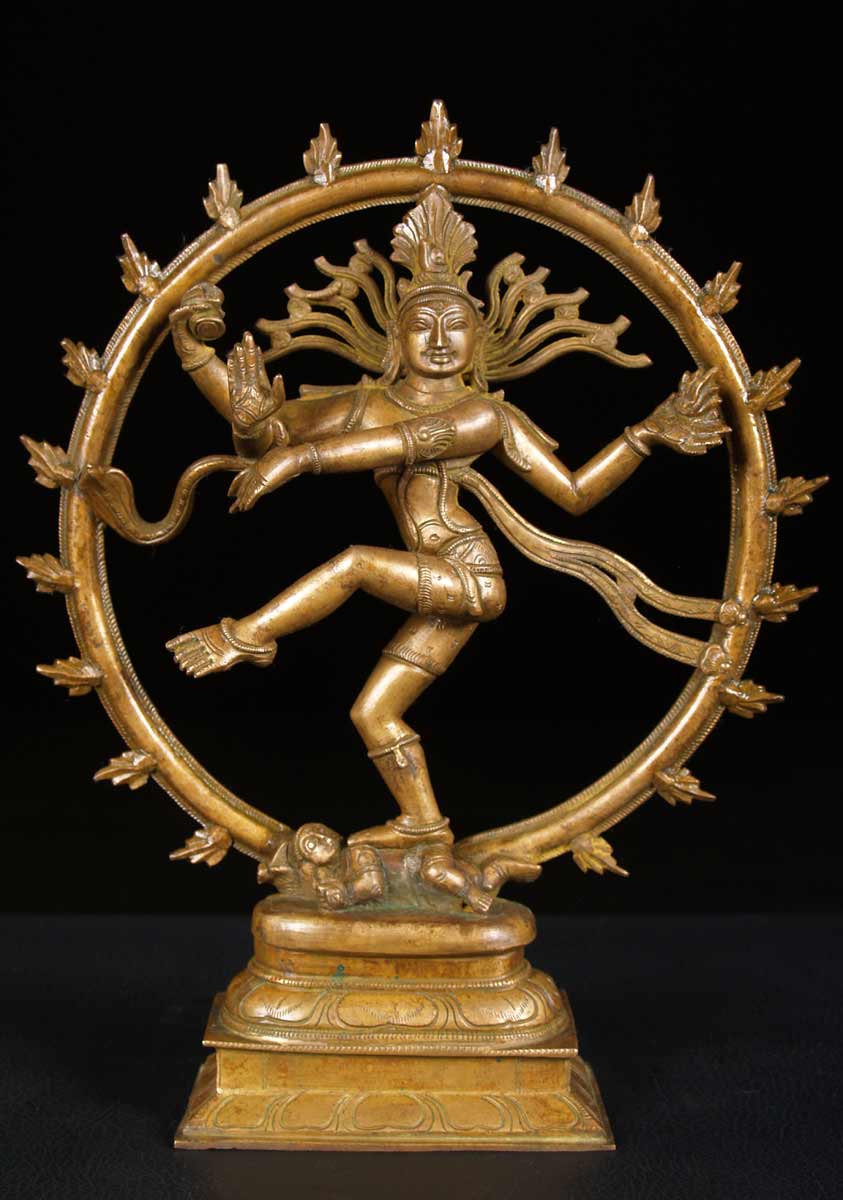
In the iconic statue of Nataraja, a famous mudra, a symbolic hand gesture, is depicted: the abayam mudra, do not fear:


That's what the older among us have to offer the younger: struggle for your place in the world, but realize that there is another more important place, the place where wisdom and love reign, and not Mr. Get-a-little-more and you'll be-a-little more. This might take time, but one need to start making place for these noble guests, beginning in youth.

I think this "no fear" or, at least "reduced fear" mantra constitutes one of the chief evolutionary purpose of old age. Many species, especially insects and fish, die after mating. Human beings are different. They need elders to show younger humans how to live. This is indeed consistent with survival of the species.

There is nothing sadder than a young person without a strong ego; there is nothing sadder than an old man who has been unable to transcend it. (A tragic example, not only for him, but for us and the rest of the world, is our needy, catastrophic current president).

What is wise behavior? Acting from the realization that everything, including everyone, is connected. This way of life is a great way to overcome egotistical, petty thoughts. An even better one is putting 'love your neighbor as yourself' into action.
These two ways are actually a single path.

We are creatures of Earth and must obey her laws. How do we do that? The following metaphor contains, I think, the secret of life:

Each one of us is a satellite revolving, whether we like it or not, around a brilliant sun. We must revolve, but it is our decision whether or not to rotate, to revolve around our own axis. If you choose not to; if you choose to spend your life always facing the void like the dark side of the moon, that is your choice. If you choose to keep moving, however, you will certainly become well acquainted with the night, but will also know that day follows night: you will also spend a good portion of your life basking in the sun while choosing life. Choose life.

9.03.2015

The Cosmic Dance


1. Introduction

Today I received the very sad news that my wife's sister, Shyamala, passed away unexpectedly. She was on a fishing trip with her husband, an annual event that gave Shyamala a chance to be close to nature for an extended period--how my sister-in-law loved to be outdoors!  They were somewhere in the wilds of British Columbia when she suffered a massive heart attack.  She went peacefully and painlessly with her husband at her side in sublime surroundings--that is indeed a consolation.

As soon as I heard the news, I started to prepare for an evening meditation in her memory.  On our little altar is a statue of Shiva Nataraja, The Lord of the Dance, which we bought so long ago in Chennai, India.  This iconic representation of the cosmos originated in South India over one thousand years ago, and has not lost its significance to this day. Staring at the cosmic dance during the meditation, I knew I had to write a little essay about it in Shyamala's memory.

2. The Cosmic Dance


Everything is in motion, nothing--not even "nothing" stays still. (So-called empty space is seething with activity at the Planck level, less than a billionth of a billionth of a billionth of a centimeter.) We imagine permanence in things because their rate of change is so much slower than ours that they seem permanent.  It takes a plastic bag among the tons of garbage unconscionably thrown into the ocean centuries to disappear; it takes us only about eighty years. Protons take so long to degrade that we're not quite sure whether they degrade at all; the acoustic acuity of humans begins to degrade at the age of thirty.  It will take a very long time for all of the estimated 300 billion stars in the Milky Way to die; the 100 billion neurons of a human brain just might disappear tomorrow. Like it or not, death is always in the picture, advancing, somewhere between background and foreground, until the whole canvas is blank.

The cosmic dance, however, is not lugubrious; the face of the dancing Shiva is always serene.  Why?  That is the subject of this essay.

The Hindus always knew that change is absolutely integral to the cosmos.  (There are few absolutes.)  It took centuries for the West to catch up.  The ancient Greeks believed that change was restricted to the Earth.  Everything in the heavens was thought to be unchangeable.  Scientists as late as Einstein believed the cosmos to be static; though individual cosmic bodies change, he thought that the universe over very long distances remained the same.  Now we know that the universe is expanding and is not eternal at  all, only practically permanent in comparison to us.

(Einstein, however, was sometimes wrong in a way that proved to be right, albeit in a different context.  He proposed that there was an anti-gravity force, represented by lambda, that balanced gravity.  Without this force, he reasoned, the attractive force of gravity would eventually cause the cosmos to end in a big fiery crunch.  Einstein's  equations indicate that the universe was either contracting or expanding, but not static.  Neither possibility is consistent with the static/eternal universe he imagined; hence his lambda hypothesis.  As we all know now, the universe has been expanding for several billion years, at an ever increasing rate.  Einstein later thought that his lambda hypothesis had been the greatest blunder of his career--turns out, without a doubt, that there is a lambda after all.)

We are all--along with everything else--part of Shiva's dance.  Yet we have the illusion of being separate from the cosmos, unique observers of what surrounds us.  This illusion of separation, whether an accident or an inevitable evolutionary development, conferred great adaptive  advantages.  We could "separate" ourselves from something in order to analyze it; we became tool makers, composers of great music, speakers and haters and makers, evil and good, almost gods. Evolutionary adaptions, however, are not cosmic truths. Self-awareness brought with it, however, a major inconvenience, the knowledge of death.

There is also a major consolation.  When we transcend discursive thought, when we transcend the ego through absorption in work we love, through selfless devotion to the people we love and to noble causes we love, we no longer sit like a wallflower in a dance hall while the great music plays on. Illusion disappears--for as long as our selfless absorption lasts. It usually doesn't last very long; our little identities intervene.  Let me say again: the ego is a good thing, necessary for life in the world.  The interplay between Shiva's dance and an imaginary diva, the individual soul, is the source of both the glory and tragedy of humankind.

Whenever we overcome the ego, we stand beside it, as it were.  This getting-beyond-the-self is the very definition of ecstasy.  I will close this section of the essay with a poem I wrote long ago.

Stone and River

Metaphors that help us live here
are chiefly two: stone and river.
Aware of change, afraid to be alone,
most opt for the permanence of stone:

"A boulder at the center reigns;
however fast the current, it remains;
countless, unique pebbles at each side
retain their shape, even if dislodged."

I, I, this is the language of rock;
yet everything is swirl and flux;
despite appearance, all is sea;
no me.  Fluid, all reality.

Nothing to transcend our going?
Everything is water flowing?
Nothing but fate, nothing but chance?
And ecstasy: dance.


3. The Four Mudras (Hand Gestures)

a. The Damuru Mudra


Hindu gods, when represented anthropomorphically, are often depicted as having four arms; the additional limbs represent superhuman power.  They also indicate that the anthropomorphism is merely symbolic; Shiva is not the ideal human, unlike Zeus, who was often depicted as such.

Each of Shiva's four hands displays a different hand gesture, which is crucial to any interpretation of Nataraja,  the Lord of the Dance. 

The first mudra is shown by Shiva's upper right hand.  This is the damuru mudra.  His hand is holding an hourglass drum, the damuru.  It is the symbol of creation; the hourglass represents the origin of time, which has been flowing ever since.  The prescient Hindus thus indicate that even time isn't eternal and arose at the beginning of the universe.  This is the scientific view also, which only became established in the last century.

The damuru is the best symbol I know that illustrates the essential difference between Eastern and Western religions.  In the West, creation and revelations arrive visually, not acoustically, as in the East.  God created visibility simply by saying Fiat Lux, let there be light.  Adam and Eve saw God  in the Garden of Eden.  He intervened in Exodus; the division of the Red Sea was apparent to all. He revealed himself in the Ten Commandments and in the Torah, words which were visible for all to see. In a later mythology, the actual  and only Son of God could be seen walking the Earth--and was visible, at least for forty days, from the third day after his execution.  Allah, more remote, since Islam was a later revelation and God became more and more transcendent with the passage of time, nevertheless gave, via Gabriel and Muhammad, a book every word of which is said to be of divine origin.

In the East, as illustrated by the drum in Shiva's hand, creation is represented by a sound rather than by light.  In the West, you keep your eyes wide open and witness God's revelations.  In the East, you close your eyes, turn inward, and hear the sound of creation, the sacred syllable Om, inside your own consciousness. An external god has nothing to do with it!  Gods are useful to depict and to reify insights gained by turning inward.  They are symbols--at least in the higher forms of Hinduism.  The summit of Hinduism is non-duality, which leaves no purchase for polytheism or even theism.

The differences between the two worldviews are clear.  One is an inward stance, the other an outer.  One stresses wisdom, the other stresses action.  Both views, I think, are essential.  It is a great advantage of our multicultural age that we are able to combine both and make whatever religion or non-religion we practice better by incorporating both elements.   I do think, however, that the tonal view of creation is superior and more accurate than the visual one.  Admittedly, as an avid amateur musician, I am closer to the sonal interpretation.  But the essential difference is very real: in the East revelation occurs within consciousness, in the West revelation comes from beyond consciousness.  For doubting Thomases like me, who are very skeptical regarding external revelations from a divine entity, there is no doubt: the Hindus are right.

b. The Agni Mudra


In Shiva's left upper hand, in perfect balance with the creation mudra on the right, is a flame.  Agni, fire, is the symbol of destruction.  Since this is a cosmic dance, it indicates that everything we know, matter, galaxies, people, files, come into existence and eventually disintegrate.  I hold that this symbol not only refers to a fiery death, but to cold deaths as well.  (Our universe will probably keep on expanding, eventually there will be no matter at all--a cold death.  But some scientists believe that our universe is on a "brane" which, after eons, collides with its sister brane--a fiery death.  The important thing to realize  is that  death is inevitable for both organic and inorganic entities.  Balance between the two is an essential concept of Nataraja, the Lord of the Dance.  Our universe will die, but there are likely others; many scientists assert that universes are born and die all the "time."

c. The Gajahasta Mudra, the Elephant Trunk Pose

Shiva's lower left arm points gracefully to his uplifted left leg which represents "upliftedness" or transcendence.  I've thought for some time that the pointing down mudra also represents humility.  It is essential to control the ego to approach the ecstasy of Nataraja. To make spiritual progress, an "individual" must be modest and unassuming.    Egotists believe that they are, as it were, at the center of the universe--Nothing could be farther from the truth!


d. The Abhaya Mudra,  The Do-Not-Fear Gesture


The raised palm of Shiva's lower right hand assures that one should not be afraid.  Everything in the universe is part of this dance; you are and always will be included. In scientific language, no information is ever lost.  Things continually take on different forms, dissolve, and take on different forms again.  The Darwinian illusion that we are separate has no place in Shiva's dance; humans are treated like everything else.  The individual suffers; expect and seek out help from fellow human beings and from yourself, not from Shiva. Shiva's consolation is that one's true self never dies. This is, however,  a hard truth; the dance is what it is and not what we might want it to be--The only times we understand the do-not-fear mudra is when we transcend, at least temporarily, the slings and arrows of the inevitable downside of individuality. Some form of cosmic consciousness might indeed transcend death: here, again, I must confess to be more or less a doubting Thomas.  I also confess that at other times I doubt my doubting.

4. Apasmara, "Heedlessness"


Shiva's left foot is grounded--it is supported by earth, while the other leg is raised.  I call this Shiva's objective leg.  This contact with the earth doesn't allow superstition.  It is his science leg.  He is standing on apasmara, who represents ignorance.  Shiva dispels ignorance by insight that does not flout reason.  As mentioned, previously, Hindu is a wisdom tradition; the "enemy" is ignorance, not evil.  The two, of course, are connected.  Only a person who is ignorant is able to commit evil deeds.  The raised right leg represents "upliftedness" or transcendence.  Notice that this leg can only represent transcendence while the other leg is grounded. This is a concrete way of demonstrating that transcendence is only possible when reason and nature are given their due.

5. Prabhamandala, The Ring of Fire

The statue of Nataraja is always depicted within a ring of fire.  Traditionally, this indicates the fire of destruction--Brahma is known as the God of creation, while Shiva is given the role of destroyer.  (Destroying illusion is a prominent part of the Shiva myth.)  I interpret the ring of fire somewhat differently.  I view it as an almost impenetrable barrier which separates the outer world of illusion from inner Truth. There have been a few (Jesus of Nazareth, Ramana Maharshi, Buddha) who passed through this barrier during their lifetime; there have been undoubtedly a few more who remain anonymous.  The complete and permanent awareness that one is not merely a part of, but that one actually is Shiva's dance is, however, exceedingly rare.  As mentioned earlier, we approach Shiva's dance in our best moments, that is, when we forget ourselves while completely absorbed in what we are doing.  This is however different from an irrevocable awareness that the I of individuality is nothing while the transcendent I of consciousness is everything.  In Hindu tradition, those who have passed this barrier are buried rather than cremated.  (The fire of cremation is viewed as a rite of purification.) No need to pass through fire twice.

Conclusion

Is Shiva's dance an accurate representation of reality?  (Reality refers here to an objective world beyond human consciousness.) Probably not.  As Kant proclaimed during the Enlightenment, we can never know "the thing in itself" since what we know is always an interpretation by our senses.  The Hindus knew this and went a step further, a "fact" which I will now explain. The famous Thillai Nataraja Temple, located in Chidambaran in Tamil Nadu, India, is the traditional site of Shiva's dance.  It is thus considered to be, metaphorically, the center of the universe.  It is also understood that this universe occurs within the human heart, that is, within consciousness.  There is no music, no dance, beyond the mind. But in Hindu tradition inside and outside are one--a traditional name for God in Tamil is Kadavul, meaning The Outside/Inside One. In this sense, Shiva's dance is an accurate representation of reality, since in a very "real" sense, consciousness is the creator of all things.  For those of us who imagine that we live outside the ring of fire, (that is, just about everybody), the Nataraja icon is arguably the best metaphor for wisdom that we have.