Showing posts with label Michael Ende. Show all posts

8.10.2017

Self, Love, and Wisdom: Three Interconnected Spheres

My wife recently had a serious bike accident.  She has since recovered, but she easily could have died. Such an event knocks the nonsense out of you.  I have been postponing writing this essay; I feared I was not up to the task.  That may be, but now more than ever do I understand Hillel’s famous words; If not now, when?

Three Interconnected Spheres: Self, Love, and Wisdom

1. The Self           


If I am not for myself, who is for me? –Hillel

In my long career as a pediatrician, I have seen many examples of troubled children who grew up to be troubled adults.  Houses without a firm foundation are at the mercy of unstable earth below them; if they don’t stand on solid ground, existence for their inhabitants is precarious. For human beings, a firm foundation refers to support and love during the crucial years of development.  A strong sense of self is not self-caused.

In many instances, children whom I have treated came from broken homes with little social support.  I can recall many examples of insufficient parental involvement, e.g. single mothers who slept late and expected their children to go to elementary school by themselves.  What should have been homes, were merely houses; meals entailed giving a child money to eat at McDonald’s alone. 

I am not blaming anyone, I am merely pointing out a psychological law: a healthy sense of self is necessary in order to lead a good life; without its formation in childhood, however, serious life-long problems arise.  Despite having endured a difficult childhood, even for that individual all is not lost: love that comes later can help a seriously psychologically injured person recover.  But in almost all cases, that person will never remove all the scars, and some of the injuries will remain as open wounds; we can presume that one would have had a much happier life if one had not been injured in the first place. 

Humans can hate, humans can love, but nature is always indifferent. If one falls into a ditch and cannot get out, gravity certainly will never ease up to enable the person to float to safety. Yes, a human being can lower a ladder, descend, and help the fallen stranger to get back into the world.  But that person has troubles of his own; that person has fallen into his own ditch, as it were, and is busy trying to extricate himself from his shallow pit and has little energy left over to help his neighbor out of a deeper one. 

I remember attending a Unitarian service in New York City over forty years ago.  Shortly after the service began, a seriously troubled man entered the church; he was poorly dressed, unkempt and probably homeless.  As is the case with many homeless people, he also appeared to have mental problems.  He walked up and down the central aisle without saying a word, obviously seeking help. Although he appeared to be desperate, nobody, including myself,  reached out to him in any way.  After a while, realizing that he would find as much support from us as he would from stones, he left.  The minister continued the service without ever having acknowledged the poor man, as if he had been merely static which we good Christians had tuned out.

“Nobody want you when you’re down and out” is as true now as when Bessie Smith sang the song so beautifully in 1929.  Another old saying is, "God helps people who help themselves".  
Self-reliance is certainly a good thing,  but this bromide is often used as a shaming insult to ditch dwellers.  If one lacks the wherewithal to help oneself; if one is lost in the labyrinth of an ill mind; if one lacks a functioning self,  God, that is nature, will provide no ladder to extricate the fallen individual from his prison.  Passers-by will pass by, self-absorbed with their own problems and cognizant of the enormous and time-consuming effort it would take to rescue one who has sunk so low; to assuage their conscience, many will demonize the fallen and attribute their descent to a free-will choice of depravity.  

We human beings must  be reasonably “self-fit” before we can fit in well with other selves. An important aspect of being self-fit is the development of empathy, including empathy for those who are quite different from ourselves.  Empathy for others as well as for oneself is more readily developed when one becomes more aware of the miracle of consciousness, the highest good in the universe that we know.  The realization which naturally follows,0 that one image of God, as it were, is not better than another, certainly fosters empathy.  Society demands that we must judge another’s behavior when that behavior is harmful to others; judging the person, however, is never warranted, despite the fact that this is the norm.  We don’t even know ourselves well enough to judge ourselves, much less the workings of a different mind raised in a different environment. 

Just because a person is different from us doesn’t make that person inferior or superior.  As Walt Whitman wrote, “Nor do I criticize the turtle for not being something else.”

You did not make the weed.  You did not make the redwood.  Nor did you create yourself.  The proper response to all three is awe.  Only one who has developed both self-respect and respect for others can realize, despite greed, despite hate, despite delusion, this essential inner fact: we are all intrinsically good; we are all who knows how? amazingly alive. The reality of a balanced self-hood should make us humble; if we had a different brain chemistry and a different environment, we would be a different person.  We are who we are largely due to factors beyond our control; once we realize this, how can we ever be in a position to judge others?

In summary.  to do well for ourselves and for others requires a firm foundation, a healthy sense of self.

2. Love              
If I am only for myself, what am I?
                                                           --Hillel

In nature, inanimate entities such as stones are perfect; seen from above with a transcendent eye, self is perfect as well. Seen with a human eye, however, things are different: from a humane perspective, much of our behavior is far from perfect, and, when it inflicts harm on others, even evil. No doubt about it, a cosmic eye sees perfection everywhere; from an earthly perspective, however—and we all live on earth—a self without love is, to put it mildly, deficient.

“Love, then do what you want,” ("Ama, et quod vis fac"), is an adage Augustine famously wrote well over a thousand years ago.  It is generally true, but Leviticus 18:19 is more accurate: love your neighbor as yourself.  If love is not grounded in Leviticus 18:19, love can lead one astray, as we shall see.  The biblical injunction implies a combination of a beloved self and a loving self.  As we have seen in the previous section, without a functioning sense of self, love is well-nigh impossible.  Note that the commandment does not enjoin loving your neighbor more than yourself but as yourself. 

Jesus of Nazareth taught that one should always “turn the other cheek”.  If this commandment is followed literally, one would not survive for long.  “He who lives by the sword, shall die by the sword.”  Simone Weil agreed, but added that he who puts down the sword, dies on the Cross. The middle-road interpretation of Leviticus 18:19 includes justification for legitimate self-defense.
One is perhaps closer to the truth when one interprets Jesus’s statement as a deliberate exaggeration to reduce  greed, hate, and pride.  If it is interpreted literally, it is not in accord with the Golden Rule.  Taken figuratively, however, Jesus’s advice enjoins us to significantly reduce the desire for revenge and to significantly increase the practice of love and wisdom, much-needed advice indeed.

Of the three rungs discussed in this essay, self, love, and wisdom, love is by far the one most sung about and written about.  Love is indeed a powerful emotion, but is more than a matter of feeling; it is a course of action that often requires hard work.

All of us at least on occasion worship an idol that tells us, “You’re good and they’re bad”--“they” being members of another race, class, or nationality, all neighbors whom we refuse to accept as equals.

Love must begin locally—with oneself and one’s family—If it stops there and doesn’t radiate to include others, and doesn’t continue to radiate to include the whole world, it is a poor version of love indeed.  The wonderful Native American saying that teaches us not to judge another until we walk a mile in that person’s moccasins, illustrates an essential combination of love and wisdom, that, unfortunately, is not the way of the world.

A recent example of a lapse of judgment, a failure to internalize the aforementioned Native American adage, is a recent quote by the retired neurosurgeon, Dr. Benjamin Carson.  He said that if you took everything away from a successful man and plopped him down in a ghetto, he would be back on his feet in no time.  Similarly, if you took a "typical” person from a poor neighborhood and provide him with a lot of material support, he would never get to Gold Town—his attitude would confine him to Lead Town forever.

No, Dr. Carson; you rose from the ghetto, but you had a lot of advantages: intelligence, and a mother who insisted that you work hard. One isn’t even in a position to judge oneself, much less the effect that a specific environment and a specific internal environment has had in making a person who he currently is. 
Dr. Carson is also forgetting an essential fact: if the advantaged had practiced Lev. 18:19, there wouldn’t be any ghettos in the first place.

One of the greatest moral errors is the haughtiness that arises when one compares one’s own success to the perceived failure of others.  In Dr. Carson’s case, the faulty reasoning is as follows: ‘I succeeded and came from the same neighborhood.  The reason why many have failed is simply due to laziness, etc.'  Judge not lest ye be judged, taught a wise man whom Dr. Carson worships, but not always follows.

Love is a noble emotion, yet it can lead one astray when combined with ignorance and egotism.  One of my favorite examples of this is a poem by Baldur von Shirach, the notorious Nazi of Vienna who “loved” Hitler.  (Granted that some Nazis were far worse than he, but being a rotten piece of fruit among even more rotten pieces of fruit is hardly complimentary).  He wrote a love poem to Hitler, called “Er,” (“He”) extolling in a dreadfully bad poem the virtues of a dreadfully bad man.

Love of oneself is good; love of one’s family is good as well.  But if that love is not extended to include the stranger—as Hitler’s certainly wasn’t—that love can cause a great deal of harm. When Lev. 18:19 is put into practice, however, the individual is transformed, and if enough people follow suit, society will be redeemed.  Who has ever known the meaning of life without experiencing love for oneself, one’s family and love for one’s neighbor?

We now have the image of the second sphere, love, and the combination of the two, self and love.
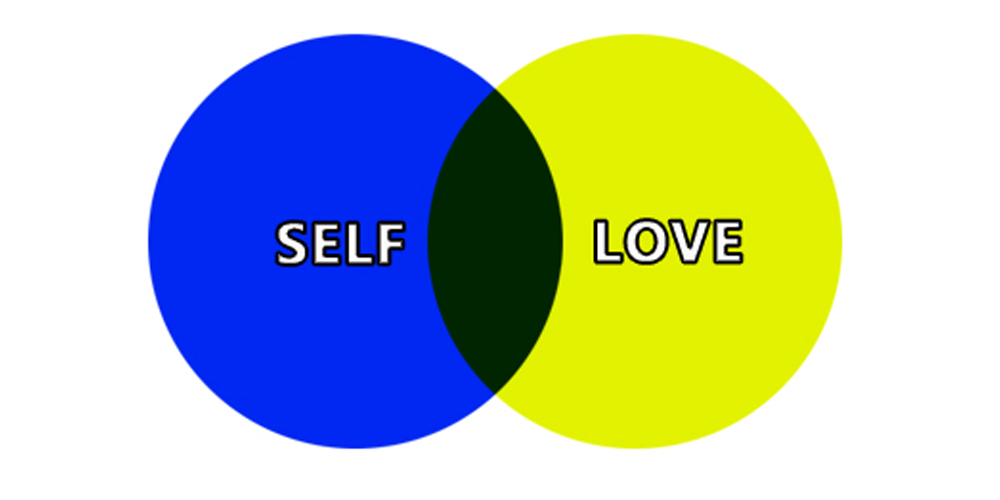


We should strive to live in the area that is a combination of each.  For self without love is selfish; for love without a well-developed self is like sowing the seeds of happiness among thistles. We still have an essential sphere to add, however.


3. Wisdom        

                                    --Tat Tvam Asi, Thou art that
                                               --The Upanishads

In general, Western religions emphasize love, while Eastern religions emphasize wisdom.  Meditation, perfected in Buddhism, is a way to transcend oneself by objectifying personal thoughts.  Meditation thus fosters wisdom, the realization that everyone and everything are connected.

This is well expressed by a poem by Michael Ende, which I translated form the German several years ago, “The Actual Apple”.

A writer and a  realist, well known
for his literality,
searched for something found at home
to delineate from A to Z:
an apple, for instance, an organic bit,
and all that goes along with it.

He described the core, the pulp, the skin,
the stem, the leaves, the branch, the tree,
the roots, the ground the roots grew in,
and Newton's Law of Gravity--

But that wasn't the actual apple at all;
he must include spring, summer, winter, and fall,
the sun and the moon and the stars--

He filled enough paper to paper a wall,
yet the ending seemed farther than quasars:
for actually he belonged there too,
this man of prose who hated verse,
and Adam and Eve and I and you
and God and the whole universe--

Finally he became fully aware
that apples are just indescribably there;
neither he nor another shall ever define
something so common, something so sublime--
He lifts his apple to the light;
smiling now, he takes a bite.


Love and wisdom can and should work together, as they do in the Great Commandment.When we love our neighbor as ourselves, our self-orientation can no longer be selfish—We learn that the center of creation is outside ourselves—in others—as well as inside ourselves.  Just as the center of the Big Bang is everywhere, the center of an inner universe is everywhere as well. We need to realize, if we are to lead full and just lives, that everyone is central to the universe.

Wisdom provides guidance for love that has gone astray.  Let us return to Baldur von Shirach’s love poem to Hitler  Hitler’s violent antisemitism is incompatible with wisdom, the knowledge that everything is connected, and that every human being deserves respect. In the eye of wisdom, the worth of a Jew is not in any way less than the worth of a Christian.  Love that only extends to one’s group--and in Hitler’s case, that was a perverse love as well—is like comparing the light of family hearth to the light of the sun.

I do not claim that love or wisdom has a supernatural origin; they originated via evolutionary adaptation to the environment.  Both of these virtues helped the individual and the group survive—and be happy.  I am not claiming that wisdom and love are merely biologically derived, either.  One cannot deny that both feel divine.

Now we can present the venn diagram that represents the best way to live:


It is in the area that is common to all three circles where self is not selfish; where love is never foolish and where wisdom is never dry.
When we go astray, the union of love, wisdom, and self acts like a magnet to draw us back to where we should be.  For instance, if we love our family but disparage those of another culture or ethnic origin, our diagram elicits the following questions: Is that love?  Is that wise?  Is that all we are? Similarly, if we enrich ourselves while depredating the environment, our diagram reveals that we have gone beyond where we should be at all times. 

Now we can return to Augustine's famous quote: love, then do what you want.  This, as we now can see, is valid only when that love resides in the common area of self, love, and wisdom.

I invite you to internalize this diagram and use it to monitor your behavior as well as the the behavior of others.  Should a wall be built between Mexico and the United States?  If we are speaking from the joint area of the three circles, the answer is obvious.  Should we accept capital punishment; should we break up families by deporting a mother or father who has lived here for a long time; should we continue to jail people for marijuana possession; are we doing enough to decrease racism and to foster peace, etc.  The questions are endless.  If we live where we should be, however, the answer to every one of them, however, is the same.

I would be pleased to receive comments from those who live where they should be, as well as from those who are moving, or at least desire to move, in the right direction.

If not now, when?

2.12.2016

Everything and Almost Nothing: Consiousness and the Theory of Everything

In this article we will travel from large to small in two ways; for the first, we will travel on the thoughtship of philosophy; for the second our minds will hurtle down to almost nothing on the abstract vehicle of particle physics.  On the first journey the last stop is transcendence; on the second it is the theory of everything (TOE).We will finish by interpreting where we've been.

1. Almost Nothing, The Journey of Simone Weil

Simone Weil (1909-1943) is very hard to categorize.  She was a social activist, and was sometimes referred to as "the Red Saint,"although she never joined the Communist party, and eventually became highly critical of communism.  She is best known for her religious philosophy.  Some refer to her as a Christian mystic, although she never converted to Christianity and would probably have objected to the term, "mystic."  Albert Camus held her in the highest regard, for him she was "the only great spirit of our times."  In contrast, Charles de Gaulle thought she was "crazy."  Still others refer to her as the greatest female philosopher who ever lived.

The aphorisms about life, nature and God, collected in a book after her death entitled, "Gravity and Grace," are astounding--at least that's this author's opinion.   Inwardly she experienced God; she was well aware of the outward absence of God as well.  In this essay, our journey begins with the following aphorism: "Every order which transcends another can only be introduced into it under the form of something infinitely small."

This pithy statement might seem inconsequential at first, but that would be incorrect, for this aphorism contains a great and essential truth.  Weil did not elaborate; the sentence came from her notebooks and was not "fleshed out" for publication.  Putting muscle onto this skeletal framework results in a body whose message is of great philosophical and religious import.

Let us first consider the largest order to be transcended: space.  (Space is something and is never empty; what we refer to as "empty space" is the vacuum, a volume containing no or very very little matter. This vacuum is seething with activity at the magnitude at which space breaks down, the Planck scale, which is unimaginably small.)  From our perspective, space is the void.  If we refer to substance as matter, the universe is much much much more space than substance.  Even our  own solar system is mostly space; all the known planets could easily fit into the space between Earth and the moon.  Earth is 93 million miles from the sun; this is defined as one astronomical unit. Neptune, the farthest away from the sun of the eight known planets, is over thirty astronomical units from the source of its faint day.  Recently, there has been convincing evidence, based on the gravitational behavior of planetoids father away than Neptune, of a ninth planet.  Its calculated orbit extends to 100 astronomical units! Beyond that,  the huge stretches of interstellar space begin.

To gauge the size of the visible universe, distance is calculated in light-years. The human mind can only mathematically comprehend a light-year.  Light traveling 186,000 miles per second covers a lot of space in one year.  Yet as a measure of the size of the universe a light-year is very, very small.  Our own galaxy imeasures 100,000 light-years across!  Andromeda, the closest galaxy to us is about 2.5 million light-years away!  The light from the galaxies farthest away from us has taken over 13 billion years to reach our eyes!  Invisible to the naked eye, these large bodies appear as mere specks even to the Hubble telescope--to put it mildly, there is a lot of space between them and us that from our non-mathematical perspective, it might as well be considered an infinite distance.  It doesn't stop even there, however--the visible universe is thought to be only a fraction of the actual universe, invisible to us because not enough time has elapsed since the universe came into being for it to reach our eyes. Yes, it doesn't stop even there; many scientists assert--string theory demands it--that there might be other universes, perhaps an infinite number of them.  Space, Space, space!

Yet to us space is made negligible due to an "infinitely small" element that transcends it.  When we look at the night sky, it is not space which impresses us, but the sparsely dispersed stars which shine through it.  The volume of space taken up by suns and planets compared to the volume of matterless space is truly infinitesimal.  Yet it is this matter--(we exclude here dark matter which is about five times the mass of the total amount of planets and stars in the universe, since we cannot see it)--which gives space definition.  Space for us is the background.  The infinitely smaller element of heavenly bodies transcends it.

We could view habitable planets as the next small order which transcends a larger one.  There might be billions of them, but their total mass compared to the total mass of stars and uninhabitable planets is infinitely small.  But let's skip to the reason why we are so interested in hospitable planets: life.  The bio-mass of Earth is infinitely small when compared to the mass of the entire planet, not to mention the total mass of suns and planets in the universe.  We would all agree that from our perspective life is a smaller yet higher order which transcends the vast order of inanimate matter.

Once again, we can consider the next higher order as intelligent or multicellular life, but let's jump to the most important one for us: human life.  It comprises a fraction of the Earth's bio-mass and has only been on the planet for a million years or so of the four and a half billion years of Earth's existence.

That human intelligence is the highest order known is demonstrated by the fact that the universe does not understand itself; a stone has no science; the tremendous size of the universe fits, as it were, snugly inside the human skull--an astonishing "miracle!"

Simone Weil did not intend for us to stop with human intelligence; for her, the supernatural being called God, is behind all existence.  The divine is an infinitely small element because it would overwhelm human existence if it were any larger.  For Weil, this ultimate higher order gives everything else definition.  It is so small that it is almost nothing; there is, in fact, no evidence for it.

This is the ultimate God-of-the-gaps position.  It is non-falsifiable, meaning that it is not a scientific view.  It is, however, a respectable view, it is natural to intuit that God exists.  In our summary, we shall discuss whether this view is necessary for one to consider oneself religious.

Addendum: Almost Nothing

Simone Weil had a great influence on me, especially in the past.  Here is a poem I wrote twenty-five years ago, excerpted from my first collection of poems, Dance Fire Dance, which demonstrates how important Weil's axiom was--and is--for me:

Almost Nothing

Every order which transcends another can only be introduced into it as something infinitely small--Simone Weil


Compared to nothing, what is matter?
A few grains in an empty silo;
a few flecks of dust scattered
here and there through a deep tarn;
seen cosmically or quantumly,
nearly everything is space,
almost everything's nothing at all.

Compared to mater, what is life?
A lichen patch on surface rock;
upon vast, ancient inorganics,
a few unstable molecules
propagating selves on top,
a fraction of this tiny planet's,
almost nothing compared to the sun.

And, capable of self-removal,
an inch on evolution's scale,
compared to the rest of life,
what are we?  Almost nothing;
there are more germs in you now
than the number of people in China,
ancient and modern, combined.

(June bug on a mountain stream
approaching a vast waterfall,
what is an individual?
Almost nothing; can one blame you
if you wish to close your eyes
and wish to create yourself, a god
stalking the primeval forest?)

When has the power of prayer
cut through death's closing-in vines
to lead us where spring water falls
in the jungle of necessity?
What is superhuman grace
compared to the world of blind force?
Again, almost nothing at all.


ll.  Effective Theory--The Journey of Physics

This journey is similar to the first in that the road leads us from largest to smallest; it differs, however, in a very significant way: it is a scientific journey.  The description of each realm we pass through must be proven by the scientific method, that is, by (direct or indirect) observation; if it isn't we can proceed no farther.  The string theory has devised a plausible path for the last steps toward the Theory of Everything; although eloquent, many questions remain.  It is unproven and remains a theory.  (Einstein's theory of general relativity which asserted that the mass of an object bends light wasn't demonstrated until 1919.  The position of Mercury appeared closer to the sun than it actually is, due to the bending of its light by the mass of the sun.  Breaking news: today, February 11, 2016, it was announced that LIGO--the laser interferometer gravitational-wave observatory-- confirmed the existence of gravitational waves--101 years after Einstein's theory of general relativity predicted their existence!)  Exploration of the final steps are impossible; the distances are too small necessitating an unimaginably huge amount of energy to explore them.  However, a piece of the puzzle might be found at the energy level of CERN or at another collider in the near future. This would be of tremendous importance and is a top priority.  It would be a good indication that the string theory actually describes the way nature works.

We will now travel from huge to tiny via effective theories.  What is an effective theory?  It is a technical term. An effective theory is one that describes the workings of nature without explaining why nature works in a specific way.  It is necessarily incomplete--the theory of everything, however, is not an effective theory, it is the final theory.

A good example is cosmology.  To understand the movement of all heavenly bodies you need to know only two things: mass and gravity.  Newton discovered the laws of gravity in the seventeenth century.  Utilizing them, Kepler determined the orbits of the planets with great accuracy.  Once the mass of an object is known--even the entire mass of a galaxy can be determined--its movements can be demonstrated and observed to be in perfect accord with Newton's laws. (Stars do not move in accordance with the gravity supplied by heavenly bodies; there has to be a huge amount of unseen matter to explain their movements.  This invisible matter is dark matter; scientists have theories of what dark matter might be; none of them has as yet been proven.)

Newton, however, had no idea how gravity worked.  For the effective theory of cosmology this knowledge is not necessary.   To help explain a particular effective theory, we need more information; this is called input, which corresponds to the "higher order" of Weil's maxim.  What is the underlying structure of mass?  

The next effective theory on our way to the final theory is the theory of atoms.  You don't have to know anything about the inner structure of atoms at this level.  All we need know are the elements and the electromagnetic force, which enables atoms to form molecules.  It makes no difference if one knows about the existence of quarks for the effective theory of atomic behavior..  An important question, however, remains unanswered: What is the structure of atoms which causes them to behave the way they do? As we proceed from the effective theory of the behavior of atoms, we need quantum input.  The particles which compose the quantum world are referred to in aggregate as the Standard Model.  The essential and last piece to be discovered was the Higgs boson, which occurred  in 2015.  The Standard Model is now complete.  

The Higgs boson gives mass to quantum particles.  But why are the masses just what they are; what is the cause of the mass of the electron, for instance?  For this we need the input of the final theory, the Theory of Everything.  At this level, bosons, various examples of which are responsible for the four forces of nature, (gravity,  the electromagnetic, the weak and the strong forces), are very different from fermions, the matter particles.  In the final theory, fermions and bosons are interchangeable.  Absolute unity exists at this level; no further explanation is necessary or scientifically possible.  Absolute unity simply is.

Weil's journey is plausible--from our point of view; many would agree that  the hierarchy of existence culminates in God.  The scientific leads to a theory which explains why things are the way they are.  God of the one voyage and absolute unity of the other are not the same thing, unless God is viewed in an absolutely impersonal way.  Weil's "infinitely small" higher order ("extremley small" would be a better term) corresponds to the input of each  effective theory all the way down until unity is reached and effective theories are no longer needed.


One is a journey of the heart; the other is a journey of the mind. But what is the source of both the heart and the mind in which both journeys exist?

Conclusion

We will answer that question shortly.  First, I must assert that my Weltanschaung, my world-view, has changed somewhat over the years.  I can no longer follow Weil's journey to its last step, at least the last step as she envisioned it.  For her, God is a supernatural phenomenon, that is, God exists out there, and is able to intervene, however sparingly, in human history.  In other words, God exists beyond consciousness and not only within it.  I do not find a shred of evidence for this.  For me the source of both the heart and the mind is consciousness, and consciousness alone.

Buddha believed that when anyone asserts a dogmatic statement about ultimate reality, the only proper response is, "Nahi, nahi," "no, no" that is, "not this, not that."

Jesus is the only begotten Son of God?  Muhammad is the final prophet?  The Lord presented the Jews with the Ten Commandments on Mt. Sinai?  Nahi, nahi, nahi! Such assertions are metaphors--and can be very meaningful as such--but they are not facts.  I don't understand how any twenty-first century mind can believe the contrary--although some very educated people, much smarter than I am, still do.  But they are apparently becoming rarer and rare.

The all is not lost, however.  It can indeed be asserted that God exists within.  As Jesus of Nazareth said, "The Kingdom of God is within you."

As the great poet Gerard Manley Hopkins wrote, "There lives the dearest freshness deep down things."  Zen teaches that a diamond of pure consciousness exists within us.  One can access it through meditation as one rises about superficial concerns.  We eventually not only realize but fully experience, at least in our best moments,  that everything is connected. This is wisdom.  One puts wisdom into practice through selfless action.  This is love.

Mind you, I stated that "it can be asserted that God exists." It is not necessary.  One may call the God within the inner light, as the Quakers do, or "the still small voice" or the core of conscience, or well, cosmic consciousness.  Call it any awesome name you like, it does not matter.  That you access it and act upon it, however, matters a great deal.

One might object that a God that exists merely (in Shakespeare's time "merely" meant "entirely") in consciousness is not the living God, but just another idea, a fantasy, albeit a noble one. For God to be real, according to this view, God must have an objective existence.  But what does objective existence man?

Modern physics can help us here.  Like the ancient Hindus, some scientists are convinced that it is consciousness that in a very real sense creates the world.  Many top physicists assert that there is no objective reality without the observer.  (There is, of course no observation without consciousness.)  John Wheeler, one of the greatest scientists of the past century, was convinced that  observation has a central role in the nature of reality.  I will close with a quote by the eminent particle physicist, Andrei Linde, as quoted in Michio Kaku's wonderful book, "Parallel Worlds":


For me, as a human being, I do not know any sense in which I could claim that the universe is here in the absence of observers...The moment you say that the universe exists without any observers, I can't make any sense of that. I cannot imagine a consistent theory of everything that ignores consciousness...In the absence of observers, the universe is dead.

Another way of saying this: consciousness creates "objective" reality by interacting with the ghostly quantum world which cannot be called objective in any real sense. (Caveat: observation cannot choose which quantum outcome arises.  Volition has nothing to do with it; it is an entirely impersonal process.  You can't win the lottery with the "power of positive thinking!") Therefore, what is outside us is not independent of what is inside us.  In a real sense, therefore, outside is inside.  Thus, the Kingdom of God within us is also the Kingdom of God in our world.  It takes a leap of faith to believe in an external God, that is, a deity with an independent existence beyond consciousness who controls everything; there is, as we have asserted, absolutely no evidence in the material world that supports this view.   This belief,  however, as we have is unnecessary.  Wisdom is ultimately all we need to know; love is ultimately all we need do. What we experience is consciousness, and it is enough.

In my view, this is the only way to be deeply religious without coming in conflict with science.

Addendum: The Actual Apple

Everything is connected with everything else; a fully separate existence is an illusion.  As we have asserted, this is wisdom.  I would like to conclude with a poem by Michael Ende, which I translated years ago. It is the same journey as the two we took in this article, except in reverse, namely, from the small to the large.   Feel free to substitute yourself for the apple!

The Actual Apple

A writer and a  realist, well known

for his literality,
searched for something found at home
to delineate from A to Z:
an apple, for instance, an organic bit,
and all that goes along with it.

He described the core, the pulp, the skin,
the stem, the leaves, the branch, the tree,
the roots, the ground the roots grew in,
and Newton's Law of Gravity--

But that wasn't the actual apple at all;
he must include spring, summer, winter, and fall,
the sun and the moon and the stars--

He filled enough paper to paper a wall,
yet the ending seemed farther than quasars:
for actually he belonged there too,
this man of prose who hated verse,
and Adam and Eve and I and you
and God and the whole universe--

Finally he became fully aware
that apples are just indescribably there;
neither he nor another shall ever define
something so common, something so sublime--
He lifts his apple to the light;
smiling now, he takes a bite.


Michael Ende
--translated from the German by
Thomas Dorsett


Your comments are most welcome!