Memento mori! Remember death! Why? That is the subject of this essay.We shall begin with one of the most famous
mementos mori, which my wife and I encountered on a recent trip to
Portugal. After mentioning a few additional examples, we will then discuss the purpose of these reminders, the
promulgation of which has long since disappeared in contemporary culture, if
not in nature, where they abound. Why were momentos mori created? What
are the benefits derived from a healthy
contemplation of death?
I would
like to answer that last question before proceeding with our discussion. When I
was a medical student, many years ago, I did a rotation at the famous Hospital
for Sick Children in London. I remember attending an autopsy of a middle-aged
man there; I recall that his stomach contained the residue of antacid—He was,
poor man, apparently ignorant of the origin of the chest pain in the hours
before a massive heart attack felled him. Over the lintel of the entrance to
the dissection room was the following Latin inscription, which I have not
forgotten to this day: Hic gaudet mors
succerere vitae, that is, “Here death triumphs in order to give succor to
life.” This is a good definition of a memento mori with the following caveat:
there is nothing sweet about this succoring, it is indeed bitter. The
antithesis of sweetness, however, can be
quite salutary, like the consumption of the Indian vegetable kaipukku, “bitter
gourd,” which lowers blood sugar, while, at least in my opinion, being tasty as well.
1, A Capela dos Ossos, The Chapel of Bones, Évora, Portugal
Évora is an
ancient town, of Celtic origin, located in the Alantejo region of Portugal.
Once of great economic importance, it is now (at least on first impression) a somewhat
sleepy town. The central square, dominated by the Gothic cathedral, is
impressive. There are many fine historic buildings, one of the most famous
being the ruins of a first-century Roman temple which was probably dedicated to
the emperor Augustus.
Not far
from the central plaça, stands the 16th
century Church of St. Francis. It is a rather unimpressive building from the
outside; it contains the skeletal Mother of All Mementos Mori, the famous
Capela dos Ossos, Chapel of the Bones. Its interior is decorated with the
bones of approximately 5,000 persons: skulls festoon the columns, skulls, look
down at you from the supporting arches of the chapel. The skulls look surprisingly small, perhaps an effect of perspective; they are placed
with an exact periodicity that reminds me of the colorful, little pill-sized candies
fastened to wax paper, each about an inch from its neighbor, which I sometimes
bought at a fair when I was a kid. But these weren’t candies, far from it; the
chapel contained the skeletal remains of enough people to fill Grand Central
Station on a busy day in New York.
Over the
entrance to the chapel the following message is inscribed:
NÓS OSSOS AQUÍ ESTAMOS, PELOS VOSSOS ESPERAMOS
Translation:
We Bones Are Here, Awaiting Yours
Here are
some photos we took of the chapel:


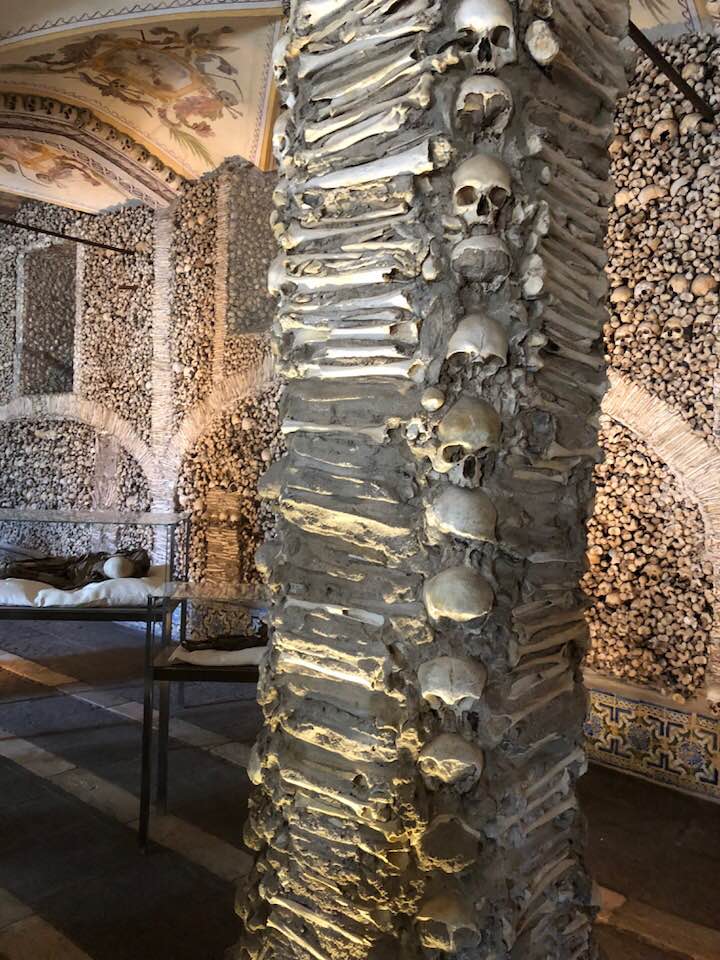

The chapel
dates from the sixteenth century, the time of the Counter Reformation. To
counter the superficialities and degenerations of the Catholic Church during
Luther’s time, the Counter Reformation tried to win the hearts and minds of the
faithful by demonstrating interest not only in gold-brocaded bishop’s mitres,
but in the inner world of the individual as well. These days one might attempt to stay the
onslaught of Protestantism with a guitar mass; in the sixteenth century,
however, a good memento mori was thought to be a condign way of scaring the bejesus
out of people, hoping that would increase dedication to an institution that
claimed to possess the keys to salvation.
There is
more than a parochial reason for a memento mori, however, one, as I hope to
demonstrate in this essay, that is much needed today.
There is, also, however, a more mundane reason why the remains of so many were exhumed. At the time of the church’s construction, there were over forty cemeteries in
the Évora region—the town, as mentioned, is very ancient. It was decided to put the
land of those cemeteries, many contained in monasteries no longer in use, into
the hands of the still (at the time) flesh-covered bones of the living.
Instead of reburying the bones, however, they were put on permanent display in order to help reduce the vanity of that factory of vanities, the human brain.
2. The Poem
On the wall
of A Capela dos Ossos is an early nineteenth century
poem, attributed to a parish priest of the church, Fr. António da Ascenção
Teles. It is a good example of a Petrarchan sonnet, remarkable for having
originated from the quill of an amateur poet, and quite appropiate to quote
here. I present first the original Portuguese poem, followed by my non-Petrarchan
translation.
Aonde vaís, caminhante, acelerado?
Pára…não prossigas maís avante;
Negócio, não
tens maís importante,
Do que
este, a tua vista apresentado.
Recorda
quantos desta vida têm passado,
Reflecte
em que terás fim semelhante,
Que
para meditar causa è bastante
Terem todos maís nisto parado.
Pondera,
que influido d’essa sorte,
Entre
negociaçães do mundo tantas,
Tão
pouco consideras na morte.
Porém,
se os olhos aqui levantas,
Pára…porque
em negócio deste porte,
Quanto
maís tu parares, maís adiantas.
Where are you rushing off to, traveler?
Stop…Do not proceed any farther;
You don’t have any business more important
Than this one here, right before your eyes.
Recall how many have already died,
Reflect that you will have a similar end;
Mortality is reason enough for everyone
To pause here awhile and meditate.
Think
how little you reflect on death;
Caught
up in the things of the world,
Ponder
how these things apply to you.
If, moreover, you choose to lift your eyes,
Pause—for,
before a theme of this import,
The more
you stop, the more you advance.
The more
you stop, the more you advance—a perfect definition of the purpose of a memento
mori.
3. Other
Examples Of Mementos Mori
a. A Scene from a Play

I recently attended a performance of Waiting for Godot, excellently performed by the Shakespeare Theater in Washington, D.C. A literary momemto mori, one made of words, occurs in the seond act. The dialogue is spoken between the down-and-out pair, Vladimir and Estragon, better known in the play by their clownish names, Didi and Gogo;
Estragon: Well, If we gave thanks for our mercies?
Vladimir: What is terrible is to have thought.
E. But did that ever happen to us?
V.: Where are all these corpses from?
E.: These skeletons.
V.: Tell me that.
E.: True.
V.: We must have thought a little.
E.: At the very beginning.
V: A charnel house! A charnel house!
E.: You don't have to look.
V.: You can't help looking.
E.: True.
--Act ll:154-166)
There are no stage directions for this dialogue. In the production we saw, Vladimir looks directly at the audience when he says, "Where are all these corpses from?" One is reminded here of the first stanza of Whispers of Immortality, in which T.S. Eliot refers to the Elizabethan playwright, John Webster: "Webster was much obsessed by death,/And saw the skull beneath the skin/And breastless creatures underground/Leaned backwards with a lipless grin." Vladimir, in this episode of very effective theater, saw our skulls beneath the skin. It is our future; the silent arrow of contingency pierces the heart. Vladimir has thus transformed the entire audience, and, by extension all humanity, into a (briefly) living memento mori.
We might view ourselves as gods, except for this one nasty detail: gods don't rot. For Vladimir and Estragon, this is a source of great pessimism--thinking, according to Vladimir, must confront suffering and mortality, and is thus for him "a terrible thing." We don't have to look, after all; many do their best not to, despite the ubiquity of sickness and death. If one thinks, however, one can't help looking. We are once again confronted with the Buddhist assertion that pessimism can be closer to the truth than a glossy-eyed optimism. On the way to wisdom, we might first fall from a superficial knoll into a ditch; there are indeed many obstacles on the narrow road to full maturity. But the purpose of life as Buddha and others saw and see it, is not to wallow in ditches. We are to climb out of the ditch and move on.
a. A Scene from a Play

I recently attended a performance of Waiting for Godot, excellently performed by the Shakespeare Theater in Washington, D.C. A literary momemto mori, one made of words, occurs in the seond act. The dialogue is spoken between the down-and-out pair, Vladimir and Estragon, better known in the play by their clownish names, Didi and Gogo;
Estragon: Well, If we gave thanks for our mercies?
Vladimir: What is terrible is to have thought.
E. But did that ever happen to us?
V.: Where are all these corpses from?
E.: These skeletons.
V.: Tell me that.
E.: True.
V.: We must have thought a little.
E.: At the very beginning.
V: A charnel house! A charnel house!
E.: You don't have to look.
V.: You can't help looking.
E.: True.
--Act ll:154-166)
There are no stage directions for this dialogue. In the production we saw, Vladimir looks directly at the audience when he says, "Where are all these corpses from?" One is reminded here of the first stanza of Whispers of Immortality, in which T.S. Eliot refers to the Elizabethan playwright, John Webster: "Webster was much obsessed by death,/And saw the skull beneath the skin/And breastless creatures underground/Leaned backwards with a lipless grin." Vladimir, in this episode of very effective theater, saw our skulls beneath the skin. It is our future; the silent arrow of contingency pierces the heart. Vladimir has thus transformed the entire audience, and, by extension all humanity, into a (briefly) living memento mori.
We might view ourselves as gods, except for this one nasty detail: gods don't rot. For Vladimir and Estragon, this is a source of great pessimism--thinking, according to Vladimir, must confront suffering and mortality, and is thus for him "a terrible thing." We don't have to look, after all; many do their best not to, despite the ubiquity of sickness and death. If one thinks, however, one can't help looking. We are once again confronted with the Buddhist assertion that pessimism can be closer to the truth than a glossy-eyed optimism. On the way to wisdom, we might first fall from a superficial knoll into a ditch; there are indeed many obstacles on the narrow road to full maturity. But the purpose of life as Buddha and others saw and see it, is not to wallow in ditches. We are to climb out of the ditch and move on.
I
mentioned earlier that I participated in a clinical elective at Guy’s
Hospital, the London Hospital for Sick Children,
during my last year of medical school in 1971. Not far from Guy’s is Southwark
Cathedral, on the south bank of the Thames near London Bridge. I often stopped
there to marvel at that fine, medieval building, and to meditate there as well,
inveterate meditator that I was then, and am still. I was struck by a memnto mori in
the cathedral, a stone statue of a cadaver in an advanced state of
putrefaction. (I remember the little stone worm crawling up its arm—at least I
think I do; it might well be the stony phantasm of a later dream, projected onto the statue by faulty memory.There are
many examples of statues like this; mementos mori were very much in vogue
during the medieval period. Here is a photo, taken from the internet:

How many
passers-by have contemplated here, who have long since passed on? I have been
one of them, soon to pass on as well.
c.
Daguerreotypes of the Dead
Daguerreotypes
were the first photographs, achieved by a laborious process that included an iodine-sensitized silvered plate and mercury vapor. (Hope those early
photographers used masks, but I doubt that they did). The method was invented by
Louis Daguerre in 1839; it took little time for daguerreotypes to enjoy
world-wide popularity. (There were many in antebellum New York, several of which Walt Whitman frequented, resulting in several portraits of the great poet).
Throughout
history, humans desired not only progeny, but to “immortalize” their features in
portraits to be hung on walls. In the last half millennium or
so, paintings or sketches were the sole methods available to achieve this aim. Many portraits of Lady This or Lordy That have survived; the faces of Tim the
Cobbler and Anne the Seamstress, however, were generally able to be recalled, after a
generation or so, as well as the nuzzle of a once-beloved lapdog, or as well as the
face of a long-since discarded clock. Daguerreotypes, the polished ancestors of
modern selfies, changed all that. Soon everyone would be snapping everyone
else. But not so soon. New products tend to be expensive; daguerreotypes were no exception. Relatives often forgot to have taken a daguerreotype of their loved ones while the
latter lived. Better late then never. Thus began the custom of post-mortem
photography, which lasted even into the beginning of the twentieth century. These
were often the only likenesses of the loved ones in question; they were for this reason often
among a family’s most prized possessions.
To the
modern eye they constitute odd examples of memntos mori. Everyone wanted the portraits of their loved ones to look natural and life-like. They often looked macabre
and deadly; after all, you can’t make a cadaver say 'cheese.'
Here are two examples:


The
second example seems to us moderns to border on child abuse. That poor
little girl! I can only imagine her subsequent nightmares. The Chapel of the
Bones is a fine place for adult contemplation; taking little children there is,
however, ghastly.
Mementos mori are thus best-suited for adults, especially older adults, in order to foster wisdom that tends to grow as one ages.
Why is that? Many adults, even older adults, alas! are afflicted by narcissism and are sorely in need of the jolts mementos mori can provide. (Yes, I admit it, they don't always work. Those most in need of contemplation and reflection are often the least likely to undertake the considerable effort needed to become more wise. Nevertheless).
Mementos mori are thus best-suited for adults, especially older adults, in order to foster wisdom that tends to grow as one ages.
Why is that? Many adults, even older adults, alas! are afflicted by narcissism and are sorely in need of the jolts mementos mori can provide. (Yes, I admit it, they don't always work. Those most in need of contemplation and reflection are often the least likely to undertake the considerable effort needed to become more wise. Nevertheless).
4. A
Buddhist Meditation on Death
In the
Therevada Buddhist classic, The Way of Mindfulness, still a sacred text in many
Buddhist countries, there is a section entitled “The Nine Cemetery Contemplations.”
It is still much in use in the East, but, as I’ve read, not in the
West, where, perhaps even among some monks, the slightest bit of dust tends to be
swept inattentively under the rug, Times have changed, however. I must admit that I’ve never meditated as instructed here; this doesn’t mean that
they can’t be of use to some persons. As we shall see in our interpretation of
mementos mori, their purpose is not to induce a morbid feeling; their purpose
is to lead us to a life of love and wisdom, and to use time better to achieve this goal. I will only quote the beginning of
the cemetery contemplations here:
After explaining body-contemplation in the form of the modes of materiality, the Master said, “And further,” in order to explain
body-contemplation through the nine cemetery contemplations.
UDDHUMATAM—“Swollen”. By reason of the swelled
state of the corpse comparable to a pair of wind-filled bellows owing to the
gradually uprisen bloatedness after death.
VINILAKAM, “Blue”… Blue is that corpse which is
reddish in the protuberantly fleshy parts, and whitish in the purulent parts...It seems to be as though
covered with a blue mantle…
VIPUBBAKAJATAM—“Festering” is the corpse that
is full of pus flowing from the broken parts or from the nine openings of the
body.
“He thinks of his own body thus: ‘Verily, this
body of mine, too, is of the same nature as that dead body, is going to be like
that body, and has not got past the condition of becoming like that body.
--The Way of
Mindfulness, Colombo, 1949, page 103
Etc.,
etc. You get the idea.
5. What is to be learned from Momentos Mori?
Two objections come to mind regarding the benefit of mementos mori. The first and
lesser objection is that the creator of a specific memento mori might have an
ulterior motive. In the case of the ossuary in Portugal, a product of the
Counter Reformation, the goal of mementos mori were not merely to frighten
people, but to utilize fright to better maintain the populace under control of the Catholic
Church. Terrified by the sight of death, an individual might be induced to
abandon worldly ways, at least temporarily, and think of salvation. According to Catholic doctrine at
the time, the Church provided the sole means of getting into heaven. Hence, existential
anxiety was fostered among the populace in order to help keep
the Church foremost in people’s minds.
Another more modern use of mementos mori are Halloween-like frights, such as in horror films, designed more or less to isolate a common dread for a cathartic release, so that one could subsequently forget about death, presumably forever.
Another more modern use of mementos mori are Halloween-like frights, such as in horror films, designed more or less to isolate a common dread for a cathartic release, so that one could subsequently forget about death, presumably forever.
The other and more widespread objection today is that mementos mori are morbid, and serve no real purpose, other than to foster sadness or even depression. There is a thin line here; morbidity for its own sake is not the true purpose of mementos mori, at least the way I see it. Anyone with a significant tendency toward depression is best kept away from mementos mori; let that person work on his or her depression first. Mementos mori work best for those, to use Keats's famous phrase, who are "half in love with easeful death," or who are so lost in non-essentials that they have forgotten just what the essentials are; to become wholly in love with the beauties and challenges of life. "Had we but world enough and time,/This coyness, Lady, were no crime...,: as Andrew Marvel famously wrote. (Failure to manage time well is, of course, not confined to the ladies!)
Persistent gloominess generally results when egotistic desires are thwarted. This isn’t dying but Death, death-within-life, which is to be avoided—and mementos mori can help here to do just that. I’m reminded of a poem of e.e. cummings which illustrates the division of a natural, inevitable phenomenon, dying, and the evil of Death:
Dying is
fine)but Death
?o
baby
i
wouldn’t
like
Death if
Death
were
good;
for
when(instead
of stopping to think)you
begin to
feel of it,dying
‘s
miraculous
why?be
cause dying
is
perfectly
natural;perfectly
putting
it
mildly lively(but
Death
is
strictly
scientific
&
artificial &
evil &
legal)
we thank
thee
god
almighty
for dying
(forgive
us, o life!the sin of Death
Thus,
the purpose of recalling death is to put an end to ‘the sin of Death’—hopefully
once and for all.
Vanity
of vanities, all is vanity, saith the Preacher. I do not agree. Vanity of vanities, almost all is vanity—that’s
a lot closer to the truth. (Without this “almost’; without the hope of rising
to the next level, mementos mori would be macabre and nothing else.
Buddha
famously formulated The Four Noble Truths centuries ago. The First Truth is
that life is suffering; the Second, that this suffering is caused by desire; the
Third is that elimination of suffering can be achieved by the elimination of
desire; the Fourth outlines the path to achieve this goal. Stated thus, Buddhism
has little to say to us today. But once we interpret suffering as mental suffering caused
by egotistic desires, Buddha’s wisdom shines. The anguish resulting from encountering the world while wearing ego-distorted glasses is why we see life as suffering. One of the chief distortions
from wearing these cloudy lenses is forgetting that everything we see is
contingent, including, of course, ourselves.
Adam and Eve gained the knowledge of individuality, the knowledge of birth and death, by eating the forbidden fruit; they were stopped, however, from eating from the Tree of Life which would have conferred immortality. They gained consciousness, and this is a very great gift. It also has a great drawback: the knowledge of death. Imagining that the ego is of cosmic importance, however, and might even last forever, can do great harm; vanity can kill. A poem by Shelley is appropriate here:
Adam and Eve gained the knowledge of individuality, the knowledge of birth and death, by eating the forbidden fruit; they were stopped, however, from eating from the Tree of Life which would have conferred immortality. They gained consciousness, and this is a very great gift. It also has a great drawback: the knowledge of death. Imagining that the ego is of cosmic importance, however, and might even last forever, can do great harm; vanity can kill. A poem by Shelley is appropriate here:
Ozymandias
I met a traveler
from an antique land
Who said:
Two vast and trunkless legs of stone
Stand in
the desert…Near them on the sand,
half sunk, a shattered visage lies, whose frown,
half sunk, a shattered visage lies, whose frown,
and wrinkled lip, and sneer of cold command,
tell that its sculptor well these passions read
tell that its sculptor well these passions read
Which yet
survive, stamped on these lifeless things,
The had
that mocked them, and the heart that fed:
And on
the pedestal these words appear:
‘My name is Ozymandias, king of kings:
Look on
my works, yet Mighty, and despair!’
Nothing
beside remains. Round the decay
Of that
colossal wreck, bondless and bare
The lone
and level sands stretch far away.
Two
types of egotism result from wearing self-distorted glasses, one leads to suicide, while the other leads to narcissism.
Shelley’s poem is a literary memento mori; it would have been perhaps
beneficial if Ozymandias himself had a vision of what would happen to Self Built
on Sand in the future. Lord knows how much destruction and suffering could have
been averted if Ozymandiases had sense knocked into them by a memento mori.
We have
seen and are still seeing—I’m writing this in May, 2018—the effects of having a
narcissist wield political power. There is a great neediness in such people; they need
admirers only, not friends or colleagues. It is a situation that is causing
harm to our democracy: the trouble arises from seeing Ozymandias in the mirror,
instead of a mortal, contingent being. It is naive, of course, to imagine that
a memento mori could convert an extreme narcissist into a balanced human being,
but for those less afflicted by pride, a memento mori might help a lot to jolt one back onto a path of balanced maturity.
Once one
takes off those delusional lenses from one’s eyes, one is able to see the
great world we live in, and the great beings that each one of us is; we can thus finally see
the world through the eyes of love and wisdom. Once the heart is no longer worn on one's sleeve, it can return to its central place. Everything we see is then a source
of wonder, as Walt Whitman wrote in the Leaves of Grass:
And the
look of the bay mare shames silliness out of me.
That is
the purpose of mementos mori: to shame silliness out of us.
Epilogue


Once a
memnto mori completely accomplishes its task; once we have given up vanity and
live a balanced life of love and wisdom for ourselves and for others, the work
of mementos mori is done. The life of the Hindu sage, Ramana Maharshi
(1979-1950) is instructive here. At any early age, he was beset by the terror
of death. After this experience, he became completely identified with cosmic
consciousness; Death or vanity had no place in his life from then on. When,
years later, a person reminded him of his birth name, Venkataraman Iyer, he
replied with a smile, “That person died long ago.” He faced his own impending
death from cancer with supreme equanimity. When followers showed their anguish
at the thought of losing him as a great teacher, he replied, no doubt with the
same smile: “Where could I go from here, and how?” He had long since become
one with cosmic consciousness. As Walt Whitman wrote in Leaves of Grass “How
can the real body be buried?”
Hindus
usually cremate their dead; it is thought to be a purification rite. Great
sages are buried, however; no need to pass through fire twice.
Permanent
identification with the cosmos, however, is very rare indeed. Only for such extremely rare individuals, mementos mori are no longer necessary. Most of the rest us come in and
out of cosmic consciousness; joyful work, artistic creation, acts of love and wisdom,
all involve the transformation of ego-noise into selfless music.
Whenever we fall from the heights of higher consciousness and land on the rocky terrain of the machinations of an injured self, an occasional memento mori can help us see that we might be on the path not only of spiritual death, but of physical death as well. In summary, the purpose of mementos mori is to shame the silliness out of us and to send us in the right direction.
I will now summarize a lovely poem by Edna St.Vincent Millay:
I shall die, but that's all I'll do for death;
I'm not on his payroll.
If a memento mori can induce us to stop working for death-in-life in the service of a fictive, tyrannical boss inside the skull, occasionally seeing the skull behind the skin will have served its purpose well. Then we can retire to life--hard work!
Whenever we fall from the heights of higher consciousness and land on the rocky terrain of the machinations of an injured self, an occasional memento mori can help us see that we might be on the path not only of spiritual death, but of physical death as well. In summary, the purpose of mementos mori is to shame the silliness out of us and to send us in the right direction.
I will now summarize a lovely poem by Edna St.Vincent Millay:
I shall die, but that's all I'll do for death;
I'm not on his payroll.
If a memento mori can induce us to stop working for death-in-life in the service of a fictive, tyrannical boss inside the skull, occasionally seeing the skull behind the skin will have served its purpose well. Then we can retire to life--hard work!


