During a recent course I gave on Goethe's Faust, I was impressed by many things in Goethe's masterwork, not the least of which is the remarkable and strange ending to the second half of the tragedy, which has been exercising the pens of critics since it appeared in 1832, the year of the author's death. For some, it's a completely unexpected and gratuitous ending, much like a deus-ex-machina ending of a play by Seneca or Plautus. For others, Faust gets exactly what he deserves, salvation. I would like to add my own interpretation, which is somewhat between the two. First, a little background information.
Faust is perhaps the most ambiguous of all literary masterworks. Criticism of Dante's Inferno might range from A to D; criticism of Shakespeare's Hamlet might range a little farther into the alphabet than that. In other words, critics basically agree; there is not a school of thought, for instance, that considers Hamlet to be a rogue, while another group of scholars considers Hamlet to be a saint. But criticism of Faust entails the entire alphabet--Some critics might have an A view, as it were, while others have a completely opposite Z view. This is true of no other major work of literature with which I am familiar.
The ending of part two of the tragedy is especially problematic. I offer in this essay a new angle from which to view the ending, one that goes beyond, as it were, the entire alphabet! Before we turn to the ending, however, I would like to summarize briefly part one and part two, emphasizing the aspects that make the ending incongruous for some, inevitable for others.
FAUST
Goethe, born in 1749, published the final version of Faust Part 1 in 1808. There is an earlier version called the Urfaust in which most of the elements of the drama first appeared; it dates from the 1770s when Goethe was in his twenties. Faust Part Two, as mentioned previously, was published in 1832; Goethe had been working on it for decades, and was still perfecting and adding to it in his eighties.
The story of Faust is well known, so I will be brief. Faust, the most prominent scholar of his age, is dissatisfied. He is after Truth, not truths. He understands that "we are not able to know," which drives him to despair. Revelation, which guided mankind in the past, is of no use in the post-Kantian pseudo-medieval modern world which Faust inhabits. ("I hear the Gospel, but I lack belief.") He makes a pact with the devil; if Mephistopheles can enable Faust to experience eternity, even for a moment, the scholar is willing to forfeit his soul. Since trying to find Truth through knowledge has proven to be futile, the devil suggests that the inexperienced Faust might find what he is looking for in the world of sensuality. Faust's youth is restored; a love potion fills him with desire. He seduces a young, beautiful innocent girl, Gretchen, who is his social inferior. As she relates in an immortal poem, Gretchen at the Spinning Wheel, her peace has been destroyed. Faust gives her a sleeping potion; she is instructed to slip it into her mother's drink, so he can seduce Gretchen at home while the older woman sleeps. She never wakes up. Gretchen becomes pregnant; Faust abandons her. Her brother curses her for the shame she has caused and dies in a duel with Faust, who is aided by the devil. Having gone mad with grief, the poor girl drowns her newborn daughter; she is condemned to death for this crime. Faust, spirited to the prison by Mephistopheles, attempts to save her, but it is too late.
The Faust of Part One is a rogue. In his striving for Truth, he is completely amoral. ("I have neither scruples nor (self) doubts, and do not fear hell or the devil." A classic example of a noble end supposedly justifying ignoble means. The Faust of Part Two continues his ceaseless striving, but with a major difference: in the first part, Faust is responsible for the deaths of four members of one family; in part two Faust seeks and obtains enormous political power and affects--and destroys--many lives. With the devil's help, he mercilessly decimates the army of one who has declared himself emperor, since the current one is an unjust fop. Prior to the devil's intervention, the alternative and presumably more just emperor's side was winning. As a reward for his savage victory, Faust requests and receives from the emperor a coastal area; his life work now is to reclaim huge stretches of land from the sea. (Perhaps a symbol of his working against nature rather than with it.) The land reclamation proceeds with the devil's help--it would have been impossible without it. Faust dies, an old man, before his life work is completed.
THE A AND THE Z OF IT
As mentioned previously, the interpretation of Goethe's work has been quite problematic. The "A" interpretation asserts that Faust, after committing many misdeeds, sincerely repents and is justified for being proud of his land-reclamation project which will, in his opinion at least, provide a major benefit to mankind. The "Z' view is that Faust remains a miscreant to the very end. If the latter case is true, his salvation at the end is gratuitous and completely undeserved. Let us now briefly discuss the arguments of each side.
The so-called "perfectiblists" assert that Faust attains the height of moral existence, after a life of misdeeds, before his death. This has been the standard view, and, until relatively recently, had remained largely unchallenged. Alleged proof of this transformation occurs in several sections at the end of the text. Faust is furious that a loving, elderly couple, Philemon and Baucis, still live on the coastal area which he has received from the emperor. (Baucis asserts that Faust's project was morally very suspect. She asserts, correctly that he used slave labor and utilized "black magic" to assist him in the construction, which took place mostly at night.) Faust, bent on owning everything on the land he is working on, decides to forcibly evict the couple. His henchmen, along with Mephistopheles--possibly accomplishing Faust's secret desire--terrorize the couple who die on the spot. Their property catches fire and burns down. Faust curses their action and washes his hands of it--he insists that he merely demanded their eviction, not their demise. This has been interpreted by some as genuine repentance. Later on, immediately before Care (that is, Anxiety, in the form of a woman) blinds the 100 years old Faust, he admits the following (in my rough translation): "I have only desired and accomplished, storming powerfully through my life; previously I was big and tough; now I proceed cautiously with wisdom." In his last monologue, Faust asserts the importance of his legacy and is convinced that "the traces of his life on earth will last forever."
The "Z" critics--and I cast my lot in with them--find no evidence of a great moral awakening; Faust remains immoral--or amoral--to the very end. He repents about what happened to the elderly couple--but these are merely words and are not followed with any change in behavior. His assertion that he "only desired and accomplished" does not result in any moral transformation either. His assertion that he now "proceeds cautiously and with wisdom" is more due to the fact that he is 100 years old, rather than due to a moral epiphany. In his final monologue he is as grandiose and self-centered as ever. Faust for the "Z" critics is a man who uses any means whatever to reach his ends. He shows not the slightest concern for his enslaved workers. He has caused considerable pain and suffering in the first part and a good deal more in the second part. He is, in this view, a megalomaniac and a scoundrel. The final two scenes, in which heavenly hosts declare him saved and then transport him to heaven, appear to this group of critics as to be either a parody or an unconvincing deus ex machina ending--albeit without the appearance of a god. I would like now to present my interpretation, in which Faust remains an unredeemed rogue throughout both parts of the play--and yet, at the end, is worthy of redemption.
FAUST'S TRANSFIGURATION AS A NEAR-DEATH-LIKE EXPERIENCE
Immediately before his final monologue, the blind Faust leaves his palace, pleased by the sounds of workers. He believes he is hearing sounds of construction on his land-reclamation project: "How the sound of spades delights me/ This is the mass of people indentured to me/ who reconcile earth with earth/ who give no borders to the waves/ and give strict limits to the sea." (lines 15139-15143.) Once again, Faust is deluded--the sounds he hears are from demons digging his grave. Faust subsequently dies and is placed in the freshly dug grave. "The terrible jaws of hell" open on stage left. Mephistopheles is ready to claim Faust's soul according to the terms of the wager. Then something miraculous happens. This "something" as we shall see, has many of the characteristics of a near-death experience.
In the stage directions, Goethe writes that a "Glory above from the right" appears. This has been translated by David Luke (Oxford University Press) as "A flash of glory from above right." We are now experiencing the brilliance of the divine light becoming manifest in the world; such epiphanies had often been depicted in medieval art as a vision of a saint, which takes the form of a brilliant apparition above him, as we can see in a rather typical painting of that era by Hans Baldung Grien, (1511).

The heavenly hosts bear glad tidings for Faust's immortal part: "Come in serene flight, ye divine emissaries, animate dust and forgive sins--Reveal friendly hints to all natures, all ye hosts floating above," (lines 11676-11684). The message of the angels is clear: they proclaim that in the divine realm all individuals are completely forgiven, no matter what they have done on earth. Thus, Faust deserves redemption as much as anyone else. A chorus of angels then strews roses from above, symbols of divine, unconditional love.
Already two major characteristics of a near-death experience have become manifest: a flash of divine light from above and the revelation that all--in this case Faust assumes the role of an Everyman--deserve and receive unconditional love from on high.
Near-death experiences, visions of an afterlife by those in a coma or determined to be clinically dead for a period of time, are remarkably consistent. This article does not claim, nor does it absolutely deny, that these experiences transcend the psychological; it does, however, assert that NDEs show a remarkable consistency and reflect deep insights into the human condition. As archetypes of our collective unconscious, their contents illustrate innate, profound patterns of thought and belief. It is therefore not completely surprising that Goethe, who had a a deep understanding of human nature, ended his great drama with great final truths. (That these truths are expressed in ways consistent with NDEs is, however, quite remarkable.) It is quite possible--even likely-- that Goethe believed that what happened to the fictive Faust after his fictive death could happen to real, flesh and blood people after death. (It has been documented that Goethe thought that death is not final.)
Pim van Lommel, a Dutch cardiologist, has done much research regarding NDEs. Examples of his research have appeared in many prestigious journals, including The Lancet. He is the author of the well-received "Consciousness Beyond Life; the Science of the Near-Death Experience", which I have reviewed. To his surprise, he discovered that about 20% of 62 of his patients who suffered clinical death had an NDE. All of the patients had cardiac arrests and had come under his care for this reason. We will use his book, and especially Moody's list of typical Near-Death Experiences, on which van Lommel elaborates, as a reference as we discuss Faust's final moments. (Moody, the author of the 1975 Life After Life is a seminal figure in the field of NDEs.)
I have found five aspects of a NDE that apply to Faust. We have already briefly mentioned two; I will now proceed to discuss these two in more detail along with the three other aspects.
1. "The Perception of a Brilliant Light or a Being of Light"
We have already seen that a flash of light appears after Faust's death radiating from a whole host of beings of light. Although they initially appear above the stage on the right, they and their light soon permeate the whole stage.
2. Unconditional Love
On page 284 of his book, van Lommel writes, "During a NDE, the encounter with 'the light' is felt to be the most intense and most essential part of the experience. This encounter is always accompanied by an overwhelming sense of unconditional love and acceptance. At this point NDErs feel completely enveloped by the enlightening and all-encompassing consciousness."
We have already mentioned corroboration of this factor in the play's final two scenes. The roses strewn by the celestial beings represent unconditional love; the angels declare that forgiveness of sins applies to "Allen Naturen" that is, to everybody. The angels (lines 11800-11805) leave no doubt that love and forgiveness are always finally victorious: "Loving flames, reveal clarity/So that Truth can heal/Those who condemn themselves/So that they cheerfully/Leave evil behind/In order to blessedly join/ Universal unity." What could be clearer? Faust had "condemned himself" throughout his entire life by thinking only about himself and by acting extremely selfishly throughout. (Faust here represents all humanity; every religion has its version of "we have all gone astray.") It is important to note that the angels proclaim as a general rule that truth will heal those who condemn themselves by committing evil.
Critics, even those in the so-called "A" group who assert that Faust has genuinely repented, have always found Faust's redemption to be problematic. As one might expect, the "Z" critics, who assert that Faust remains a scoundrel to the very end, find the ending offensive and completely unjustified. It makes no sense to them. It turns conventional (that is, earthly) morality on its head. But that's precisely the point. Let us turn to an assertion of Zen Buddhism for clarification here. Zen philosophy asserts that deep down we are all enlightened. No exceptions. There is, as it were, an indestructible diamond inside everyone. Our ignorant and evil deeds cover up the diamond with mud. In some individuals, the layer of mud is very thick, in others, less so. Enlightenment--represented by the universal truths manifested by the divine beings after Faust's death--washes the mud away, no matter how thick it had become. The diamond is then visible, although it may still need further cleansing, as we shall see in Faust's case. The manifestation of this diamond--which some can achieve in life--is redemption. In this interpretation, one's true self, the diamond, is always there, no matter how concealed. Uncovering this eternal diamond is inevitable; mud, the superficial layer, is not immortal and is eventually washed away--after death, or sometimes, (rarely) before. In this interpretation, therefore, Faust's redemption isn't problematic at all. That he possessed an internal diamond in no way justifies the thick layers of mud Faust accumulated in his lifetime.
One might object here that in a NDE the person is conscious--albeit with a higher consciousness--throughout. At the end of the tragedy, Faust is really dead; there is no indication that he is conscious of his redemption. Or is there? We will now assert, with evidence presented by the next three points, that Faust might indeed aware of what is going on.
3. The Out Of Body Experience
A bodiless consciousness, often observing the inert body of the observer, is a hallmark of NDEs. "During an out-of-body experience," Dr, van Lommel writes, "people have verifiable perceptions from a position outside and above the lifeless body" (page 19). How does this apply to Faust?
In my interpretation, Faust has left his inert body; his consciousness has now left the stage to become, as it were, part of the audience. From his new vantage point, Faust is observing everything. We will give further evidence to support this view a little later.
A critic, J.M van der Lamm, an ardent member of the "Z" group, finds Faust's redemption to be completely unacceptable. He asserts that "Faust has nothing to say or do in the last scene. He has neither power nor authority, but rests in the arms of attending angels. They carry him, or that which remains of him and is immortal,...providing the motion of which he himself is now incapable. The great man of action is now the man of inaction," (Seeking Meaning for Goethe's Faust, Continuum International Publishing Group, London, 2007, page 151). What is gratuitous for him is inevitable for me: the mud has been washed away. I would refer Mr. van der Lamm to the quote of Goethe on the the very first page of his book: Wir sind Originale weil wir nichts wissen--that is, "We are individuals because we know nothing." When the truth is revealed, the mud disappears and the diamond is manifest. He is not now "a man of inaction"--he has become part of a universal consciousness on its way home. "The great man of (destructive) action" is now, thankfully, dead. The diamond, the essential nature of everyone and in everyone, shines on.
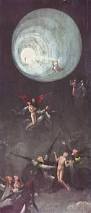
In a famous painting of Hieronymous Bosch, (1450-1516), "Visions of the Afterlife" several aspects of a NDE experience are depicted, such as the light, the ascent, the tunnel. (Van Lommel found that the "tunnel experience" was present in only 21% of his cases, however.)
4. "Encounters with Spiritual Beings And/Or With the Deceased"
Whenever a NDEer encounters someone known to him or her, that person, often a relative, is no longer among the living. Despite all the varied aspects of a NDE, there are no exceptions to this fact. I find this to be astounding. If we were dealing with usual dreams here, one would expect that an NDEer, entering, say, the tunnel, would see at least occasionally see close family members on the earthly side, begging him not to depart. This is never the case. There are no good-byes at the beginning of the tunnel.
In the final scene of Faust, there is no one among the living who witnesses Faust's apotheosis. Even Mephistopheles, who defined himself in the first part as "a part of that power"--has disappeared, since the deepest reality does not include his, at best, partial, subjective, truths. The only encounter Faust with someone known to him on earth is with "una poenitentium, formerly known as Gretchen" who rejoices as Faust's returns to her. Gretchen asserts: "Surrounded by the noble chorus of spiritual beings/The new arrival is scarcely conscious of fresh life..See how he is leaving behind the bonds of earth of the old shell.. .Give me permission to instruct him;/ The new day is blinding him still." This request is granted by the Mater Gloriosa, the Virgin in her Glory, as opposed to the statue of the "Mater Dolorosa" of the first act, depicted as mourning the crucifixion of her Son.
As stated before, the diamond is now apparent, but still has traces of mud on its surface and in need of further cleansing. Gretchen will restore it to its original brilliance by teaching Faust something that was so very lacking in his earthly existence, love.
5. Universal and Culturally Bound Aspects
As mentioned earlier, unconditional love is experienced in virtually all NDEs. This is also astounding. One would expect that Westerners, whose religions assert that the good will be rewarded and the bad be punished in the afterlife, would not always encounter absolute acceptance in their NDEs. There is almost never any aspect of judgement in a NDE. The myth of Christ welcoming those on His right to heaven and condemning those on the left to hell proves to be just that, a myth; it dies with the body of the NDEer. It is truly noteworthy that an important aspect of the teaching of the three Abrahamic religions, namely, some form of judgement, is completely absent in the dying minds of NDErs who practiced one of these religions during life.
Other aspects of NDEs are not universal. NDErs often interpret the beings they encounter according to the religious symbolism they had been familiar with in life. Christians often see Jesus; Jews, Hindus, etc. don't. This for me provides evidence that Faust is having a NDE-like experience. Many of the spiritual beings he encounters have their origin in Christian, specifically Catholic, mythology. This is the faith in which Faust grew up. (I imagine that by the time Faust is perfected, the cultural myths will have abated, leaving nothing but everything, the diamond of universal consciousness.)
In Part 1 of Faust, Faust contemplates suicide because he despairs of ever reaching universal knowledge. It is Easter morning and he hears the joyous sounds of Christians celebrating the Resurrection. Even though he does not believe that the Resurrection ever occurred, he is swept away with joy. It reminds him of the delights Easter provided in his childhood. The celebrations invade his being and turns him away from suicide. "Earth has me again", he asserts. Although the Church can never have him again, its symbolism remains deep inside him. This is, I think, why Catholic mythological figures appear at the end. It is his NDE; it contains universal truths as seen and imagined according to the cultural tradition in which Faust was raised. The faces might be different, but what's behind them is the same. I think Goethe, a lapsed Protestant who asserted that he was decidedly not Christian, uses these symbols because they would be familiar to Faust as he reaches the first stage of his transfiguration. This is consistent with my statement that Faust is now part of the audience, experiencing the afterlife in terms he would understand.
What the angels, having carried "Faust's immortal part" into the higher realm, proclaim in lines 11936-11937 is one of the most famous and most important revelations of the drama: "We are able to redeem those/Who never cease to strive." This is undoubtedly what Faust, now in the audience, as it were, would want to hear. (It is also undoubtedly what the ever-active Goethe would want to hear as a revelation from on high.) But the angels that Goethe imagines do not leave it at that; they delve deeper into the essence of things. The lines are ambiguous; they are a "this side/that side" welcome. Faust needs to hear something he can relate to, the "this side" aspect for one whom "the new day still blinds." But it subtly leads Faust beyond, the "that side" aspect of the lines. The German word for redeem, "erlösen," also means to release, in this case, release from chains. That type of striving is now over! In addition, the angels do not proclaim that only the strivers are redeemed; that they can redeem the active does not imply that they can't redeem contemplatives. As stated previously, they are perfectly capable of redeeming everyone. (A less driven person might well hear the angels proclaim, "We can redeem (release from all chains) those who were satisfied with what they had."
All earthly striving is now to be transcended and replaced by something deeper which really isn't striving at all. This view is proclaimed by the Mystical Choir, in the famous last lines of the play, which sums everything up for Faust and for us all: "Everything that is not permanent/Is merely a symbol;/ What cannot be reached/Is reached here;/What can't be described/Is accomplished here/ The eternal-feminine/ pulls us on." The "eternal-feminine", of which Gretchen was a good example, is the power of love. Notice that Goethe has this power pull us. This is reminiscent of NDEers who feel them selves being drawn rapidly into a realm of light. It is a passive process. Faust sees his immortal part being taken rather than striving towards ultimate reality. At this point, one no longer has the choice of rambling through space, as it were; the individual satellite has come sufficiently close to be captured by the gravity of the transcendent realm--it will and must land there without any further action of its own. It is a dis-covering, an uncovering of the diamond inside. Faust is finally learning his lesson, the lesson. Love, not egotistical striving, is what ushers in eternity. There are many aspects of the drama that apply to humanity as a whole, and this is the most important of all of them. I think Goethe would agree with me that this is something, better sooner than later, that we will and must learn, too.
Summary
The last two scenes of Faust Part 2 reveal several typical aspects of a NDE, something, to my knowledge, that has never been asserted before. Whatever a NDE is, it certainly illustrates what a dying mind universally deems to be of the utmost importance. Although NDE-like experiences have occurred throughout all times and cultures--albeit not with the frequency of today, due to increased awareness of these encounters--there is no evidence that Goethe had any knowledge of this phenomenon. It is more likely that Goethe, who had profound knowledge of the deepest truths of the human condition, revealed these universal truths at a time for Faust when all earthly vanities are cast away, namely, after death. This after-death revelation is the essence of virtually all NDEs. This is why Goethe's deepest insights have so many characteristics of those who have had transcendent experiences after clinical death; this is why understanding NDEs helps us see Faust's salvation in a new light. Whether he was aware of it or not, Goethe thus depicted a NDE-like experience in the last two scenes of his great play, perhaps the most beautiful and profound example of such in all literature.
Goethe Essays by Thomas Dorsett
(All are accessible on the internet by googling the title in question along with thomasdorsett, or by accessing my blog, thomasdorsett.blogspot.com)
1. Goethe's Prometheus
2. Wanderers Nachtlied ll
3. Who Never Ate His Bread in Tears
4. Goethe's Wanderers Nachtlied und ein Einfacheres
5. A Fictional NDE-like Experience from Goethe's Faust Part 2
6. An Analysis of Two Schubert/Goethe Lieder
Faust is perhaps the most ambiguous of all literary masterworks. Criticism of Dante's Inferno might range from A to D; criticism of Shakespeare's Hamlet might range a little farther into the alphabet than that. In other words, critics basically agree; there is not a school of thought, for instance, that considers Hamlet to be a rogue, while another group of scholars considers Hamlet to be a saint. But criticism of Faust entails the entire alphabet--Some critics might have an A view, as it were, while others have a completely opposite Z view. This is true of no other major work of literature with which I am familiar.
The ending of part two of the tragedy is especially problematic. I offer in this essay a new angle from which to view the ending, one that goes beyond, as it were, the entire alphabet! Before we turn to the ending, however, I would like to summarize briefly part one and part two, emphasizing the aspects that make the ending incongruous for some, inevitable for others.
FAUST
Goethe, born in 1749, published the final version of Faust Part 1 in 1808. There is an earlier version called the Urfaust in which most of the elements of the drama first appeared; it dates from the 1770s when Goethe was in his twenties. Faust Part Two, as mentioned previously, was published in 1832; Goethe had been working on it for decades, and was still perfecting and adding to it in his eighties.
The story of Faust is well known, so I will be brief. Faust, the most prominent scholar of his age, is dissatisfied. He is after Truth, not truths. He understands that "we are not able to know," which drives him to despair. Revelation, which guided mankind in the past, is of no use in the post-Kantian pseudo-medieval modern world which Faust inhabits. ("I hear the Gospel, but I lack belief.") He makes a pact with the devil; if Mephistopheles can enable Faust to experience eternity, even for a moment, the scholar is willing to forfeit his soul. Since trying to find Truth through knowledge has proven to be futile, the devil suggests that the inexperienced Faust might find what he is looking for in the world of sensuality. Faust's youth is restored; a love potion fills him with desire. He seduces a young, beautiful innocent girl, Gretchen, who is his social inferior. As she relates in an immortal poem, Gretchen at the Spinning Wheel, her peace has been destroyed. Faust gives her a sleeping potion; she is instructed to slip it into her mother's drink, so he can seduce Gretchen at home while the older woman sleeps. She never wakes up. Gretchen becomes pregnant; Faust abandons her. Her brother curses her for the shame she has caused and dies in a duel with Faust, who is aided by the devil. Having gone mad with grief, the poor girl drowns her newborn daughter; she is condemned to death for this crime. Faust, spirited to the prison by Mephistopheles, attempts to save her, but it is too late.
The Faust of Part One is a rogue. In his striving for Truth, he is completely amoral. ("I have neither scruples nor (self) doubts, and do not fear hell or the devil." A classic example of a noble end supposedly justifying ignoble means. The Faust of Part Two continues his ceaseless striving, but with a major difference: in the first part, Faust is responsible for the deaths of four members of one family; in part two Faust seeks and obtains enormous political power and affects--and destroys--many lives. With the devil's help, he mercilessly decimates the army of one who has declared himself emperor, since the current one is an unjust fop. Prior to the devil's intervention, the alternative and presumably more just emperor's side was winning. As a reward for his savage victory, Faust requests and receives from the emperor a coastal area; his life work now is to reclaim huge stretches of land from the sea. (Perhaps a symbol of his working against nature rather than with it.) The land reclamation proceeds with the devil's help--it would have been impossible without it. Faust dies, an old man, before his life work is completed.
THE A AND THE Z OF IT
As mentioned previously, the interpretation of Goethe's work has been quite problematic. The "A" interpretation asserts that Faust, after committing many misdeeds, sincerely repents and is justified for being proud of his land-reclamation project which will, in his opinion at least, provide a major benefit to mankind. The "Z' view is that Faust remains a miscreant to the very end. If the latter case is true, his salvation at the end is gratuitous and completely undeserved. Let us now briefly discuss the arguments of each side.
The so-called "perfectiblists" assert that Faust attains the height of moral existence, after a life of misdeeds, before his death. This has been the standard view, and, until relatively recently, had remained largely unchallenged. Alleged proof of this transformation occurs in several sections at the end of the text. Faust is furious that a loving, elderly couple, Philemon and Baucis, still live on the coastal area which he has received from the emperor. (Baucis asserts that Faust's project was morally very suspect. She asserts, correctly that he used slave labor and utilized "black magic" to assist him in the construction, which took place mostly at night.) Faust, bent on owning everything on the land he is working on, decides to forcibly evict the couple. His henchmen, along with Mephistopheles--possibly accomplishing Faust's secret desire--terrorize the couple who die on the spot. Their property catches fire and burns down. Faust curses their action and washes his hands of it--he insists that he merely demanded their eviction, not their demise. This has been interpreted by some as genuine repentance. Later on, immediately before Care (that is, Anxiety, in the form of a woman) blinds the 100 years old Faust, he admits the following (in my rough translation): "I have only desired and accomplished, storming powerfully through my life; previously I was big and tough; now I proceed cautiously with wisdom." In his last monologue, Faust asserts the importance of his legacy and is convinced that "the traces of his life on earth will last forever."
The "Z" critics--and I cast my lot in with them--find no evidence of a great moral awakening; Faust remains immoral--or amoral--to the very end. He repents about what happened to the elderly couple--but these are merely words and are not followed with any change in behavior. His assertion that he "only desired and accomplished" does not result in any moral transformation either. His assertion that he now "proceeds cautiously and with wisdom" is more due to the fact that he is 100 years old, rather than due to a moral epiphany. In his final monologue he is as grandiose and self-centered as ever. Faust for the "Z" critics is a man who uses any means whatever to reach his ends. He shows not the slightest concern for his enslaved workers. He has caused considerable pain and suffering in the first part and a good deal more in the second part. He is, in this view, a megalomaniac and a scoundrel. The final two scenes, in which heavenly hosts declare him saved and then transport him to heaven, appear to this group of critics as to be either a parody or an unconvincing deus ex machina ending--albeit without the appearance of a god. I would like now to present my interpretation, in which Faust remains an unredeemed rogue throughout both parts of the play--and yet, at the end, is worthy of redemption.
FAUST'S TRANSFIGURATION AS A NEAR-DEATH-LIKE EXPERIENCE
Immediately before his final monologue, the blind Faust leaves his palace, pleased by the sounds of workers. He believes he is hearing sounds of construction on his land-reclamation project: "How the sound of spades delights me/ This is the mass of people indentured to me/ who reconcile earth with earth/ who give no borders to the waves/ and give strict limits to the sea." (lines 15139-15143.) Once again, Faust is deluded--the sounds he hears are from demons digging his grave. Faust subsequently dies and is placed in the freshly dug grave. "The terrible jaws of hell" open on stage left. Mephistopheles is ready to claim Faust's soul according to the terms of the wager. Then something miraculous happens. This "something" as we shall see, has many of the characteristics of a near-death experience.
In the stage directions, Goethe writes that a "Glory above from the right" appears. This has been translated by David Luke (Oxford University Press) as "A flash of glory from above right." We are now experiencing the brilliance of the divine light becoming manifest in the world; such epiphanies had often been depicted in medieval art as a vision of a saint, which takes the form of a brilliant apparition above him, as we can see in a rather typical painting of that era by Hans Baldung Grien, (1511).

The heavenly hosts bear glad tidings for Faust's immortal part: "Come in serene flight, ye divine emissaries, animate dust and forgive sins--Reveal friendly hints to all natures, all ye hosts floating above," (lines 11676-11684). The message of the angels is clear: they proclaim that in the divine realm all individuals are completely forgiven, no matter what they have done on earth. Thus, Faust deserves redemption as much as anyone else. A chorus of angels then strews roses from above, symbols of divine, unconditional love.
Already two major characteristics of a near-death experience have become manifest: a flash of divine light from above and the revelation that all--in this case Faust assumes the role of an Everyman--deserve and receive unconditional love from on high.
Near-death experiences, visions of an afterlife by those in a coma or determined to be clinically dead for a period of time, are remarkably consistent. This article does not claim, nor does it absolutely deny, that these experiences transcend the psychological; it does, however, assert that NDEs show a remarkable consistency and reflect deep insights into the human condition. As archetypes of our collective unconscious, their contents illustrate innate, profound patterns of thought and belief. It is therefore not completely surprising that Goethe, who had a a deep understanding of human nature, ended his great drama with great final truths. (That these truths are expressed in ways consistent with NDEs is, however, quite remarkable.) It is quite possible--even likely-- that Goethe believed that what happened to the fictive Faust after his fictive death could happen to real, flesh and blood people after death. (It has been documented that Goethe thought that death is not final.)
Pim van Lommel, a Dutch cardiologist, has done much research regarding NDEs. Examples of his research have appeared in many prestigious journals, including The Lancet. He is the author of the well-received "Consciousness Beyond Life; the Science of the Near-Death Experience", which I have reviewed. To his surprise, he discovered that about 20% of 62 of his patients who suffered clinical death had an NDE. All of the patients had cardiac arrests and had come under his care for this reason. We will use his book, and especially Moody's list of typical Near-Death Experiences, on which van Lommel elaborates, as a reference as we discuss Faust's final moments. (Moody, the author of the 1975 Life After Life is a seminal figure in the field of NDEs.)
I have found five aspects of a NDE that apply to Faust. We have already briefly mentioned two; I will now proceed to discuss these two in more detail along with the three other aspects.
1. "The Perception of a Brilliant Light or a Being of Light"
We have already seen that a flash of light appears after Faust's death radiating from a whole host of beings of light. Although they initially appear above the stage on the right, they and their light soon permeate the whole stage.
2. Unconditional Love
On page 284 of his book, van Lommel writes, "During a NDE, the encounter with 'the light' is felt to be the most intense and most essential part of the experience. This encounter is always accompanied by an overwhelming sense of unconditional love and acceptance. At this point NDErs feel completely enveloped by the enlightening and all-encompassing consciousness."
We have already mentioned corroboration of this factor in the play's final two scenes. The roses strewn by the celestial beings represent unconditional love; the angels declare that forgiveness of sins applies to "Allen Naturen" that is, to everybody. The angels (lines 11800-11805) leave no doubt that love and forgiveness are always finally victorious: "Loving flames, reveal clarity/So that Truth can heal/Those who condemn themselves/So that they cheerfully/Leave evil behind/In order to blessedly join/ Universal unity." What could be clearer? Faust had "condemned himself" throughout his entire life by thinking only about himself and by acting extremely selfishly throughout. (Faust here represents all humanity; every religion has its version of "we have all gone astray.") It is important to note that the angels proclaim as a general rule that truth will heal those who condemn themselves by committing evil.
Critics, even those in the so-called "A" group who assert that Faust has genuinely repented, have always found Faust's redemption to be problematic. As one might expect, the "Z" critics, who assert that Faust remains a scoundrel to the very end, find the ending offensive and completely unjustified. It makes no sense to them. It turns conventional (that is, earthly) morality on its head. But that's precisely the point. Let us turn to an assertion of Zen Buddhism for clarification here. Zen philosophy asserts that deep down we are all enlightened. No exceptions. There is, as it were, an indestructible diamond inside everyone. Our ignorant and evil deeds cover up the diamond with mud. In some individuals, the layer of mud is very thick, in others, less so. Enlightenment--represented by the universal truths manifested by the divine beings after Faust's death--washes the mud away, no matter how thick it had become. The diamond is then visible, although it may still need further cleansing, as we shall see in Faust's case. The manifestation of this diamond--which some can achieve in life--is redemption. In this interpretation, one's true self, the diamond, is always there, no matter how concealed. Uncovering this eternal diamond is inevitable; mud, the superficial layer, is not immortal and is eventually washed away--after death, or sometimes, (rarely) before. In this interpretation, therefore, Faust's redemption isn't problematic at all. That he possessed an internal diamond in no way justifies the thick layers of mud Faust accumulated in his lifetime.
One might object here that in a NDE the person is conscious--albeit with a higher consciousness--throughout. At the end of the tragedy, Faust is really dead; there is no indication that he is conscious of his redemption. Or is there? We will now assert, with evidence presented by the next three points, that Faust might indeed aware of what is going on.
3. The Out Of Body Experience
A bodiless consciousness, often observing the inert body of the observer, is a hallmark of NDEs. "During an out-of-body experience," Dr, van Lommel writes, "people have verifiable perceptions from a position outside and above the lifeless body" (page 19). How does this apply to Faust?
In my interpretation, Faust has left his inert body; his consciousness has now left the stage to become, as it were, part of the audience. From his new vantage point, Faust is observing everything. We will give further evidence to support this view a little later.
A critic, J.M van der Lamm, an ardent member of the "Z" group, finds Faust's redemption to be completely unacceptable. He asserts that "Faust has nothing to say or do in the last scene. He has neither power nor authority, but rests in the arms of attending angels. They carry him, or that which remains of him and is immortal,...providing the motion of which he himself is now incapable. The great man of action is now the man of inaction," (Seeking Meaning for Goethe's Faust, Continuum International Publishing Group, London, 2007, page 151). What is gratuitous for him is inevitable for me: the mud has been washed away. I would refer Mr. van der Lamm to the quote of Goethe on the the very first page of his book: Wir sind Originale weil wir nichts wissen--that is, "We are individuals because we know nothing." When the truth is revealed, the mud disappears and the diamond is manifest. He is not now "a man of inaction"--he has become part of a universal consciousness on its way home. "The great man of (destructive) action" is now, thankfully, dead. The diamond, the essential nature of everyone and in everyone, shines on.
In a famous painting of Hieronymous Bosch, (1450-1516), "Visions of the Afterlife" several aspects of a NDE experience are depicted, such as the light, the ascent, the tunnel. (Van Lommel found that the "tunnel experience" was present in only 21% of his cases, however.)
4. "Encounters with Spiritual Beings And/Or With the Deceased"
Whenever a NDEer encounters someone known to him or her, that person, often a relative, is no longer among the living. Despite all the varied aspects of a NDE, there are no exceptions to this fact. I find this to be astounding. If we were dealing with usual dreams here, one would expect that an NDEer, entering, say, the tunnel, would see at least occasionally see close family members on the earthly side, begging him not to depart. This is never the case. There are no good-byes at the beginning of the tunnel.
In the final scene of Faust, there is no one among the living who witnesses Faust's apotheosis. Even Mephistopheles, who defined himself in the first part as "a part of that power"--has disappeared, since the deepest reality does not include his, at best, partial, subjective, truths. The only encounter Faust with someone known to him on earth is with "una poenitentium, formerly known as Gretchen" who rejoices as Faust's returns to her. Gretchen asserts: "Surrounded by the noble chorus of spiritual beings/The new arrival is scarcely conscious of fresh life..See how he is leaving behind the bonds of earth of the old shell.. .Give me permission to instruct him;/ The new day is blinding him still." This request is granted by the Mater Gloriosa, the Virgin in her Glory, as opposed to the statue of the "Mater Dolorosa" of the first act, depicted as mourning the crucifixion of her Son.
As stated before, the diamond is now apparent, but still has traces of mud on its surface and in need of further cleansing. Gretchen will restore it to its original brilliance by teaching Faust something that was so very lacking in his earthly existence, love.
5. Universal and Culturally Bound Aspects
As mentioned earlier, unconditional love is experienced in virtually all NDEs. This is also astounding. One would expect that Westerners, whose religions assert that the good will be rewarded and the bad be punished in the afterlife, would not always encounter absolute acceptance in their NDEs. There is almost never any aspect of judgement in a NDE. The myth of Christ welcoming those on His right to heaven and condemning those on the left to hell proves to be just that, a myth; it dies with the body of the NDEer. It is truly noteworthy that an important aspect of the teaching of the three Abrahamic religions, namely, some form of judgement, is completely absent in the dying minds of NDErs who practiced one of these religions during life.
Other aspects of NDEs are not universal. NDErs often interpret the beings they encounter according to the religious symbolism they had been familiar with in life. Christians often see Jesus; Jews, Hindus, etc. don't. This for me provides evidence that Faust is having a NDE-like experience. Many of the spiritual beings he encounters have their origin in Christian, specifically Catholic, mythology. This is the faith in which Faust grew up. (I imagine that by the time Faust is perfected, the cultural myths will have abated, leaving nothing but everything, the diamond of universal consciousness.)
In Part 1 of Faust, Faust contemplates suicide because he despairs of ever reaching universal knowledge. It is Easter morning and he hears the joyous sounds of Christians celebrating the Resurrection. Even though he does not believe that the Resurrection ever occurred, he is swept away with joy. It reminds him of the delights Easter provided in his childhood. The celebrations invade his being and turns him away from suicide. "Earth has me again", he asserts. Although the Church can never have him again, its symbolism remains deep inside him. This is, I think, why Catholic mythological figures appear at the end. It is his NDE; it contains universal truths as seen and imagined according to the cultural tradition in which Faust was raised. The faces might be different, but what's behind them is the same. I think Goethe, a lapsed Protestant who asserted that he was decidedly not Christian, uses these symbols because they would be familiar to Faust as he reaches the first stage of his transfiguration. This is consistent with my statement that Faust is now part of the audience, experiencing the afterlife in terms he would understand.
What the angels, having carried "Faust's immortal part" into the higher realm, proclaim in lines 11936-11937 is one of the most famous and most important revelations of the drama: "We are able to redeem those/Who never cease to strive." This is undoubtedly what Faust, now in the audience, as it were, would want to hear. (It is also undoubtedly what the ever-active Goethe would want to hear as a revelation from on high.) But the angels that Goethe imagines do not leave it at that; they delve deeper into the essence of things. The lines are ambiguous; they are a "this side/that side" welcome. Faust needs to hear something he can relate to, the "this side" aspect for one whom "the new day still blinds." But it subtly leads Faust beyond, the "that side" aspect of the lines. The German word for redeem, "erlösen," also means to release, in this case, release from chains. That type of striving is now over! In addition, the angels do not proclaim that only the strivers are redeemed; that they can redeem the active does not imply that they can't redeem contemplatives. As stated previously, they are perfectly capable of redeeming everyone. (A less driven person might well hear the angels proclaim, "We can redeem (release from all chains) those who were satisfied with what they had."
All earthly striving is now to be transcended and replaced by something deeper which really isn't striving at all. This view is proclaimed by the Mystical Choir, in the famous last lines of the play, which sums everything up for Faust and for us all: "Everything that is not permanent/Is merely a symbol;/ What cannot be reached/Is reached here;/What can't be described/Is accomplished here/ The eternal-feminine/ pulls us on." The "eternal-feminine", of which Gretchen was a good example, is the power of love. Notice that Goethe has this power pull us. This is reminiscent of NDEers who feel them selves being drawn rapidly into a realm of light. It is a passive process. Faust sees his immortal part being taken rather than striving towards ultimate reality. At this point, one no longer has the choice of rambling through space, as it were; the individual satellite has come sufficiently close to be captured by the gravity of the transcendent realm--it will and must land there without any further action of its own. It is a dis-covering, an uncovering of the diamond inside. Faust is finally learning his lesson, the lesson. Love, not egotistical striving, is what ushers in eternity. There are many aspects of the drama that apply to humanity as a whole, and this is the most important of all of them. I think Goethe would agree with me that this is something, better sooner than later, that we will and must learn, too.
Summary
The last two scenes of Faust Part 2 reveal several typical aspects of a NDE, something, to my knowledge, that has never been asserted before. Whatever a NDE is, it certainly illustrates what a dying mind universally deems to be of the utmost importance. Although NDE-like experiences have occurred throughout all times and cultures--albeit not with the frequency of today, due to increased awareness of these encounters--there is no evidence that Goethe had any knowledge of this phenomenon. It is more likely that Goethe, who had profound knowledge of the deepest truths of the human condition, revealed these universal truths at a time for Faust when all earthly vanities are cast away, namely, after death. This after-death revelation is the essence of virtually all NDEs. This is why Goethe's deepest insights have so many characteristics of those who have had transcendent experiences after clinical death; this is why understanding NDEs helps us see Faust's salvation in a new light. Whether he was aware of it or not, Goethe thus depicted a NDE-like experience in the last two scenes of his great play, perhaps the most beautiful and profound example of such in all literature.
Goethe Essays by Thomas Dorsett
(All are accessible on the internet by googling the title in question along with thomasdorsett, or by accessing my blog, thomasdorsett.blogspot.com)
1. Goethe's Prometheus
2. Wanderers Nachtlied ll
3. Who Never Ate His Bread in Tears
4. Goethe's Wanderers Nachtlied und ein Einfacheres
5. A Fictional NDE-like Experience from Goethe's Faust Part 2
6. An Analysis of Two Schubert/Goethe Lieder


.png)

