11.30.2013

Do You (Still) Have My Back?

Yes, Mr. President, I still have your back.

                                            1. Introduction

That's the question (and my answer) that I recently received, part of a fundraising letter from Democrats.org.  On the envelope I was asked if I still supported Obama.  The letter began with a check-off box indicating Yes, Mr. President, I still have your back!  There were no other choices; the only other boxes to check were to indicate the amount of a hoped-for donation.

Along with the letter came a little bumper sticker,  It states in blue type: I've Got His Back,  This slogan was used in the presidential campaign.  The difference now is that the word "still" is inserted (in red) between the first two words.   Uh-oh, Mr, President, your presidency is in trouble; it's currently in the worst state since you were first elected president in 2008. What happened to Yes, we can?

 Obviously you and your supporters have had to watch your back since a hysterical, hyperpartisan opposition has been relentlessly trying to stab you there since you were elected. Yet major wounds to your presidency have been self-inflicted, such as those resulting from failing to adequately inform the public what you have done and what you are doing, thus allowing the Republican disinformation efforts to be more effective.  The disastrous rollout of your signature legislation, the much needed Affordable Care Act--problems which you should have anticipated and prevented--has caused major damage..  Republicans are no fools; they know that once health care is fully enacted, people are going to like it.  It is a delicate time now; health care reform is in danger, and it is partially your fault that it is.  

                                             2. The Voyage of a Political Life

The health care debacle has taken you to a new place in your political career.  I would like to illustrart that career now, with the help of Thomas Cole's series of paintings entitled, The Voyage of Life

                       Stage One: Political Infancy                                                   


You came from nowhere, symbolized in the painting by a dark cave.  (That's you as a happy infant in front of your guardian angel.) Raised largely by your mother, you were smart and showed great promise.  You went to Harvard and graduated in the upper ten percent of your class.  You studied law and became the editor of the Harvard Law Review.  Quite a distinction.  After that, you had a successful stint as a community organizer in Chicago.  Right from the beginning, you were helping the poor and middle class, a noble and lasting characteristic of your personality.


                                                    Stage Two: Politics
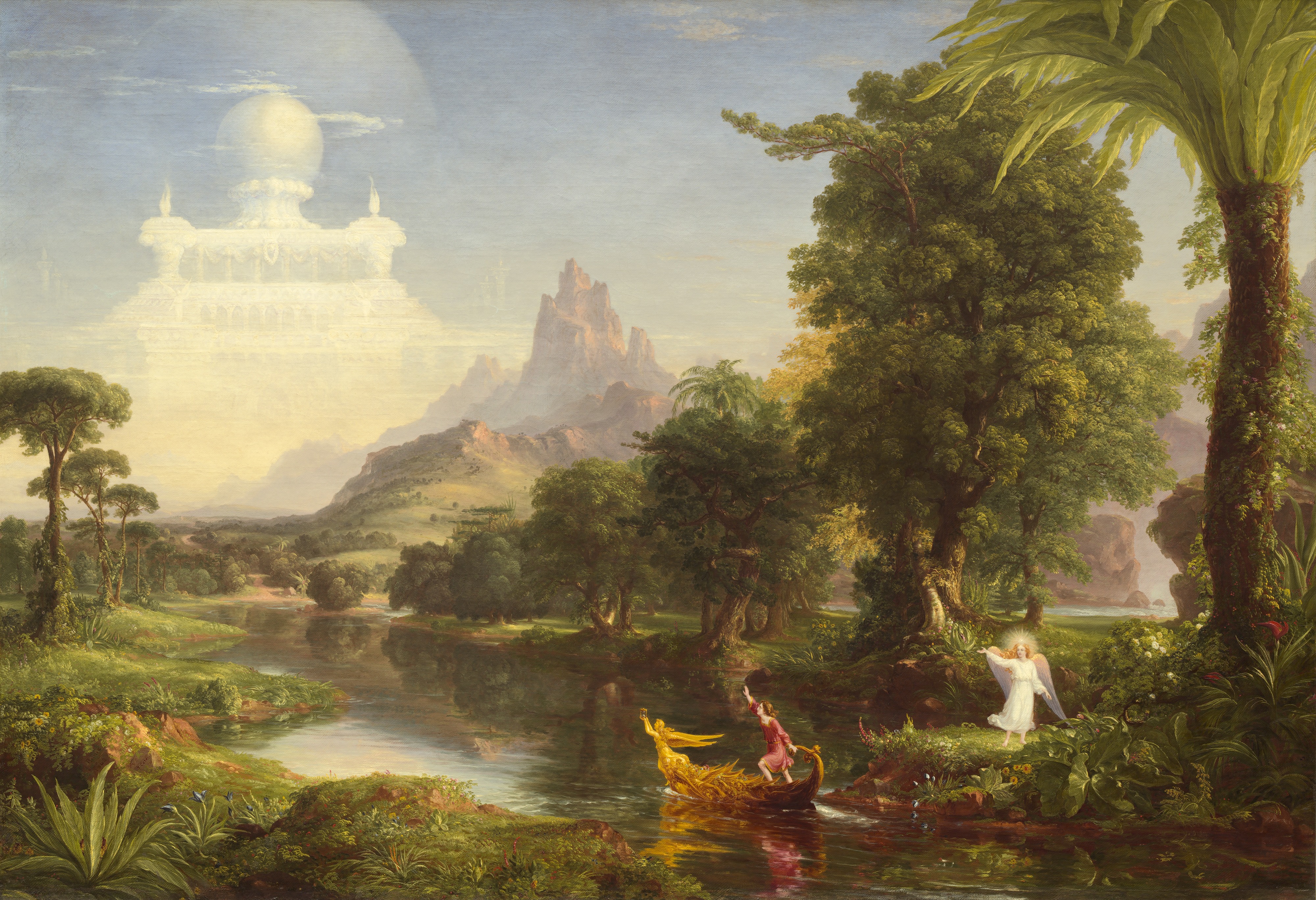

A great career has been launched!  You ran for the senate of Illinois and won, and served as senator from 1997-2004.  You sponsored and supported many bills, involving ethics and health care, etc.  You sponsored and got passed the first law in the United States that requires videotaping of police interviews in potential homicide cases.  What is striking about your stint as state senator was how well you worked with Republican legislators; much of the legislation you advocated received, with some give and take, bipartisan support.   You were obviously going places.  From 2005-2008 you served as one of the two U.S. senators from Illinois.  You opposed the Iraq War from the beginning and did not vote for it, unlike Hillary Clinton.  You were involved with much legislation, one of which bears your name.  You sponsored the Democratic Republic of the Congo Relief, Security and Democracy Promotion Act, which President Bush signed into law in 2006.  You conducted a poll to see if you had the support to run for presidency; you were certainly an underdog, but you took the chance.  And it paid off--Hillary Clinton's campaign was not run nearly as well as yours.  You inspired the young, and ran a very digitally sound campaign.  You received the nomination, and won.  Yes we can, you told enthusiastic throngs.  We will put an end to politics as usual; we will work together with Republicans and usher in a new age of cooperation and achievement.  You received a terrible legacy from President Bush, whose disastrous policies created the worst recession since the Great Depression.  Although you were vociferously opposed by Republicans from the beginning, you achieved great things.  Here is a partial list: millions of jobs have been created during your presidency; you passed a much needed stimulus program; you saved the auto industry; you eliminated bin Laden; you ended the war in Iraq; you passed new fuel efficiency standards which will eventually cut auto emission by about 50%; you reduced the deficit; reached an accord with Iran regulating the development of nuclear weapons--all truly stellar achievements.  You are the first president since Roosevelt to receive the majority of the popular vote in two elections. Let's not forget, of course, your signature legislation, the Affordable Care Act, which--at last! provides health care to all.

                                         
                                                    Stage Three: Approaching the Rapids


In 2010, the Democrats lost control of the House, thanks largely to their having gerrymandered their districts.  (The Democrats actually received a majority of the votes in the red states.)  Since then opposition has been fierce.  The mad hatters of the Tea Party took over the Republican Party and refuse to compromise on anything.  You've been called many thing,s including a socialist, a Nazi,  a communist, a Muslim, etc.  Filibusters are to be used judiciously to assure that the minority party has a voice; the Republicans used it to a really unprecedented degree to oppose you on everything.  (Fifty percent of the filibusters in the entire history of the United States have been used against you.  You would not be able to fill any positions if the senate had not been forced by your irresponsible opponents to change the legislation regarding the use of filibusters.)  Your popularity has plummeted.  The latest poll registered doubts even about your honesty.  The downward spiral has been caused in large part by the failure of the computerized exchanges to deliver, a failure that has come at a very critical time in your presidency.  Will you be able to backpaddle and be towed against the current by a more competent staff?  Will you be able to return to calmer waters?  Is this the beginning of stage four?
 

                                                     Stage Four: The End of Your Career


Here we see an old man in a broken vessel.  His Guardian Angel shows him the light above.  Perhaps it is heaven; perhaps it's just a light under which he can write his memoirs.  Old age is a symbol here; you have lost your power and are no longer of any consequence, even though you might only be in your fifties.  The Republicans have been trying to get you to this stage since you were elected president.  The Tea Party would have won if you came prematurely to this stage; to celebrate your defeat there would be a lot of Republicans--especially John Boehner--drinking more than tea.  They might have a good chance now to repeal the ACA, thus nullifying your legacy and causing the American people significant suffering.  This is indeed a possibility, since the public has not felt the beneficial effects of universal health care as yet and are woefully ignorant on the subject.  Stage Four is not inevitable any time soon.  Even a bad man like Scrooge received a vision and changed his life around.  You, a good man, can change around the difficulties you--and we--are in.  I am confident you will be able to do so.


                                            3. Why Do They Hate You?

I can't remember any time in my lifetime--and I am not young--when political opposition has been so hateful and destructive.  As Rush Limbaugh, a fanatic Republican commentator, and Mitch McConnell, the Senate minority leader--both speaking for the majority of Republicans, I'm afraid-- stated,  their primary objective is to see to it that Obama fails.  Not to see America prosper, mind you, but to see to it that our president fails.  Everything that the president tries to do is thus vociferously opposed.  A huge disinformation campaign is in effect, and it has been quite successful.  Any yes that is achieved is despite a right-wing that automatically says no.  Why this fanaticism that is so harmful not only to the country but to Democrats and Republicans as well?  (The tantrum-like temporary shut-down of the government did not benefit the Republican party.)  What is the reason for this unprecedented destructive partisanship?
Racism is often cited as a reason, and no doubt this is partially correct.  But I don't think this is the main reason why Republican leaders oppose Obama.  I don't think the Koch brothers would have any problem breaking bread with Clarence Thomas or Alan Keyes.  The real reason, I think, is that Republican oligarchs are terrified by the prospect of a successful Democratic president.  The Republicans are a minority party--most Americans are not filthy rich--they fear that their power will be diminished by a party that sees the horrible inequality of our country as a problem.  The two recent presidents that significantly raised the degree of opposition to hysteria are Clinton and Obama.  Note that both of these had/have centrist policies; Clinton for instance required those on welfare to work; Obama for instance has significantly decreased the national debt and has not increased programs such as SNAP, the food stamp program, which, despite the severe economic downturn, has actually been cut.  Despite this centrism, Republican fear that if any Democrat is successful, the days of unchecked oligarchy are numbered.  This is obvious in their fanatic opposition to Obamacare, the plan for which was first developed by a Republican think tank;  an almost identical version of it was implemented in a state by a Republican governor.  Since they are a minority party, the Republicans must trick a not too sophisticated electorate to vote for them if they are to remain in power.  They will find areas where slander will be the most effective; they are really good at this.
With Clinton, it was adultery.  They knew that adultery in a president would cause no scandal in France, but not so in America.  (Prior to Clinton's presidency, politicians were more discrete--Kennedy, Roosevelt, etc had committed adultery also.) So they caused a scandal that had nothing to do with Clinton's ability to govern, and almost ruined his second term.  Mission (almost) accomplished!
With Obama--perhaps an even greater threat to them than Clinton--things were different.  They knew that this upright family man did not have a mistress in his closet.  So they got him on race, not so much because they were racists themselves but because they knew racism was still widespread in America.  The race card would help them trick voters to vote against their own interests, so they played it.  "Barack" to be sure is not a common name in Kansas; they deepened their propaganda against him as a member of a minority by conflating that otherness with the otherness of a supposed foreigner.  The Birther Movement was born.  Once he was deemed "the other" that is, not a true American, it was easy to accuse him of being a socialist, a communist or even a Nazi.  Some of these scandalous accusations had grass-roots origins, but at the very least have been supported by large swaths of the Republican hierarchy.  Some examples of this extremism: one Republican congressman stated that he felt sick just by standing near Obama.  During the shutdown "negotiations," one GOP House leader told Obama outright, "I can't stand to even look at you."  The atmosphere is obviously poisonous.  What has Obama done to deserve this other than the fact that he is black and is working hard for the sake of all Americans?
Your signature legislation may be in danger, Mr. President.  We will briefly discuss how this came to be and how you can turn things around.  First a few words why universal health care is so necessary.

                                      4. The Obvious Case for Universal Health Care

While waiting to get my haircut, I overheard the conversation between a customer and the barber.  The customer was a middle-aged white man from the working class.  He stated that Obamacare is a disaster; premiums will go up--way up--for everybody; the takeover of health care by the government will lead to death panels; the American people are stupid and have been manipulated into trading in their freedom for governmental slavery, etc.  The barber, a middle-aged Korean woman, agreed completely.  When he had left and it was my turn, I gently tried to present her with some facts to the contrary.  She clammed up completely and I gave up.  If this is a typical situation, Republican propaganda has been markedly effective, and the President has done a bad job in informing the public of the truth.  I'm afraid both are true.

The necessity for universal health care has been discussed at length in many articles, so I will only present one slide that says it all:


The United States is an outlier.  Every advanced country has health care; nearly all spend half or less than what we spend on health, yet our country has worse outcomes.  (Mortality rates are obviously the most important indicator of the success of health care delivery.)  Take one example, Italy,  The vertical axis indicates that peopl;e live much longer there than they do in America.  The health care costs per person are less than half of what we pay.  We, in fact, spend almost 18% of our GDP on health care; most other countries, as the chart clearly indicates  pay less than half of what we do per person,--and  with better outcomes.  If all this is true, and it is, how can one imagine that health care costs will not be brought down by the Affordable Care Act?

                                                    5.  Obama's Problem

In Time's cover story of the December 2nd, 2013 issue, entitled "Broken Promise" I read that, as a candidate for the presidency in 2007, you said, "Some in this debate around experience seem to think the job of the President is to go in and run some bureaucracy.  Well, that's not my job.  My job is to set a vision of 'Here's where the bureaucracy needs to go."  How wrong this is!  We didn't elect you to be our Presidential Adviser, but our president.  If a president develops policies wise as Lincoln's but has the political savvy of van Buren, there will be extreme difficulties in implementing those policies.  And implementing them is the bottom line!  Who cares about good laws that are never enacted?  Look, the presidency is  a hard job.  No one can have all the skills needed.  But if you're basically a great policy wonk, yet lack both desire and skill to push your visions into laws, you must see to it that you have people around you who are able to do so.  In that same article was a devastating assessment from Elaine Kamarck, from the Brookings Institution: "The President has never surrounded himself with people who have deep experience in managing government."  You admitted, Mr President, in your Nov. 14 news conference, that you were, among other things, ignorant that there were significant problems with  the national health care web-site.  There is no excuse for that, Mr. President!  It has put your legacy in danger at a very critical time.  Another consequence of your aloofness is that nobody is afraid of opposing you on Capital Hill.  Do you think Lincoln, Roosevelt and Johnson would have gotten their signature laws passed without seeing to it--even sometimes with intimidation--that they could obtain the necessary votes?
Although the news is bad now, it is far from all bad; I still am confident that you will succeed with the health care law, despite the precipitous decline in the polls both for you and this law.  You are too intelligent not to learn your lesson about how government works.  Even better, the health care law is showing signs of success.  Medicaid continues to expand on target in those states where Republican governors have not sabotaged this aspect of the new law.  California, with 38 million people, making it larger than several European countries, is well on target.  Important here is to note that prior to the law, California had many uncovered residents.  A large number are young, and they are signing up in unprecedented numbers--which is of crucial importance if the program is to be successful.  State exchanges in several other states are working well, too--notably in Kentucky and Washington.  The national web site is functioning better now, and improvements will continue to be made, I have no doubt about this.  Yes, there will be problems.  Some people, especially if they work part-time, might lose their coverage from their employers and might have to settle for more restrictive policies from the exchanges.  Some people, especially wealthy young people, will have to pay more.  But prices will undoubtedly follow the pattern established in the rest of the world and come down.  People will have to abandon cheap, shabby policies for better ones that might cost a bit more.  There are generous subsidies to help out the majority of Americans to pay for coverage.  Best of all, the national shame of having over forty million people uncovered will finally come to an end.
But you have shot yourself in the foot and now must swim upstream, bloodied in a river full of piranhas.  Get yourself some help, and you will be successful.  The American people are depending on you!
I will end this essay with The Parable of the Fastidious Woman.

6. The Parable of the Fastidious Woman

Once there was a woman who grew medicinal herbs in her garden.  They did not grow easily and she worked tirelessly because she knew that the herbs could cure an illness that was the plague of many.  After  much effort, she harvested a sufficient quantity of the priceless plants.  She put them in a basket to deliver them to the people that needed them--But there was a problem.  The sick people lived on the other side of a very polluted stream.  There were no bridges.  She would have to wade across the foul stream, if she wanted to help--and that was her fervent desire.  She approached the bank of the stream, but couldn't walk any farther.  She was too fastidious.  She thought for a while, and came up with a solution.  She went to a neighboring town and hired people who were not afraid to get dirty.  They bore her, high above their heads, across the stream.  She delivered the herbs to the sick, after which she was brought back to her garden, where she continued to grow a variety of herbs for the sake of many.  One day she noticed a group of healthy people waving to her from across the stream.  She gave them her best smile.


11.26.2013

The Truth is in Ourselves, Not in the Stars

                                                               1.

I am interested in many things; poetry, music, politics, cosmology  and ethics are prominent among them.  I am decidedly uninterested in many things, too; guns, stamp collecting, Angry Birds, baking and synchronized swimming are among the many subjects I choose not to be subjected to.  To the latter list I must add listening to people debate whether God exists or not.  It seems so pimply-adolescent to me.  I do realize that it is important to point out to fundamentalists and other religious people who take their mythologies to be facts that their "facts' are at best myths and at worst nonsense..  Fundamentalism, which no doubt provides consolation to some, is on the whole quite detrimental.  It often goes in tandem with a denial of evolution; the teaching of so-called intelligent design in schools is undoubtedly creating fetid backwaters in young minds  that need to be cleared by the alembics of scientific reasoning.  So giving clear indications that the Watchmaker's heart isn't ticking is important.  But it is tiresome, since the result of debates between scientific views and backwater religious views are so obvious.  I've watched a few of these debates; scientists have won all of them so far.  But something inside me protests.  Not so fast, it says; it will have more to say in the course of this essay.

                                                            2.

One of the scientists with an almost religious zeal in his fight for atheism, is Richard Dawkins.  He is a great evolutionary biologist; two of his books,  "The Selfish Gene" and "The Ancestors' Tale"  have especially delighted me and made me see evolution in a new way.  He writes exceptionally well and is almost always exceptionally informative as well.  He is also a tireless preacher for atheism.  His book, "The God Delusion" falls considerably short in comparison to his books on biology.  How often can you inform a reader that myths are myths and facts are facts without boring that reader to tears?

I have seen, in spells of insomnia, some of his debates with "true believers" on YouTube.  (These appear "miraculously" as recommendations for me to view, most likely because I frequently write about religion; the internet is apparently omniscient.)  The arguments are always the same.  There is no evidence for a creator.  Things inevitably evolve from the simple to the complex; beginning with God, an incredibly complex being, explains nothing.  Physicists have now posited a reasonable theory that the universe originated as a quantum Free Lunch, and needs no creator as an explanation for everything.  Believing that Jesus is the Son of God because he is portrayed that way in a book written decades after his death  in an age that had no idea about the laws of science is as ridiculous as believing one of the Hindu myths that asserts that creation arose from an ocean of milk.  It is not necessary to believe in God to do good, etc.  All these arguments are undeniably valid to those who refuse to suppress rationality.  Sometimes opponents hold their own for a while, stating science isn't everything, etc.  They eventually devolve, however,  into utter nonsense, such as asserting that Christ is literally present in the Eucharist.

The result is always the same:  Logic KO's Ignorance!  Is that really all there is to it?

Before answering that question, I must tell you my version of a well-known story.  It is a Hasidic tale attributed to Rebbe Simha-Bunam of Pshishkhe.

                                                   3.

Yitzak ben Yekel was a poor Jew who lived in Cracow many years ago.  Outwardly he was not the brightest bulb in the Hasidic community; the light of his piety, however, shone inside him with the light of a thousand suns, even though few noticed.  He was extremely poor; he was saddled with debt and was greatly saddened by the fact that he could not, due to lack of means, not due a lack of their inner and outer beauty, arrange his daughters' marriages.  Although still in the flush of youth, they were not getting any younger, as they say.  But Yitzak's faith in his Creator was unshakable.  He trusted in Him and was convinced that somehow, some way, things would turn out well.
 One night, after going to bed while still hungry, Yitzak had a dream.  He found himself at the foot of a bridge that led to a palace.  A voice from a great height told him, "This is Prague.  The bridge leads over the Moldau, as you can see, to a palace.  Look around you and fix the details in your mind.  You must go to Prague.  Under the bridge you will find a white stone.  Remove the stone and dig.  You will find a great treasure buried there.  Use it to help yourself, your family and your community."
What a strange dream, Yitzak thought the next morning.  Prague is very far away and I have no means for travel.  I will not risk making things worse--things are bad enough already--by following a silly dream.  Then Yitzak went to work, eking out a living as a peddler.
But that was not the end of it.  He dreamed the same dream every night.  He became convinced that he had received a supernatural message that he dare not disobey.  So he set off for Prague.  He had no choice but to travel by foot.
When he finally arrived in Prague, he had no difficulty in finding the bridge and the palace, even though he was exhausted.  But there was a complication: the bridge that led to the palace was guarded by a soldier.  Yi Every day the palace guard watched him walk up and down, shovel in hand, with a troubled expression.  The proud guard, having tried his best not to notice the poor Jew who. he thought,  was undoubtedly crazy, was eventually unable to contain his curiosity.
"Hey you, there!  What do you think you're doing?  Are you mad?  Do you want me to have you arrested?  Why are you here?"
Poor Yitzak was unable to lie.  He blurted out the truth.
The palace guard began to laugh.  Oh, you Jews are so simple-minded!, he said.  A grown man wasting his time on dreams!  I for one had a dream every night for a long time; I ignored it and it went away.  Unlike you, I am a rational man. In my dream, a Jew comes to Prague to find a treasure.  When he arrives in Prague, he learns that he has made a terrible mistake.  He realizes that the journey to Prague was merely a test and that the treasure is to be found under the stove of his humble home.  Ha! Ha!  Do you think I'm crazy enough to believe that? The similarity between your dream and mine is just a coincidence.  Besides, God doesn't answer the prayers of Jews.  Don't you even know that?"
Yitzak realized that he had received a message from a supernatural source--perhaps from an angel--even though the guard was completely unaware of this fact.
He traveled back to his home town as fast as his feet would allow.  He pushed the stove aside and began to dig.  He soon found a fabulous treasure.  He used it, as you may have guessed,  to pay off his debts and get his daughters married.  The rest--a considerable sum--was used to build a synagogue and to help Jews in need in Cracow, of which there were many. Despite his wealth, however, the light of his piety remained undiminished.  The difference was that people who had thought he was merely a shadow of a man--if they had thought of him at all-- now could see it.
The Lord, blessed be He, had answered his prayer without Yitzak ever having put it into words.

                                                                  4.

What does this story have to do with debates about science vs. religion?  Plenty.  We foolishly seek our treasure beyond the stars while it is actually within us. The mystery of mysteries is not in deep space or in religious dogmas; it is consciousness, it is ourselves.  The wonderfully strangest thing that we know of does not have to do with the origin of our universe or the possibility of a multiverse; it is the fact that we are able to learn about such things.  That the vastness of the cosmos is able at least partially fit into our tiny skulls, as it were,  is amazing beyond belief. Stones, as far as we can tell, lack this ability; consciousness is, indeed, the mystery of mysteries.
We take consciousness for granted, yet are at a complete loss to explain the subjective experience of being self-aware.  Sure we are increasingly able to locate areas in the brain involved with perception, but the subjective experience of consciousness, at least at the present, remains completely elusive.  We take consciousness for granted so much that we imagine what we perceive is objective reality.  We actually have no idea, as Kant taught, what objective reality is, or more radically, if anything at all exists beyond consciousness.   (Where do stars go when a cosmologist sleeps?) Knowledge is, in my opinion, the confrontation of consciousness with an unknown substrate, creating our apparently known reality. Consciousness precedes all knowledge; scientists are wrong when they believe to have a body of facts independent of it. (Most scientists know this, they just tend to forget it, since consciousness, the basis of everything, is so basic that it is easily overlooked.)
Cosmologists assert that the laws of quantum physics underlie reality.  They also assert the amazing fact that galaxies are the result of ancient quantum variations!  But we are able to ignore quantum gravity in our everyday lives, since we cannot directly perceive their effects.  But they are indeed there; a great many technological advances would have been impossible without taking these laws into account.  Just so with consciousness: we think of ourselves and the objects of our thought to be  independent entities, but they are not.  Without quantum laws, there would be no world.  Consciousness is even more basic; without it the knowledge contained in the previous sentence would not exist.
We also take for granted the subjective feeling of a personal "I" that seemingly underlies our consciousness.  Modern science--as well as ancient Hinduism-- holds that this subjective feeling is an illusion.  The intuitive feeling of a subjective observer in our heads is probably nothing more than the strongest thoughts or impressions among many in the brain at a given time.  They are responsible not only for awareness, but for the illusion that there is a separate being, our "I," doing the observing.  If the "I" is not an illusion, what constitutes it?  Every atom in our body can be found in inanimate things.  Where are the "I"-carbons, as it were?
Scientific facts are impersonal.  I am certainly convinced that science will never find evidence of intelligent design in creation.  But this evidence is obtained by a vehicle that is convinced that it is a person; the deepest insights of some religions and science reveal this to be an illusion.  But if we are not persons, what are we?  Would we ever treat a daughter as if she were, well, an illusion?  Are we not convinced that our "I's" are real?  Here falls the shadow; the mind results in a profound paradox which I don't think will ever be fully explained. It is indeed a paradox, but it is a live one, and it is here.
So don't bother traveling to Prague; you'll return empty-handed.  Or as the Buddhists say, "Some fish imagine that they're dying of thirst.  How silly!  Don't they realize that they live in water?"

                                                                     5.

Lawrence Krauss, the eminent cosmologist, recently wrote a book entitled, "A Universe from Nothing."  It is a fascinating book; a review of it by me can be found online.  The only tedious parts of the book is his total rejection of religion.  Dawkins, crusader that he is, wrote an afterward.  It contains this glaringly inaccurate statement: "If you ask religious believers why they believe, you may find a few "sophisticated" theologians who will talk about God as 'the Ground of all Isness' or as "a metaphor for personal fellowship" or some such evasion."
Or some such evasion!!  Dawkins here is like Mr. Gradgrind in  Dickens's novel, "Hard Times." Facts, facts, facts; that's all there is.  But I hope I have made it clear that there are no facts without the subjective experience of consciousness.  Professor Dawkins, if you gave some thought to who you really are instead of to what you know, I think you would sing a new tune, one which I have no hesitation of calling a religious or a spiritual one--(I use both terms more or less interchangeably.)   There is more to religion and more to life than becomes apparent in those tiresome debates.

                                                                 6.

Tina Turner famously sang, "What's love got to do with it?"  Consciousness evokes radical amazement, but, you might ask, "What does God have to do with it?"  Nothing or something, I reply; it depends on your choice of words.  (No, Mr. Dawkins, this is not an evasion.) We humans are conscious, but some of our conscious or unconscious actions are sometimes at best stupid or at worst evil.  These actions are largely the results of out-of-control desires of our egos.  Through acts of kindness and wisdom, which help overcome egotistic obsessions, and, importantly, by turning inward, we become aware of something higher. It is so high that it is eventually experienced not as your truth, but as everyone's truth, as Truth itself. And it is not a fact; it can only be expressed metaphorically, such as by using the term, "God." Realizing this, one experiences profound feelings of joy. I have no objection if one chooses to call that something within us God.  I also have no objection if that term is not used, such as in classical Buddhism.  The ineffable experience and the joy it produces are what counts, not what you call it.  Nothing factual or scientific can be said about it, it's just too close to and too far from us.  We can be certain, however, that without this "something higher," without this unknown known there isn't even the possibility of an objective and absolute void, which is Lord-knows-what without consciousness to conceive it.  Our only adequate response to consciousness is the silence of radical amazement.

                                                                  7.

The debate of ultimate importance is thus not between science and religion, but between idle chatter and Silence.  Which side are "you" on?

11.17.2013

DO THEY REALLY BELIEVE IT?

I have always been flummoxed when (at least fairly) intelligent people say outrageous things.  Politicians and religious leaders come to mind; all of us, however, have probably come into contact with people who make ridiculous claims about themselves, a far too common disorder that  goes by the name of narcissism.  I am especially interested in those in positions of power and influence who say things that are patently absurd.  I ask myself, do they really believe it?  Maybe they do.  Another possibility is  they are suppressing their doubts, doing their best to convince themselves of an absurdity, especially in cases where more power and more money are gained thereby.  In other words, maybe they half believe the things they are saying. The third possibility is, of course, that they're lying through their teeth in order to maintain or increase their influence.

We can never be completely  sure which one of these possibilities is paramount, especially in cases of public figures we don't know personally.  But it is both fun and informative to make educated guesses, using logic and our consciences as our guides.  So let's play a game called Do They Really Believe It?  The first example is  from a recent encounter of mine; I will subsequently quote two politicians, one religious leader and end with a quote from that incomparable political commentator, Sarah Palin.  (Note:Among the politicians, we will hear from  a Republican and a Democrat; this article has no political agenda.  I must admit, though, that my conscience informs me that the most outrageous political statements these days are from Republicans.)  In each case I will give my educated guess whether they're lying, half lying, or whether they believe what they said.

You are invited to play along using the comment section at the end of this blog.  Let's begin.

Case Number One: An Unidentified Texan

My wife and I, along with four other friends, recently took a cruise up the Rhine.  At  Nuremberg, our tour guide took us to a garish monstrosity, an imitation of the Colosseum that only a fascist could love.  Hitler was having it built to stage rallies until the invasion of Poland called for even more horrible priorities.; it was left unfinished.  When the inevitable question arose about how the Germans could have followed such an evil leader, we were told that the extreme economic woes of the country  helped radicalize it.  A member of our group, a tall elderly Texan wearing cargo pants, exclaimed, without a shred of irony, that he understood perfectly.  "The same thing happened in our country.  That's why we elected Obama."  Yes, he was really comparing Obama to Hitler.  (If you don't think this is outrageous, please read some other blog.)  Did he really believe it?

Hint one:  The next day he was sitting on the bus when his wife boarded.  For some reason, she suggested that they sit somewhere else.  He screamed at her.  GO SIT ANY DAMN PLACE YOU WANT.  I'M STAYING HERE.  Yes, he really yelled.  The bus was filled with older tourists who spoke in hushed tones if they spoke at all.  It woke us all up.  This guy was obviously a nasty man.

Hint two: During a bus trip to Prague, he informed our young tour guide that America was different.  We're not socialists like you.  We believe in freedom and the Contsituiton.  In America, when somebody fails they start over again. We're on our own and like it that way.  If we provide more help to the poor, it will make government stronger and destroy our freedom.

Did he really believe Obama is like Hitler?  
My answer: You betcha..


Case Number Two: Ted Cruz


After the Sandy Hook elementary school slaughter in 2012, President Obama proposed some gun control legislation.  Here is Ted Cruz's response: "I think it's really sad to see the president of the United States exploiting the murder of children to push his own extreme anti-gun agenda."  Did he really believe it?

On December 12, 2012, Adam Lanza, a deranged young man, entered an elementary school in Connecticut and proceeded  to murder 20 children and six adults.  He was armed with semiautomatic weapons, at least one of which was equipped with a 30-round magazine.   If he hadn't had this capability, he would have been forced to load more frequently, increasing the likelihood that he would have been stopped before killing all 26 people.  President Oaoma's modest proposal for gun control legislation is to increase background checks, ban semiautomatic weapons and magazines with a capacity greater than 10 rounds.  That's it.  Such legislation would help ensure that a similar tragedy would at lest be limited.  There would be no control over all other types of guns.  Hardly an "extreme anti-gun agenda."  Cruz's statement is obviously outrageously inaccurate.  Did he really believe it?

There are some factors that might indicate he was not telling the truth.  He is extremely ambitious; many of the people in his power base are fanatics regarding gun control  He might have said that to get more votes.  But I doubt it.  He sees himself as a crusader and often takes extreme positions.  I think he's fanatic enough to really believe that President Obama is trying to seriously undermine basic freedoms, such as "the right to bear arms."  He might be the blind leading the blind, but he seems to be convinced that his vision is second to none.

Does he really believe President Obama has an extreme anti-gun agenda?
My answer: Yes.


Case Three: George Pell, Cardinal of Sydney


I recently listened to a debate on YouTube between the evolutionary biologist, Richard Dawkins, and the Cardinal of Sydney, George Pell.  It was as I expected; the atheist Dawkins argued convincingly that a literal interpretation of scriptures is no longer compatible with critical thinking; the Cardinal, however, at least at the beginning, held his own.  He did not deny evolution; he believed atheists could go to heaven, and that many stories of the Bible, while religiously significant, are not to be taken literally.  I do not believe in an external God who intervenes in human history , yet I respected the cardinal for his integrity and intellect--even though he thought homo sapiens are descended from their cousins, the Neanderthals!  Then came the shocker for me:.  The Cardinal said, "I certainly believe that when the words of consecration are spoken, (the wafer) becomes the body of Christ."  He went on to state that this transformation is to be taken literally, even though it can't be proven.

How can a man of reasonable intelligence believe such nonsense?  Does he really believe in magic?

Once again I thought of possible mitigating circumstances.  A literal belief in this transformation is indeed Catholic dogma.  The Church is an authoritarian institution and does not permit dissent regarding Church teachings.  Therefore, as a cardinal he could not deny the doctrine of transubstantiation publicly.  However, if you saw the debate you realized that he seemed to be absolutely convinced that the wafer become Christ's body.

We might now ask how the Church can perpetuate a doctrine which the modern mind considers to be ridiculous.  Once again, the desire for power and money is an unspoken motivation.  Catholics are taught to believe that consuming the consecrated Host is very important for salvation.  Well, how does this belief play out?  You can't order a consecrated Host online and consume it after meditation.  If you believe it becomes the body of Christ, you must attend mass. to Church.  You thus come under the Church's control. (I am not denying that this might be a source of consolation for many.) The Cardinal has dedicated his life to the Church, and would never counter any of its teachings publicly.  Deep down there , however, he may have his doubts.

Does he really believe it?
Answer: Probably.

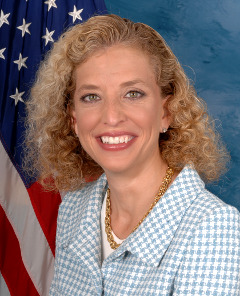
Case 4:  Debbie Wasserman Schultz


Ms. Schultz is a member of Congress from Florida.  She was part of the panel on a recent Bill Maher show.  Maher expressed what I consider to be a reasonable opinion: it might be time for the United States to rescind its boycott of Cuba.  Ms Schultz was adamantly opposed, stating that the boycott should be continued exclusively on moral grounds.  According to her, Cuba has gotten worse; she believes that there is more repression there now than ever.  This is doubtful.  Cuba is by no means a democracy, but dissidents are more tolerated in Cuba today.  An example of improved human rights: Castro has apologized for past persecution of homosexuals; he has now accorded them civil rights.  Russia, however--not to mention many African countries--is stepping up discrimination against homosexuals.  Why don't we boycott them?  What about human rights abuses in China?  Doesn't she realize that considerations of American self-interests  are involved here and not exclusively moral ones?  Here and elsewhere, one of the most important factors is power.  The U.S.wants to contain the spread of the Cuban form of government into neighboring countries.  Also, unlike China and Russia, Cuba is a small and relatively weak country, thus making the imposition of a boycott much easier.

We mustn't forget that Ms. Schultz represents a region many inhabitants of which hate Castro with passion.  Her own self-interest--like all politicians, she wants to be reelected--without a doubt  heavily influenced her allegedly objective opinion  .  Ms. Schultz is very intelligent and must realize this.

Does she really believe it?
Answer: No.  

I have written this essay to encourage readers to be skeptical of taking statements at face value, especially public statements of people in power.  Follow the money, as they say; psychological factors might also apply.  What do they really mean, we should ask ourselves, especially when they say outrageous things.

I will end the essay on a lighter note: Sarah Palin.


It is well known that she hates Obamacare, even though the core of the Affordable Care Act originated with Republicans.  During a recent interview on a morning TV show, the interviewer pressed her several times to present a Republican alternative to Obamacare.  After evading the question for some time, she gave the following garbled reply:

“The plan is to allow those things that had been proposed over many years to reform a health-care system in America that certainly does need more help so that there’s more competition, there’s less tort reform threat, there’s less trajectory of the cost increases, and those plans have been proposed over and over again. And what thwarts those plans? It’s the far left. It’s President Obama and his supporters who will not allow the Republicans to usher in free market, patient-centered, doctor-patient relationship links to reform health care."


The unregulated Free Market, mind you, got away with excluding coverage for pre-existing conditions, and with many other abuses.  It was quite content to allow at least thirty million U.S. citizens to remain uninsured.  It has been extremely inefficient, resulting in windfall profits for insurance companies while health outcomes remain poorer than in other nations which spend far less on health care. (About 17% of U.S. GDP goes to health care; in Germany it's half that.)  Palin's assertion, as is most of the things she says, is indeed outrageous. 

Does she really believe it?
Answer: Who cares?

11.11.2013

BOOK REVIEW: A UNIVERSE FROM NOTHING BY LAWRENCE M. KRAUSS

A Universe From Nothing
Lawrence M. Krauss
Free Press, New York, 2012

Whenever I mention the extraordinary developments in modern cosmology, a friend of mine likes to try to stump me with the age-old question, "How could something come from nothing?"  Why are quarks quarks, how can things pop out of nowhere?  No one knows of course; that's just the way it is.  Yet believing that quantum indeterminacy leaves room for a "God of the gaps"-explanation of nature is becoming increasingly untenable.  The belief that nature inevitably leads to God--which Catholics call "natural theology,"--along with the assertion that God created the world out of nothing--"Ex nihilo creavit deus mundum--are not substantiated by science. Lawrence M. Krauss's fascinating book, "A Universe from Nothing," helps to fill in that gap where God still allegedly dwells; he of course does not completely remove it--nothing can, pun intended.  It is becoming increasingly likely that the only ingredient needed to create a universe is so-called empty space, or even more radically, nothing at all.  And to ask where nothing at all came from is meaningless indeed.

I continue to be fascinated by a cosmology that envisions the universe as the ultimate "free lunch"--something, quite a lot in fact, from nothing.  I knew about virtual particles popping in and out of so-called empty space; this is allowed by the laws of quantum physics as long as the existence of these particles is extremely short and that the net charge of particles remain zero. Many of the theories discussed in the book, however, were new to me.

One of the things I've inferred, although I've never seen it in print, is that there is no such thing as nothing in our universe.  Space without matter and radiation is not empty at all.  It is seething with activity at the Plank length--10 to the minus 35 meters, that is, approximately a billionth of a billionth of a billionth of a billionth of a meter--This is the border beyond which our "regular" world governed by Einstein's laws breaks down.  The laws of cause and effect no longer apply; in this "area" particles pop in and out of existence all the time.  Pure nothing does not exist in the cosmos; it is a concept that exists in our heads.  We know of nothing in nature, that is, well, nothing.

I've learned a lot from Krauss, a renowned cosmologist and first-class theorist, who directs the Origins Project at the University of Arizona.  His book is well written and well worth reading by anyone interested in physics.  He wrote the book for an educated lay audience, members of which will have no difficulty with his explanations.  Here are some of the things that a member of this group, namely myself, learned from the book:

1. I used to believe that creation occurs when a virtual particle, very occasionally, bursts into existence by having enough energy to become "real."   This would take an extraordinary amount of energy.  Krauss informs us that this is unnecessary; if the gravitational energy and mass energy of the particle were zero, as it is in our universe, the particle could remain in existence without abrogating the law of conservation of energy, as the first example would. After this, a phase change would cause a phenomenal inflation resulting in a flat universe like ours.

2. I used to believe that the only plausible basis for the birth of a universe was empty space, the home of virtual particles, as indicated above.  Krauss speculates that there might have been truly nothing before our universe came into being.  The creator here would again be quantum fluctuations, which, by chance, would enable something to arise.

3.  A new concept for me is the theory that something arises from nothing because nothing is unstable.  Nothing, (either the nothing that might have "predated" our universe or the "empty space" nothing of our universe,) inevitably results in something!  Krauss quotes  the physicist Frank Wilczek who was one of the first to develop this concept:

One can speculate that the universe began in the most symmetrical state possible and that in such a state no matter existed; the universe was a vacuum.  A second state existed, and in it matter existed.  The second state had slightly less symmetry, but was also lower in energy.  Eventually a patch of less symmetrical phase appeared and grew rapidly.  The energy released by the transition found form in the creation of particles.  This event might be identified with the big bang...The answer to the ancient question "Why is there something rather than nothing" would be that "nothing" is unstable. (Page 159.)

It is important to note that while the creation of universes from nothing is inevitable, this doesn't make ours or any other universe special in any way. The Copernican principle, namely that, cosmically speaking, there is nothing special about our position in the universe, is thus almost infinitely extended--There is nothing special about our entire universe either, being merely one of countless other quantum fluctuations that have come into existence in the multiverse.

Does God play dice?  You betcha.

As far as I can tell, we have no idea of the cause of quantum fluctuations, which may indeed be a meaningless question.  They are the basis of everything, galaxies, suns, planets, knickknacks and you and me.  If a precocious child should ask, "Daddy, why are there quantum variations?,"  Daddy has no recourse but to reply, "That's the way it is."  And that apparently is the way it is.  Few modern physicists believe, as Einstein did, that there is something more fundamental.  Certainly not a creator God!

We thus can counter the Catholic "Ex nihilo creavit deus mundum," with the more accurate,' "Nihil et deum creavit homo"--Human beings created nothing and God!

Wallace Steven wrote in a poem of the need to distinguish the "nothing that isn't (from) the nothing that is."    Most physicists and poets would agree--if you're not sure, read this fascinating book.  If you do, I am sure you will never view nothing as nothing again.

10.09.2013

UNDERSTANDING WHITE RAGE

As I write this, the federal government of the United States has been shut down due to unreasonable demands from a relatively small group of Republicans, the so-called Tea Party Republicans.  They are holding the rest of the lawmakers hostage by demanding that a law they don't like, a much needed law that is going to provide healthcare to millions of currently uninsured Americans, be decimated before they agree to keeping the government open.  For the same reason, they are apparently prepared to threaten the nation with default, which would be catastrophic for America and the world.

I think I understand what's motivating Tea Party activists.  It is easy to call them racists, yahoos, and reactionaries, but this misses the point.  True 79% of them are white and over 60% are male; if there is racism involved in the movement--and I do think there is some of that--it is not the driving force.  Much more important is the fact that Tea Party activists are older, more educated and much more wealthy than average Americans.  What is motivating the Tea Party is the desire to keep more of the money that they've earned for themselves.  They think that government is increasingly in the business of redistributing wealth, which, Ayn-Rand-like, they view as a moral outrage.  They are fighting to preserve all the privileges of their class, and view the rest of Americans with disdain.  I understand that.  They're rich and they want things to stay that way. This is the way most of the wealthy have behaved throughout history.  Normal immoral, perhaps, but normal nevertheless.

What is truly counter-intuitive is the overwhelming support they get from working class whites.  How can the latter support the former?  That is the subject of this essay.

A good example of the problem is the demographics of Owsley County, Kentucky.  It is just about the poorest county in the nation.  It is 98% white; over 50% are below the poverty level.  The majority receives food stamps.  They are also 81% Republican.  Their Republican representative does everything in his power to make things worse for them--voting against raising the minimum wage, voting to significantly reduce money for food stamps while increasing subsidies for agro-businesses, etc.  The representative, Hal Rogers, has received abysmal evaluations from civil rights groups--7% on civil rights, 0% on gay rights, and 0% on senior issues.  He is adamantly against the Affordable Care Act, even though many of his constituents are uninsured.

How is it that the residents of this county can elect someone who is doing all he can to increase their distress?

It is not only Owsley County.  Of the 254 counties where food stamp usage has doubled, 213 voted for Mitt Romney. Why do poor whites have such poor judgment?

Two-thirds of the those living in poverty live in red states, where working-class and impoverished whites continue to elect those who disdain them.  A glaring example: most of the Republican governors of these states are refusing to receive federal money to expand medical assistance to the abject poor, that is, those who are "too rich: to qualify for medical assistance under current state laws  and too poor to qualify for subsidized insurance under Obamacare., This would be at no cost to the states for three years, then only ten percent of the cost after that.  This refusal of Republican governors to aid those in their states who are in dire need reveals how extreme and callous they are.  Yet the white downtrodden continue to support those who tread them down.  I ask again: why do poor whites have such poor judgement? Regarding Democrats, they are biting the hands that help feed them; regarding Republicans, they are feeding the hands that punch them where it really hurts.  How can this be?

Although race is not the main motivational force of tea party activists, it is primary here.  There is not a single impoverished county in the United States that has an African-American majority which has elected a Republican.  They, and working-class Hispanics, know who is representing their interests.  Why are working class whites so willing to vote for those who treat them with contempt?  The reason, I think, white rage.  Rage is illogical, emotional and often devastating.  How else can we account for the recent ludicrous statement of a Tea Party Republican which asserts that the Affordable Care Act is a worse assault on freedom than the Fugitive Slave Act--the heinous law which required that slaves that escaped to the North be returned to their "owners"?  It is one of many examples of politicians pandering to white anger and discontent.

I do not advocate characterizing the white working class as racist, stupid, or a bunch of hillbillies.  They are mostly decent people like everyone else.  I want to help explain the rage which is making them act irrationally, and what can be done about it.  Needless to say, understanding their rage does not mean that their anger is justified.  I see three reasons for white rage, which I will now briefly discuss.

1. The Decline of the White Working Class

In the late 1940s, over 80% of white workers lacked a college degree; now it is about 30%.  After the war, manufacturing jobs were readily available for all whites who were willing to work.  Those jobs are now mostly gone. The many whites who obtained higher education over the past decades became professionals and left working-class neighborhoods--many of these now compose the Tea Party!  Income increased rapidly for the white working class after the war, but now it is stagnant.  The rich are getting ridiculously richer, the poor and the working class are getting poorer. Current inequality in the U.S.borders on the obscene. Unemployment abounds.  The white working class is now the most pessimistic of all.  A full 75% believe it's much harder to succeed these days; only 60% of African-Americans share this view.  The white working class had been successful participants of the American dream; the dream has burst.  The difficulty many have in obtaining a living wage is the principal fuel for white rage,

2. The Decline of the White Working Class Male

They saw themselves as breadwinners.  They have become increasingly marginalized.  Many women are financially independent or at least work to help support their families.  This is of course a good thing, but can indeed be stressful to all family members. Increasing numbers of white children, especially in the lower classes, are born out of wedlock.  Fathers are becoming, especially in the lower classes, much less essential.  A leading group of single mothers, for instance, believes that having a father in a family is good, but by no means essential.  It used to be essential.  What do you do when you feel humiliated by not being able to find work, or adequate work?  What do you do when you feel increasingly useless and marginalized?  You get angry, sometimes very angry.

3. White Racism

There is no doubt that racism is behind a good deal of animus against our president and against the Democratic Party.  White workers saw themselves as frontiersman needing no help from anyone.  Despite previous government assistance--in the obtaining of mortgages, for instance--white workers tended to believe they achieved success all on their own.  Government assistance was believed to be for the lazy and shiftless--and you know what these terms are code words for.  White workers saw themselves as the most successful working class in history, and indeed it was. Other groups were deemed inferior; it wasn't oppression, according to them, that made blacks poor, but blackness itself. When a white worker was doing poorly, at least he could look in the mirror and say, "At least I'm not black!" The world order has changed.  Blacks are now proving themselves to be every bit as capable as whites in all things,   Believing yourself to be the king of creation and finding yourself working at Dairy Queen can make you very irate.

In sum, many whites, working class and non-, feel that the culture has turned against them.  Waves of immigration are changing the demographics of the United States, and not in their favor.  They feel that the government favors minorities and has repudiated what they believe to be the white values of hard work, self-reliance and independence.  Their God-fearing culture is being repudiated, they believe, by a liberal government's march toward godlessness, exemplified by such abominations as abortion, gay marriage, globilization,  etc.  If society were a building, they think they deserve the top floor, which they have, as it were, occupied for generations.  Now they feel they are being pushed toward an open window on that top floor by forces beyond their control.  They look out the window and see an abyss.  The forces of evil, represented by--horror of horrors! a black president, are out to destroy them.  They are ready to fight for their lives.

If you were a member of the white working class and believed such things, you would probably be very angry.  Your rage would prevent you from acting rationally.  You would fall into the hands of white politicians who seem every bit as angry as you.  You wouldn't vote your interests, you would vote your skin.

THE SOLUTION

The solution for the crisis is easy to state and difficult to realize: the white working class must change its identity from color to class.  Its members have much more in common with black and Hispanic workers than they do with white oligarchs.  Things will change only when they realize that the baracks and bidens of this world, whatever their color, are on their side, while they mits and mitches of this world, whatever their color, are working against them..  This necessary transformation will not be easy, since racism in our still very segregated society remains entrenched.  It is, however, the only solution.  In the meantime, justice will be thwarted by white rage.


9.03.2013

RELAX, DONALD, HE'S ONE OF OURS


Well, there they go again.  Right-wingers are apparently appalled by our President's "disgraceful behavior."  He put his feet up on the desk!  A famous desk at that, one presented by Queen Victoria!  Doesn't this make your blood boil?, a Tea Party site asked.  No respect.  Brought up badly, another one opined.  Disgraceful, disgraceful, disgraceful

Never mind that Bush and Ford did the same thing:


I am not writing this to point out another example of right-wing hypocrisy.  That's too easy, that's too obvious. They hate him; they find everything he does to be disgusting and disgraceful. My point is this: by putting his feet up on the desk, Obama innocently revealed that he is American as The Second Amendment.

Fact is, the rest of the world does think putting feet on one's desk while doing business is quite rude.  Dickens was shocked by such behavior and caricatured it in the American episode of his novel, Martin Chuzzlewit.  Exhibiting what Dickens thought to be a total lack of proper upbringing, a rude man in the book--according to Dickens he is so American that he doesn't even know he's being rude--puts his feet up on a desk.  Miss Grundy back home was undoubtedly shocked.

Here is an excerpt from a biography of an actress, a contemporary of Dickens:

A sofa had carelessly been left in one of the passages. Some tired carpenter was stretched upon it in an attitude which Dickens would have described as peculiarly American. His feet protruded over one arm of the sofa in a somewhat more elevated position than his head. My flight brought me suddenly in contact with a pair of heavy boots.

Poor thing!

Several years prior to the most recent desk episode, Obama was having a phone interview with Netanyahu. The press photo revealed that he had his feet propped up on the desk while talking with the Israeli prime minister.  This is how the paper Haaretz, a liberal newspaper, mind you, assessed the situation:

A photo released by the White House, which shows Obama talking on the phone with Netanyahu on Monday, speaks volumes: The president is seen with his legs up on the table, his face stern and his fist clenched, as though he were dictating to Netanyahu: "Listen up and write 'Palestinian state' a hundred times. That's right, Palestine, with a P." As an enthusiast of Muslim culture, Obama surely knows there is no greater insult in the Middle East than pointing the soles of one's shoes at another person. Indeed, photos of other presidential phone calls depict Obama leaning on his desk, with his feet on the floor.

I'm afraid that almost all Americans have no clue that there is no greater insult than this.  The fact that Obama--as well as Bush, Ford and about 300,000,000 of his compatriots--does not view such behavior as insulting  proves that he is American as corn dogs and Sean Hannity.

So, dear Donald, stop all this birther nonsense.  No Muslim, no Kenyan would dream of ever putting his feet up on a desk in the presence of others.  You have to be quintessentially American to do that.  He doesn't need to show you his birth certificate; he has put incontestable proof of his Americaness right there on his desk.

9.02.2013

THE TEA PARTY OF THE MIDDLE EAST

The current president of the United States is indeed very good, but far from perfect.  He is a policy expert--you can count on nearly everything he proposes to be really good for the American people.  He is a centrist, somewhat to the left of Dwight Eisenhower, but not by much.  (I remember that when asked during the last presidential debates how big government should be, he responded, with obvious sincerity, that is should be the minimum size necessary.  Not as big as necessary, mind you.  He acknowledges, as any sane person would, that government has legitimate tasks, in stark contrast to Reagan who believed that government is,"not part of the problem, but the problem."  Another insight  into Obama's world view occurred when he was asked, "What was the one thing a lot of people don't realize about you?"  He asserted that he was an ardent supporter of capitalism, a fact that was not widely known due to propaganda from his opponents.   He said this without any bluster; he was obviously telling the truth.

His fault is that he is a wise owl and not a pit bull, more of a policy wonk than a politician.   As has been pointed out, nobody is afraid of him on Capital Hill, where they had once been deathly afraid of Johnson. Lincoln, like Obama, was almost always right; he, however, knew how to fight.  This fault might be an endearing trait in an uncle, but it can get a president into a lot of trouble, and, in this case, it has.
The president is a good, reasonable man with a slightly left-leaning politcal stance.  In the beginning, he actually welcomed debate with those who had a right-leaning stance.  If they shook hands, he believed both sides would pull each other up to an upright position.  Yes we can!  He actually believed it--He actually thought he could reason with the other side!  No need to twist arms, logic would triumph.

Reason has become a Democratic cat trapped on a Republican hot-tin roof.

Take the example of health care.  The United States was, prior to the passage of the Afordable Care Act, the only major industrialized nation without universal heath care. None of the citizens of any of those countries would agree with the Tea Party that universal health care is an evil; none would ever petition their country to rescind their version of it.  In every case the cost of care for these countries is less than that of ours; on average, the cost of health care per citizen is about 50% less--and the outcomes are, on the whole, better.  Universal coverage has not forced people from full to part-time employment anywhere.The fact that the richest country in the world has over 30,000,000 citizens who lack health coverage is--any snane person must agree-a moral outrage.  Now the president, mind you, didn't try to push through a single payer system, that is, one with a huge governmental role--and one likely to have been more efficient--but negotiated a consumer-driven model that was anything but hard on the insurance business.  The plan was actually originally developed by a Republican think tank and was implemented by a Repblican governor in Massachusetts--and, as among the nations of Europe, there is no movement in Massachusetts to repeal it.  But those who believe ardently in strife, vanity and the pursuit of Obama would make you think that this "government takeover" will ruin the nation!

That irrational me-for-all called the Tea Party has caused an extreme shift toward the right. (There are a few moderate Republicans left, but most are willing to dance to the extremists' whip. Politicians will do almost anything to get reelected. )  Remember the congressman who shouted out "You lie!' while Obama was addressing Congress?  This is unprecedented; when Bush was lying through his teeth, no one shouted out such things.  It is obvious that those who love the Tea Party  hate him and will do everything to destroy him.  Their arguments are emotional and irrational, as hate always is.  Many would rather bring the country to its knees by causing a default rather than act in the country's interest--that is, by doing what sane politicians do, compromise.

You cannot negotiate with hate. Obama has learned this lesson--the hard way  For instance, he has finally vowed not to negotiate over the debt ceiling, which is of course the right thing to do.  If he were to budge on this, he would be setting a truly dreadful precedent, allowing the party not in power to get its way over the will of the American people.

Yes, he learned the hard way not to compromise with those who won't compromise with him.  He now knows that cooperation with domestic fanatics would force him to backtrack on issues he was elected to implement.  But what about foreign fanatics?

I hear Reagan in the background saying, "There he goes again.."

After the reckless and irresponsible policies of George Bush, one can understand that Obama wanted to think twice before taking military action in the Middle East again.  Remember the neoconservative assertion that shortly after the war started Iraqis would be waving American flags, welcoming their "liberators?"  We all know how that turned out.  But I think Obama's hesitance to use force went beyond reluctance to take military action after the Bush-era disasters.  I believe he wanted to give the Middle East countries time to work out their problems themselves.  Certainly this would be the best solution--if that solution occurred.  Not only did he not want to risk more American lives; not only did he not want to initiate costly military action at a time when the American economy--due to other Bush-era disasters--is still in such a weak state; he wanted to treat those in power in the Middle East as adults.  Surely, if given time, they would see reason, he thought.  Once again, he mistakenly believed that most politicians are decent, reasonable people like himself.

Surely this is why he warned Assad one year ago that if he used chemical weapons extensively he would be "crossing a red line," and  would face "enormous consequences" if he did. Surely, he thought, Assad wouldn't be crazy enough to use chemical weapons.  Well, Mr.President, he did use those weapons in a war that he was, by all reports, winning. Your delay in responding did not help reasonable people come to the fore; over the past year the opposite has happened: the rebels have been significantly infiltrated by Sunni terrorists. Your decency has, in fact, made matters worse.

I could imagine him thinking: No, Assad wouldn't do something like that.  After all, he's a doctor, he's an ophthalmologist.  Well, Mr. President, loony Rand Paul is an ophthalmologist, too.

Assad makes Ted Cruz look as quaint as Disney's Mad Hatter.  Face facts, Mr. President: They're having a Tea Party in Damascus, too-- and it's far worse than the one here: the poison Cruz and his ilk are serving the American people is bad enough, but it isn't sarin.

Mr. President it's Tea Party here and Tea Party there!  Reason might work reasonably well among politicians in Maryland and Connecticut, but not in Mississippi--and certainly not in Syria!  Why has it taken you, Mr. President, so long to find that out?

It is time, Mr. President.  Syria, Iran and North Korea would love to have you continue to speak softly without carrying a big stick.  You tried decency--and it didn't work. You apparently have found that out. We are waiting for reason to strike, and trust we won't have to wait long.