After reading a few books about near-death experiences (NDEs), I recalled the conversion experience that changed the Tamil boy Venkataraman Iyer into the sage Ramana Maharshi, widely known as the most prominent Indian sage of the twentieth century. I now saw it in a new light. I also realized that his second near-death experience which occurred sixteen years after the first, when Ramana was 32, was a classic NDE; it changed the way Ramana interacted with the world, without altering the irrevocable transformation that took place when he was sixteen. Although his second NDE has a lot in common with NDEs experienced by others, Ramana was no ordinary human being. The purpose of this article is to demonstrate that while NDEs share much in common, Ramana's were also categorically different. In fact, I know of no human being who was transformed by his experience the way he was. The article will, I hope, adequately explain why this is so.
My ambitious attempt is to bring the following readers together: 1. Those who are familiar with Ramana Maharshi and the non-duality worldview; 2. those who have studied the phenomenon of NDE and 3. skeptics who are thirsty for wisdom. The intelligence of the latter group will not be contravened here; the article might indeed sometimes suggest something beyond the current reductionist worldview, but reason is never flouted.
William James's view of mysticism, as discussed in his seminal work, The Varieties of Religious Experience, (1902), is very applicable here. The validity of a religious experience does not depend whether it can be scientifically corroborated or not--this is, I believe, impossible; the validity lies in the effect it has on the person who experienced it. Having undergone a conversion that results in little more than pathological withdrawal and fixation on such things as pus-filled bandages (St. Louis of Gonzaga) is one thing; having a mystic vision that results in a life dedicated to wisdom and love (St. Francis) is another. Wisdom and love are always what's most important; if an experience results in their increase, it is a worthy subject of discussion. The emphasis here will be thus on the results of Ramana Mahrshi's NDEs, not their origin. (I admit, however, that I strongly suspect that there is something more to such experiences than meets the eye, but I do not impose this view on the reader. The essay is valid without it.)
This essay is in several parts. First comes a brief description of NDEs, with an emphasis on the psychological transformation that NDEs almost always induce in those who have experienced them. We will then briefly discuss Ramana Mahrshi's life, followed by a discussion of his two NDEs. We will conclude with a brief discussion of the extraordinary significance of these two events.
NEAR DEATH EXPERIENCES AND THE 'HINDUIZATION' OF THOSE WHO EXPERIENCE THEM
A classic near-death event consists of vivid experiences which occur during an apparent clinical death, which are recalled after a successful resuscitation. During such an event, brain stem function, which controls breathing and the beating of the heart, has ceased completely; there is no evidence of higher cortical function. Many of those who have had a NDE insist that the experience was even more lucid than the waking state. Why this is so remains a mystery. There have been a handful of cases of NDE throughout history. The NDE is a continuum, but those who have had a full-blown NDE have many characteristics in common. These include an outer-body experience, passing through a tunnel of white light, meeting beings which often include deceased relatives, a panoramic life-review, becoming informed that it is not the time for the experiencer to die and the subsequent, often painful, return to the body. (To my knowledge, there has never been a case, as one would expect in a dream, in which a living relative or friend appears, perhaps advising the person in question to return to the living. This is quite odd and unexpected.) The experience is always interpreted to be real and not a dream, and almost always has a profound effect on subsequent life.
After Dr. Raymond Moody's book Life After Life, which appeared in 1975, and documented many NDEs, interest in this phenomenon greatly increased. An Association for the Scientific Study of Near-Death Phenomena has been established and remains active. It is estimated that about 5% of the population has had a near-death experience. One of the most prominent experts in the field is the Dutch cardiologist Pim van Lommel, who, upon questioning patients he had treated for cardiac arrest, found, to his amazement, that a significant minority had experienced a NDE. In his prospective study (that is, a study that enrolls those in a group over time as opposed to a chart review) published in the Lancet in 2001, 18% of the 344 patients who needed to be resuscitated had a NDE; 2% of the 344 had a full-blown experience.
Dr. van Lommel gives a possible explanation of NDEs, namely that consciousness is not limited to the brain. The brain is more of a receiver of consciousness, much as a radio is a receiver of radio waves. Transcendent consciousness is non-local consciousness. If this is true, the revelation is physics, not belief. This view is supported by many scientists, albeit a decided minority of them. There are several theories supporting this view, some involving quantum entanglement and/or resonance, which will not be discussed here. Dr. van Lommel's book, Consciousness Beyond Life, HarperOne 2010), is an excellent resource, with many suggestions for further reading. I must remind the reader that we are concerned here with the transformation an NDE induces, not whether the experience has a reductionist or non-reductionist origin.
What I find especially interesting is the follow-up Dr. van Lommel conducted eight years after the events occurred. As compared to those without an NDE, there was a marked decrease in the fear of death; an increase in concern for and acceptance of others and oneself; a heightened awareness of the inner meaning of life; and a three-fold increase in the belief of life after death. The most statistically significant result was a markedly increased spirituality--that is, a non-reductionist worldview-- among NDEs survivors and a markedly decreased spirituality among those whose who did not have a NDE.. This increase in spirituality was often accompanied by a decline in religious affiliation. Dr. van Lommel refers to this as "a decline in religious affiliation coupled with greater religious sentiment."
A typical transformation follows, as quoted in van Lommel's book:
It is possible to be physically dead while your mind lives on. Only one thing matters; your attitude
toward other people,. I think about everything now. Why? Everything continues and nothing continues. I feel very peaceful now; I'm no longer afraid of death. I now accept life as it is.
A recent book entitled Proof of Heaven by a neurosurgeon documents the transformation which occurred in him, after experiencing a NDE while he lay in a coma. The message from his NDE "translated into earthly language," as he recounts, consists of three parts: l. "You are loved and cherished, dearly, forever." 2. "You have nothing to fear." and 3. ""Thee is nothing you can do wrong." Although the result of his experience lead to a return to Christianity, the message does not appear to be traditionally Christian at all. No guilt! The first part seems in tune with the bliss of being, characterized by the non-dual school of Hinduism referred to in the next paragraph. The second is inconsistent with divine judgement and the possibility of hell, as taught by Christianity. (A prominent icon of Hinduism, Nataraja, the cosmic dance of Shiva, is clear about fear: Shiva reveals that once wisdom is achieved, fear vanishes. He indicates this with an outstretched palm, the so-called abayam mudra, that is, the no-fear hand position.) I can't imagine anything more inconsistent with traditional Western religion than the statement "There is nothing you can do wrong." This non-Western worldview is consistent with the new convictions of many who have experienced a NDE.
I refer to this transformation as the Hinduization of the individual. Life is accepted as it is. There is no dogma. One has experienced that consciousness pervades everything. One has greater knowledge of one's true nature. A sense of love and compassion increases. Obsession with good and evil cease with a resultant inability to cause harm to others or to oneself. This is the Hindu ideal. In Sanskrit, the spiritual summit is referred to as sat chit ananda; sat, wisdom; chit, universal consciousness, and the resultant ananda, bliss. When the ultimate truth is realized, as Ramana Maharshi pointed out on many occasions, we automatically experience the bliss of being. This school of Hinduism is called advaita, or non-duality. Ramana Maharshi was the embodiment of the advaita worldview. (There is nothing exotic about this; nearly all who have had a NDE claim that "the other side" induced a feeling of deep peace or bliss. The difference is that they believe to have experienced a realm "over there" while in advaita, "over there" is what always underlies "over here." This distinction between NDEs and advaita is merely apparent; they both are witness to the same underlying truth.)
RAMANA MAHARSHI, THE SAGE OF ARUNACHALA

Ramana Maharshi (1879-1950) is arguably the greatest Indian sage of the past century. As stated previously, he was the embodiment of advaita (non-dual) philosophy, which holds that all separation is illusory. His unique contribution to this ancient branch of Hinduism is called Self-Inquiry. By means of contemplation and self-analysis, one is able to trace individuality to its source. (NDE researchers might refer to this as tracing bodily consciousness to its non-local source.) Once this non-dual "I," which subsumes the individual "I," is found and completely identified with, all problems are solved. Ramana Maharshi was a charismatic teacher, very erudite, and very dedicated to helping all those who came to him for guidance. Seekers came from all over the world. One of my favorite Bhagavan (Ramana was lovingly known to his followers as Bhagavan) has to do with an encounter in 1938 with Somerset Maugham. (The sage in the novel The Razor's Edge is based on Ramana Maharshi..) Sometime after he arrived at the ashram, Maugham fainted, possibly due to the heat. He was taken to his guest cottage. Having been informed of this, Ramana, always concerned about the welfare of ashram visitors, came to him. Maugham was apparently very nervous; for about a half hour they sat across from each other. Neither said a word. Finally Maugham asked whether he was supposed to say anything? Bhagavan replied,--I am sure, with a radiant smile: "No--Silence is best. Silence is also communication." (I am convinced Maugham was greatly put at ease by this.) Ramana's silence was indeed communication, and often had a profound effect on those who came before him.
Ramana Maharshi was born Venkataraman Iyer in Tiruchuli, near Madurai, India, in 1879. His father was an educated man. Venkataraman was normal in just about every way--one of the exceptions being that his sleep was so extremely deep that it was very difficult to wake him. He excelled in sports; he was popular; he was very intelligent albeit indifferent to his studies. He was not particularly religious--although then, as even now, religion permeated all levels of Indian culture. He read an account of Tamil Shaivite saints entitled, Periyapuranam and was quite impressed by it. Later when a relative told him of a recent visit to the sacred mountain Tiruvannamalai--where Venkataraman would soon spend the rest of his life--he was amazed that someone could actually visit such a sacred place. Other than these two episodes, there is little to indicate that Venkataraman was anything other than a normal Tamil youth.
Of significance, however, was the sudden death of his father at age 42 while Venkataraman was 12. He was profoundly affected by this and wondered where the "I" of his father had gone, after leaving behind a corpse.
Then, at age 16, he was transformed forever. He was now in full puberty and capable of abstract and philosophical thinking. The subject of death could no longer be as easily brushed off as it often is during childhood. One day he was seized by the terror of annihilation. The experience he had would now be classified as a "Fear-Death Experience, " similar to a Near-Death Experience, but without the cessation of cardiac and respiratory function. (This is a well-documented phenomenon.) Much later, Ramana Maharshi recounted this event as follows:

To my knowledge, Ramana's transformation has never been described as a categorical fear-death experience, which it undoubtedly was. The result, however, was far from typical. As mentioned previously, most people who experience a deep NDE--I am including fear-death experiences under this rubric--are deeply transformed by it. They become more spiritual and less religious in the conventional sense. They tend to lose their fear of death, become wiser, etc. But they still remain the same person. Ramana was completely transformed, as he relates in the quote above. Most NDE-experiencers visit the other side, as it were; Ramana returned as the other side.
There was, of course, a marked change in his behavior. His upper middle-class family expected Bhagavan to become, well, you guessed it, a professional; his aloof behavior caused much friction. One day, Bhagavan simply could no longer do things like copy sections from an English grammar, which was his assignment at the time; his elder brother angrily mocked him with the following words, "What good is all this to such a one?" Bhagavan realized that his brother was right; he realized that he must live on the outside what he was now on the inside. So he left, unannounced, for the sacred mountain, Tiruvannamalai. When he arrived, he discarded his clothes except for a loincloth. He discarded his brahmin ponool, the sacred thread worn across the chest by all brahmin males. (This signifies that he was now beyond caste.) He threw away the little money he had left, and never touched money again. He remained in deep meditation--samadhi--for very long periods. His mien and bearing attracted the attention of villagers. One took special care of him. This man was a bit unbalanced and was often teased by boys. To protect Ramana from occasional stone-throwing, he was brought to an underground room of a temple. It was dark and infested with vermin. Ramana did not care at all and continued in deep meditation. (He didn't move, even when insects stung him. The scars caused by those insects remained on him for life.)
Ramana then was moved to a little room of a shrine on Arunachala, the sacred mountain. He remained there for years.

Needless to say his family, especially his mother, Alagammal, was very upset. She finally learned where he was. She traveled to Tiruvannamalai and found him. She begged him to return home; he remained silent. She returned several times with the same request. He never uttered a word. Then, upon a subsequent visit, he took pen and paper and wrote the following words:
The Ordainer ordains the fate of souls in accordance with their prarabdhakarma (destiny to be worked out in this life). Whatever is destined not to happen will not happen, try as you may. Whatever is destined to happen will happen, try as you may to prevent it. This is certain. The best course, therefore, is to remain silent.
Hamlet used simialr language after experiencing what critics refer to as his enlightenment. Horatio is warning him not to fight Laertes. Hamlet responds in Act V, Sc.ii, with the following words:
Not a whit, we defy augury. There is special providence in
the fall of a sparrow. If it be now, 'tis not to come; if it be not to
come, it will be now; if it be not now, yet it will come—the
readiness is all. Since no man, of aught he leaves, knows what is't
to leave betimes, let be.
My ambitious attempt is to bring the following readers together: 1. Those who are familiar with Ramana Maharshi and the non-duality worldview; 2. those who have studied the phenomenon of NDE and 3. skeptics who are thirsty for wisdom. The intelligence of the latter group will not be contravened here; the article might indeed sometimes suggest something beyond the current reductionist worldview, but reason is never flouted.
William James's view of mysticism, as discussed in his seminal work, The Varieties of Religious Experience, (1902), is very applicable here. The validity of a religious experience does not depend whether it can be scientifically corroborated or not--this is, I believe, impossible; the validity lies in the effect it has on the person who experienced it. Having undergone a conversion that results in little more than pathological withdrawal and fixation on such things as pus-filled bandages (St. Louis of Gonzaga) is one thing; having a mystic vision that results in a life dedicated to wisdom and love (St. Francis) is another. Wisdom and love are always what's most important; if an experience results in their increase, it is a worthy subject of discussion. The emphasis here will be thus on the results of Ramana Mahrshi's NDEs, not their origin. (I admit, however, that I strongly suspect that there is something more to such experiences than meets the eye, but I do not impose this view on the reader. The essay is valid without it.)
This essay is in several parts. First comes a brief description of NDEs, with an emphasis on the psychological transformation that NDEs almost always induce in those who have experienced them. We will then briefly discuss Ramana Mahrshi's life, followed by a discussion of his two NDEs. We will conclude with a brief discussion of the extraordinary significance of these two events.
NEAR DEATH EXPERIENCES AND THE 'HINDUIZATION' OF THOSE WHO EXPERIENCE THEM
A classic near-death event consists of vivid experiences which occur during an apparent clinical death, which are recalled after a successful resuscitation. During such an event, brain stem function, which controls breathing and the beating of the heart, has ceased completely; there is no evidence of higher cortical function. Many of those who have had a NDE insist that the experience was even more lucid than the waking state. Why this is so remains a mystery. There have been a handful of cases of NDE throughout history. The NDE is a continuum, but those who have had a full-blown NDE have many characteristics in common. These include an outer-body experience, passing through a tunnel of white light, meeting beings which often include deceased relatives, a panoramic life-review, becoming informed that it is not the time for the experiencer to die and the subsequent, often painful, return to the body. (To my knowledge, there has never been a case, as one would expect in a dream, in which a living relative or friend appears, perhaps advising the person in question to return to the living. This is quite odd and unexpected.) The experience is always interpreted to be real and not a dream, and almost always has a profound effect on subsequent life.
After Dr. Raymond Moody's book Life After Life, which appeared in 1975, and documented many NDEs, interest in this phenomenon greatly increased. An Association for the Scientific Study of Near-Death Phenomena has been established and remains active. It is estimated that about 5% of the population has had a near-death experience. One of the most prominent experts in the field is the Dutch cardiologist Pim van Lommel, who, upon questioning patients he had treated for cardiac arrest, found, to his amazement, that a significant minority had experienced a NDE. In his prospective study (that is, a study that enrolls those in a group over time as opposed to a chart review) published in the Lancet in 2001, 18% of the 344 patients who needed to be resuscitated had a NDE; 2% of the 344 had a full-blown experience.
Dr. van Lommel gives a possible explanation of NDEs, namely that consciousness is not limited to the brain. The brain is more of a receiver of consciousness, much as a radio is a receiver of radio waves. Transcendent consciousness is non-local consciousness. If this is true, the revelation is physics, not belief. This view is supported by many scientists, albeit a decided minority of them. There are several theories supporting this view, some involving quantum entanglement and/or resonance, which will not be discussed here. Dr. van Lommel's book, Consciousness Beyond Life, HarperOne 2010), is an excellent resource, with many suggestions for further reading. I must remind the reader that we are concerned here with the transformation an NDE induces, not whether the experience has a reductionist or non-reductionist origin.
What I find especially interesting is the follow-up Dr. van Lommel conducted eight years after the events occurred. As compared to those without an NDE, there was a marked decrease in the fear of death; an increase in concern for and acceptance of others and oneself; a heightened awareness of the inner meaning of life; and a three-fold increase in the belief of life after death. The most statistically significant result was a markedly increased spirituality--that is, a non-reductionist worldview-- among NDEs survivors and a markedly decreased spirituality among those whose who did not have a NDE.. This increase in spirituality was often accompanied by a decline in religious affiliation. Dr. van Lommel refers to this as "a decline in religious affiliation coupled with greater religious sentiment."
A typical transformation follows, as quoted in van Lommel's book:
It is possible to be physically dead while your mind lives on. Only one thing matters; your attitude
toward other people,. I think about everything now. Why? Everything continues and nothing continues. I feel very peaceful now; I'm no longer afraid of death. I now accept life as it is.
A recent book entitled Proof of Heaven by a neurosurgeon documents the transformation which occurred in him, after experiencing a NDE while he lay in a coma. The message from his NDE "translated into earthly language," as he recounts, consists of three parts: l. "You are loved and cherished, dearly, forever." 2. "You have nothing to fear." and 3. ""Thee is nothing you can do wrong." Although the result of his experience lead to a return to Christianity, the message does not appear to be traditionally Christian at all. No guilt! The first part seems in tune with the bliss of being, characterized by the non-dual school of Hinduism referred to in the next paragraph. The second is inconsistent with divine judgement and the possibility of hell, as taught by Christianity. (A prominent icon of Hinduism, Nataraja, the cosmic dance of Shiva, is clear about fear: Shiva reveals that once wisdom is achieved, fear vanishes. He indicates this with an outstretched palm, the so-called abayam mudra, that is, the no-fear hand position.) I can't imagine anything more inconsistent with traditional Western religion than the statement "There is nothing you can do wrong." This non-Western worldview is consistent with the new convictions of many who have experienced a NDE.
I refer to this transformation as the Hinduization of the individual. Life is accepted as it is. There is no dogma. One has experienced that consciousness pervades everything. One has greater knowledge of one's true nature. A sense of love and compassion increases. Obsession with good and evil cease with a resultant inability to cause harm to others or to oneself. This is the Hindu ideal. In Sanskrit, the spiritual summit is referred to as sat chit ananda; sat, wisdom; chit, universal consciousness, and the resultant ananda, bliss. When the ultimate truth is realized, as Ramana Maharshi pointed out on many occasions, we automatically experience the bliss of being. This school of Hinduism is called advaita, or non-duality. Ramana Maharshi was the embodiment of the advaita worldview. (There is nothing exotic about this; nearly all who have had a NDE claim that "the other side" induced a feeling of deep peace or bliss. The difference is that they believe to have experienced a realm "over there" while in advaita, "over there" is what always underlies "over here." This distinction between NDEs and advaita is merely apparent; they both are witness to the same underlying truth.)
RAMANA MAHARSHI, THE SAGE OF ARUNACHALA
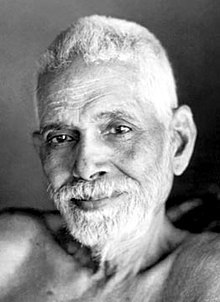
Ramana Maharshi (1879-1950) is arguably the greatest Indian sage of the past century. As stated previously, he was the embodiment of advaita (non-dual) philosophy, which holds that all separation is illusory. His unique contribution to this ancient branch of Hinduism is called Self-Inquiry. By means of contemplation and self-analysis, one is able to trace individuality to its source. (NDE researchers might refer to this as tracing bodily consciousness to its non-local source.) Once this non-dual "I," which subsumes the individual "I," is found and completely identified with, all problems are solved. Ramana Maharshi was a charismatic teacher, very erudite, and very dedicated to helping all those who came to him for guidance. Seekers came from all over the world. One of my favorite Bhagavan (Ramana was lovingly known to his followers as Bhagavan) has to do with an encounter in 1938 with Somerset Maugham. (The sage in the novel The Razor's Edge is based on Ramana Maharshi..) Sometime after he arrived at the ashram, Maugham fainted, possibly due to the heat. He was taken to his guest cottage. Having been informed of this, Ramana, always concerned about the welfare of ashram visitors, came to him. Maugham was apparently very nervous; for about a half hour they sat across from each other. Neither said a word. Finally Maugham asked whether he was supposed to say anything? Bhagavan replied,--I am sure, with a radiant smile: "No--Silence is best. Silence is also communication." (I am convinced Maugham was greatly put at ease by this.) Ramana's silence was indeed communication, and often had a profound effect on those who came before him.
Ramana Maharshi was born Venkataraman Iyer in Tiruchuli, near Madurai, India, in 1879. His father was an educated man. Venkataraman was normal in just about every way--one of the exceptions being that his sleep was so extremely deep that it was very difficult to wake him. He excelled in sports; he was popular; he was very intelligent albeit indifferent to his studies. He was not particularly religious--although then, as even now, religion permeated all levels of Indian culture. He read an account of Tamil Shaivite saints entitled, Periyapuranam and was quite impressed by it. Later when a relative told him of a recent visit to the sacred mountain Tiruvannamalai--where Venkataraman would soon spend the rest of his life--he was amazed that someone could actually visit such a sacred place. Other than these two episodes, there is little to indicate that Venkataraman was anything other than a normal Tamil youth.
Of significance, however, was the sudden death of his father at age 42 while Venkataraman was 12. He was profoundly affected by this and wondered where the "I" of his father had gone, after leaving behind a corpse.
Then, at age 16, he was transformed forever. He was now in full puberty and capable of abstract and philosophical thinking. The subject of death could no longer be as easily brushed off as it often is during childhood. One day he was seized by the terror of annihilation. The experience he had would now be classified as a "Fear-Death Experience, " similar to a Near-Death Experience, but without the cessation of cardiac and respiratory function. (This is a well-documented phenomenon.) Much later, Ramana Maharshi recounted this event as follows:

I must admit that I never fully appreciated Ramana's enlightenment experience until I learned about NDEs, specifically fear-death experiences. I knew that Ramana had become permanently transformed--the rest of his life shows absolutely no backtracking--; I also knew that his transformation was much more important than how it had occurred. I was puzzled. What if some demon sneaked in and cut off Ramana's head while he was lost in such thoughts? Would he still be able to claim that he was the deathless Spirit? Do his words prove that he experienced a consciousness beyond the brain? I doubted that it did. No matter, I thought; there can be no doubt that Ramana became a sage. Now I think differently. I now believe that it is possible, perhaps even likely, that Bhagavan actually experienced universal consciousness. Many researchers--as one would expect, by no means all--would concur. As Dr. Pim van Lommel, the eminent cardiologist referred to earlier, asserts: "The content of a near-death experience suggests a continuity of consciousness that can be experienced independently of the body." He continues: "...identical experiences are reported during examples of mortal fear..." (Consciousness Beyond Life, page 300.) The latter phenomenon, the so-called fear-death experience, applies to the episode, quoted above, that changed a young man forever."It was in 1896, about 6 weeks before I left Madurai for good (to go to Tiruvannamalai-Arunachala) that this great change in my life took place. I was sitting alone in a room on the first floor of my uncle's house. I seldom had any sickness and on that day there was nothing wrong with my health, but a sudden violent fear of death overtook me. There was nothing in my state of health to account for it nor was there any urge in me to find out whether there was any account for the fear. I just felt I was going to die and began thinking what to do about it. It did not occur to me to consult a doctor or any elders or friends. I felt I had to solve the problem myself then and there. The shock of the fear of death drove my mind inwards and I said to myself mentally, without actually framing the words: 'Now death has come; what does it mean? What is it that is dying? This body dies.' And at once I dramatised the occurrence of death. I lay with my limbs stretched out still as though rigor mortis has set in, and imitated a corpse so as to give greater reality to the enquiry. I held my breath and kept my lips tightly closed so that no sound could escape, and that neither the word 'I' nor any word could be uttered. 'Well then,' I said to myself, 'this body is dead. It will be carried stiff to the burning ground and there burnt and reduced to ashes. But with the death of the body, am I dead? Is the body I? It is silent and inert, but I feel the full force of my personality and even the voice of I within me, apart from it. So I am the Spirit transcending the body. The body dies but the spirit transcending it cannot be touched by death. That means I am the deathless Spirit.' All this was not dull thought; it flashed through me vividly as living truths which I perceived directly almost without thought process. I was something real, the only real thing about my present state, and all the conscious activity connected with the body was centered on that I. From that moment onwards, the "I" or Self focused attention on itself by a powerful fascination. Fear of death vanished once and for all. The ego was lost in the flood of Self-awareness. Absorption in the Self continued unbroken from that time. Other thought might come and go like the various notes of music, but the I continued like the fundamental sruti note ["that which is heard" i.e. the Vedas and Upanishads] a note which underlies and blends with all other notes."[web 2]
To my knowledge, Ramana's transformation has never been described as a categorical fear-death experience, which it undoubtedly was. The result, however, was far from typical. As mentioned previously, most people who experience a deep NDE--I am including fear-death experiences under this rubric--are deeply transformed by it. They become more spiritual and less religious in the conventional sense. They tend to lose their fear of death, become wiser, etc. But they still remain the same person. Ramana was completely transformed, as he relates in the quote above. Most NDE-experiencers visit the other side, as it were; Ramana returned as the other side.
There was, of course, a marked change in his behavior. His upper middle-class family expected Bhagavan to become, well, you guessed it, a professional; his aloof behavior caused much friction. One day, Bhagavan simply could no longer do things like copy sections from an English grammar, which was his assignment at the time; his elder brother angrily mocked him with the following words, "What good is all this to such a one?" Bhagavan realized that his brother was right; he realized that he must live on the outside what he was now on the inside. So he left, unannounced, for the sacred mountain, Tiruvannamalai. When he arrived, he discarded his clothes except for a loincloth. He discarded his brahmin ponool, the sacred thread worn across the chest by all brahmin males. (This signifies that he was now beyond caste.) He threw away the little money he had left, and never touched money again. He remained in deep meditation--samadhi--for very long periods. His mien and bearing attracted the attention of villagers. One took special care of him. This man was a bit unbalanced and was often teased by boys. To protect Ramana from occasional stone-throwing, he was brought to an underground room of a temple. It was dark and infested with vermin. Ramana did not care at all and continued in deep meditation. (He didn't move, even when insects stung him. The scars caused by those insects remained on him for life.)
Ramana then was moved to a little room of a shrine on Arunachala, the sacred mountain. He remained there for years.

Needless to say his family, especially his mother, Alagammal, was very upset. She finally learned where he was. She traveled to Tiruvannamalai and found him. She begged him to return home; he remained silent. She returned several times with the same request. He never uttered a word. Then, upon a subsequent visit, he took pen and paper and wrote the following words:
The Ordainer ordains the fate of souls in accordance with their prarabdhakarma (destiny to be worked out in this life). Whatever is destined not to happen will not happen, try as you may. Whatever is destined to happen will happen, try as you may to prevent it. This is certain. The best course, therefore, is to remain silent.
Hamlet used simialr language after experiencing what critics refer to as his enlightenment. Horatio is warning him not to fight Laertes. Hamlet responds in Act V, Sc.ii, with the following words:
Not a whit, we defy augury. There is special providence in
the fall of a sparrow. If it be now, 'tis not to come; if it be not to
come, it will be now; if it be not now, yet it will come—the
readiness is all. Since no man, of aught he leaves, knows what is't
to leave betimes, let be.
Even more than Hamlet, Ramana sounds like a Delphic oracle. Ramana's response to his mother is a good example of how utterly beyond earthly life he had become. Even his mother received an impersonal response. He sounds almost inhuman.
Ramana gradually began to be more responsive, but remained essentially extremely aloof. He had become, as it were, the mountain itself. Then, sixteen years after his enlightenment another extraordinary event occurred. Here we have an account of it in Ramana's own words:
Those familiar with NDEs will immediately realize that Ramana had experienced a full-blown NDE. His respiration and circulation, as corroborated by witnesses, ceased for about fifteen minutes. Though unconscious, he heard and saw what was being said and happening around him. He saw a white curtain in an intense light. His "usual state of awareness" that is, intense awareness, continued to function unabated.
The importance of this event is that it caused a further transformation in Ramana. Now the human element returned. Though he never left the wisdom-awareness that began with the fear-death experience, he now became much more lovingly involved with those around him. (The Somerset Maugham-episode, referred to in this article, evinces this change; it occurred 26 years after the second transformation.) If anyone asked him a question, he would answer it. He engaged in long discussions about wisdom; he gave advice especially tailored to the questioners. He read newspapers and books. He became involved with the day-to-day operations of the ashram which had been built at the base of Arunachala. He evinced a keen intellect and a keen sense of humor. He became devoted to his devotees, and made sure he was available to help them until the end of his life. (He faced death from cancer, of which he died at the age of 70, without a shred of fear.)
Another remarkable transformation! Ramana who had been the embodiment of transcendental wisdom now was the embodiment of that wisdom combined with deep humanity and love.
SUMMARY
Ramana Maharshi is one of the greatest Indian sages. He didn't claim, however, to be a sage. He never claimed to have any supernatural powers. He simply remained completely identified with the Self that underlies all reality. His kindness and wisdom are preserved in many books which are readily available.
Although the enlightenment experience at age sixteen is a central part in his biography, I have never heard it referred to as a fear-death experience, which it obviously was His subsequent life is illustrates how this event changed him.
He had become the embodiment of Wisdom, as it were, aloof, beyond ordinary life. Then an equally remarkable even occurred. His classic near-death experience at age 32 gave him, the embodiment of wisdom, a human face. He was now a perfect and readily accessible incarnation of the Self, radiating both love and wisdom. I know of no other person who was transformed in this way by two near-death experiences. I think that the information presented in this article , namely that Ramana had a fear-death and a near-death experience, and was irrevocably changed, in different ways, by both, is extremely important. It unites the wisdom of the East with the wisdom that Westerners, and others, have obtained not only through a NDE, but also through study, life experiences, and meditation. Deep down, there is one unifying reality; that people from different cultures come to the same basic conclusion unites all cultures and all humanity. Science is certainly not averse to the belief that there is no separation in the absolute sense. Thus skeptics, who doubt the existence of non-local consciousness, can at least agree on this point. Experiencing and living this unity, which Ramana absolutely did and NDE experiencers in varying degrees did and continue to do, runs much deeper, of course, than mere knowledge of it.
Ramana's story indicates that there is indeed consciousness beyond the brain. This need not be viewed as something supernatural; it might indeed be very natural, perhaps partially explicable through physics. Non-local consciousness, consciousness independent of the body--is indeed a possibility. (I doubt that this will ever be proven, but it might; I think information indicating it will continue to mount.) The physics genius John von Neumann stated that everything is consciousness. Ramana Maharshi, along with many who have experienced a NDE, is a good indication that von Neumann was right.
As the lives of those that have had a NDE indicate, and, especially, as the life of the sage of Arunachala fully demonstrates, experiencing universal consciousness cannot fail to make one more connected to oneself and to the world. Another word for it is Wisdom. Yet another word for it is Wisdom-In Action, Love. Ramana Maharshi was right: this realization transforms not only oneself, but helps transform the entire world.

"The landscape in front of me disappeared as a bright white curtain was drawn across my vision and shut it out. I could distinctly see the gradual process. There was a stage when I could still see a part of the landscape clearly while the rest was covered by the advancing curtain. It was just like drawing a slide across one's view in a stereoscope. On experiencing this I stopped walking lest I should fall. When it cleared I walked on. When darkness and faintness came over me a second time I leaned against a rock until it cleared. The third time it happened I felt it safer to sit, so I sat down near the rock. Then the bright white curtain completely shut off my vision, my head was swimming and my circulation and breathing stopped. The skin turned a livid blue. It was the regular death hue and it got darker and darker. Vasudeva Sastri, in fact, took me to be dead and held me in his arms and began to weep aloud and lament my death."I could distinctly feel his clasp and his shivering and hear his words of lamentation and understand their meaning. I also saw the discoloration of my skin and felt the stoppage of my circulation and breathing and the increased chilliness of the extremities of my body. My usual current of awareness still continued in that state also. I was not in the least afraid and felt no sadness at the condition of the body. I had sat down near the rock in my usual posture and closed my eyes and was not leaning against the rock. The body, left without circulation or respiration, still maintained that position. This state continued for some ten or fifteen minutes. Then a shock passed suddenly through the body and circulation revived with enormous force, and breathing also, and the body perspired from every pore. The colour of life reappeared on the skin. I then opened my eyes and got up and said, 'Let's go.' We reached Virupaksha Cave without further trouble. This was the only fit I had in which both circulation and respiration stopped."
Those familiar with NDEs will immediately realize that Ramana had experienced a full-blown NDE. His respiration and circulation, as corroborated by witnesses, ceased for about fifteen minutes. Though unconscious, he heard and saw what was being said and happening around him. He saw a white curtain in an intense light. His "usual state of awareness" that is, intense awareness, continued to function unabated.
The importance of this event is that it caused a further transformation in Ramana. Now the human element returned. Though he never left the wisdom-awareness that began with the fear-death experience, he now became much more lovingly involved with those around him. (The Somerset Maugham-episode, referred to in this article, evinces this change; it occurred 26 years after the second transformation.) If anyone asked him a question, he would answer it. He engaged in long discussions about wisdom; he gave advice especially tailored to the questioners. He read newspapers and books. He became involved with the day-to-day operations of the ashram which had been built at the base of Arunachala. He evinced a keen intellect and a keen sense of humor. He became devoted to his devotees, and made sure he was available to help them until the end of his life. (He faced death from cancer, of which he died at the age of 70, without a shred of fear.)
Another remarkable transformation! Ramana who had been the embodiment of transcendental wisdom now was the embodiment of that wisdom combined with deep humanity and love.
SUMMARY
Ramana Maharshi is one of the greatest Indian sages. He didn't claim, however, to be a sage. He never claimed to have any supernatural powers. He simply remained completely identified with the Self that underlies all reality. His kindness and wisdom are preserved in many books which are readily available.
Although the enlightenment experience at age sixteen is a central part in his biography, I have never heard it referred to as a fear-death experience, which it obviously was His subsequent life is illustrates how this event changed him.
He had become the embodiment of Wisdom, as it were, aloof, beyond ordinary life. Then an equally remarkable even occurred. His classic near-death experience at age 32 gave him, the embodiment of wisdom, a human face. He was now a perfect and readily accessible incarnation of the Self, radiating both love and wisdom. I know of no other person who was transformed in this way by two near-death experiences. I think that the information presented in this article , namely that Ramana had a fear-death and a near-death experience, and was irrevocably changed, in different ways, by both, is extremely important. It unites the wisdom of the East with the wisdom that Westerners, and others, have obtained not only through a NDE, but also through study, life experiences, and meditation. Deep down, there is one unifying reality; that people from different cultures come to the same basic conclusion unites all cultures and all humanity. Science is certainly not averse to the belief that there is no separation in the absolute sense. Thus skeptics, who doubt the existence of non-local consciousness, can at least agree on this point. Experiencing and living this unity, which Ramana absolutely did and NDE experiencers in varying degrees did and continue to do, runs much deeper, of course, than mere knowledge of it.
Ramana's story indicates that there is indeed consciousness beyond the brain. This need not be viewed as something supernatural; it might indeed be very natural, perhaps partially explicable through physics. Non-local consciousness, consciousness independent of the body--is indeed a possibility. (I doubt that this will ever be proven, but it might; I think information indicating it will continue to mount.) The physics genius John von Neumann stated that everything is consciousness. Ramana Maharshi, along with many who have experienced a NDE, is a good indication that von Neumann was right.
As the lives of those that have had a NDE indicate, and, especially, as the life of the sage of Arunachala fully demonstrates, experiencing universal consciousness cannot fail to make one more connected to oneself and to the world. Another word for it is Wisdom. Yet another word for it is Wisdom-In Action, Love. Ramana Maharshi was right: this realization transforms not only oneself, but helps transform the entire world.


